
Wrestling Heritage welcomes memories, further information and corrections.
The press continued to have mixed feelings about professional wrestling; criticism was mostly that matches were barbaric not that results were pre-determined.
Where reports of contests were published they were usually included in the sports pages, and when Douglas Clark signed to meet the Belgian Laurent Gerstamann for the “World heavyweight championship,” there were no questions raised about the authenticity of the title.
The Daily Express, which was often critical, reported that the sport was becoming “an increasingly fashionable, and highly curious, feature of London life.”
In some quarters steps were being taken to investigate ways of limiting the rate of development. City councils in Sheffield and Oxford were amongst those considering curbing wrestling on grounds of excessive violence. Oxford Council’s Property Management Committee proposed banning wrestling, but the proposal was overturned by the full council. It transpired only two of the councillors voting had actually seen a match, and they both voted in favour of the sport. It was decided to review the decision after attending an All In wrestling show. Three weeks later the council banned wrestling. Oxford Councillor Mrs Collier said she would rather see bull fighting than wrestling, and had left the show after watching just one contest. In April Hull Corporation Baths Committee voted to cease letting the baths for All-In wrestling which had been staged at the baths the previous year. A temporary licence to stage wrestling in Huddersfield was granted when it was decided that wrestling “was no worse than boxing.”
In October, 1933, the British Boxing Board of Control passed a motion that banned any further combined boxing and All-In wrestling shows. Now it was going to be a case of wrestling standing on it’s own feet or withering away.
Irrespective of official disapproval increasing numbers were paying their money at the box office and the number of shows was on the rise, although the Daily Mirror claimed audiences were shrinking in northern England where fans preferred Catch-as-Catch-Can style. In June Walthamstow Greyhound Stadium presented a meeting that combined all-in wrestling with Greyhound racing. In February All-In wrestling made it’s debut in Goole and York, with a four bout bill topped by Douglas Clark meeting The Black Tiger; Clark winning by two falls to nil.
The nature of wrestling was becoming a much discussed topic, and not just amongst those at ringside but in pubs, at work and around the dinner tables of the middle class. Opinions were polarised. On 21st January, 1933, the BBC presented a programmes on the National Service in which wrestler Bob Gregory posed the question “What is the future of wrestling?”
Irrespective of anyone’s personal views the sport was slowly becoming an established part of wider British culture. The American film “Deception” was screened in Britain. Directed by Nat Pendleton, a silver medalist in the 1920 Olympic Games, the film told the story of the downfall of a crooked wrestling promoter; a tale of clean sport winning over rigged matches.
By 1933 very unpleasant elements had become a regular feature of many tournaments, with increasingly violent spectacles demanded by some of the fans. When Johanfesson issued a public challenge from the ring to All-In champion Douglas Clark at Huddersfield in February the challenger demanded that punches with a clenched fist and double rabbit punches should be allowed. Clark was a conclusive winner, displaying superior strength and technique to take submissions in both the second and third rounds. Hunslet rugby player Walt Stringer and Jimmy Tullett rolled out of the ring and continued fighting, to the delight of ringsiders, until Douglas Clark intervened and separated the men.
Tragedy struck on 3rd March when a twenty-seven year old wrestler, George Johnson, known as Strangler Johnson, collapsed and died at Sheffield railway station on his way home to Chesterfield from an All-In wrestling match. The inquest, recording a verdict of death by heart failure, added that wrestling ought to be barred, with the Coroner adding that all-in wrestling seemed to be an unlawful sport, and when a combatant died as a result his opponent was liable to a charge of manslaughter. Questions about the death of Strangler Johnson and the need to regulate wrestling, were raised in Parliament.
Women wrestling, advertised as Catch as Catch Can style, was staged at the St James Hall, Newcastle, on 27th March, The “Imperial Troupe of Lady Wrestlers” were applauded when entering the ring in their woollen bathing costumes. The show went ahead without protest, in contrast to protests leading to cancellation of women wrestling in Hull and Middlesbrough. Home Secretary, Sir John Gilmour, said he was not yet in a position to say whether legislation to ban women wrestling was necessary but assured the House he would give the matter very careful consideration.
Even Benny Sherman, the American who had persuaded Oakeley and Garnon to turn professional, was reported to be demanding the setting up of a Board of Control capable of regulating all matches.
This sad state of affairs was not consistent, however, with some shows attempting to replicate the violence of American rings and others loosely adhering to a set of rules. Whilst some of those competing were genuine sportsmen, skilful in the art of wrestling, the rapid popularity of the sport placed a demand on wrestling that could only be met by the employment of some with little skill. When the Chief Constable of Leeds attended a wrestling tournament at the Brunswick Stadium he reported there was nothing to cause any qualms about its suitability for public showing. The eight wrestlers, including Douglas Clark, Billy Riley, Mitchell Gill and Harold Angus, were reported as having conducted themselves in a clean and sportsmanlike fashion.
Atholl Oakeley continued to claim the British heavyweight title, a claim disputed by Douglas Clark who had won the title in a Catch As Catch Can tournament at the London Sports Club on 4th March, 1931. Bert Assirati, who had spent most of 1932 in America returned to wrestle in Britain in 1933 and he too disputed Oakeley’s championship claims. Assirati offered £250 to Plymouth Hospital if Oakeley would face him. Oakeley responded that his claim to the championship was based on winning tournaments open to anyone in 1931 and 1932. Amongst Oakeley’s challengers was a young Northumberland wrestler destined for great things in the wrestling world; Dave Armstrong was beaten in championship matches in April over four rounds at Glasgow, and by two falls to one in September.
Douglas Clark was incensed in August when he received a letter from the International Wrestling Syndicate of the London Sports Club (Lanes Club) stating that he was required to defend the title he had won in 1931, against the winner of an open heavyweight tournament. The Nottingham Evening Post suggested this open tournament may have been a means of introducing new talent. Adding insult to injury Clark was informed that he was eligible to enter the open tournament to find a challenger to meet Atholl Oakeley who was the “indisputable All-In Champion.” Clark questioned the legitimacy of the International Wrestling Syndicate and stated he would never wrestle at the London Sports Club again. He was, though, willing to wrestle Oakely according to All-In rules anywhere else in the country, not only putting his British and World championships up for grabs but also offering a sidestake of his £500 against Oakeley’s £100.
Clark was certainly a powerful and worthy holder of the British title. By virtue of his defeat of just about all the main European contenders he was matched with the Belgian Laurent Gertsmanns at the Headingley Rugby League Ground in Leeds on July 3rd in a contest billed as the World Heavyweight Championship. On a hot summers evening a crowd of 10,000 witnessed an evenly matched contest drawn over six ten minute rounds, the referee was Fred Davis. Clark was undeniably the more skilful of the two men, and it was only the three stones weight advantage of Gerstmann that enabled him to hold on for a draw following sixty minutes of wrestling without a fall. One week later agreement was reached for a return contest at Fartown, Huddersfield, on 24th July, with 7,000 fans passing through the turnstile. The return was a more ferocious and shorter contest, with Clark knocking out the Belgian to win the title after six minutes and fifteen seconds of the fourth round. The championship belt was presented to Clark by the donor, Mr T.H.Kaye.
With Douglas Clark and Bert Assirati in the ascendency, Atholl Oakeley’s career seemed to be in a steep decline. Losses against newcomer George Clark, Carver Doone, King Curtis and Canadian Billy Bartush (in 45 seconds) led to demands in the newspapers that Oakeley should retire.
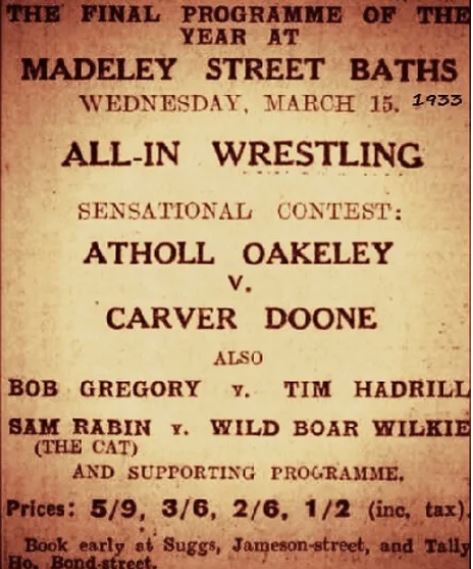
Another man causing a lot of interest was the giant Carver Doone, a creation of wrestler-promoter Atholl Oakeley. Oakeley’s lifelong interest in the romantic novel, “Lorna Doone” lay behind the re-creation of a twenty stone Devonian, Jack Baltus, as the fictional “Frankenstein of Devon,” Doone was said to stand seven feet tall, which seems to be an exaggeration of around three inches.
Amateur wrestling was enjoying something of a resurgence. The national amateur championships were held in March at Lambeth Baths, London. Competitions took place in both Cumberland and Westmorland and Catch-As-Catch-Can styles. Amongst winners in the Catch competitions were two men who were to go on to compete professionally, Robert Cook (at light Heavyweight) and Joe Reid (bantamweight). Veteran champion George MacKenzie won his thirteenth national title. There were almost fifty entrants to the Yorkshire championships in Bradford, in which a young fellah named Norman Morrell defeated Olympic Games representative Jack Taylor. Later in the year Morrell made his way to London to win an open tournament at the Ashdown Club.
In August the famous Casey family of Sneem, Ireland, Paddy, Steve, Tom, Jim and Dan (cox) won the Salter’s Cup for the third time at Killarney Regatta making them outright holders of the cup. The brothers refused the Killarney Committee’s request to sell the cup back to them for £60.
Highland Games champion hammer thrower and shot putter George Clark was establishing himself in the professional wrestling ranks. Clark easily defeated Irishman Michael John O’Sullivan by two falls to none in two minutes at the Brunswick Stadium, Leeds. When George faced Douglas Clark shortly afterwards it was their first meeting under All-In rules, although they had wrestled each other eight times under Cumberland and Westmorland rules, each claiming four victories. Highlight of the year for the Scot travelling south must have been his victory over Atholl Oakeley at Barnsley Stadium in October.
Also making a good impression was Karl Pojello, the Lithuanian friend of Oakeley who had arrived in Britain at the end of 1932. The Lithuanian possessed an extraordinary variety of holds and counters and was very agile for man of his size, as demonstrated in his victories over each of Bulldog Bill Garnon, Izzy Van Dutz and the Black Tiger by two falls to nil. In February Pojello beat Germany’s Heinrich Froehner at Nottingham in the sixth round to win the European Heavyweight Championship. Froehner had taken the title from Oakeley some six weeks earlier.
The Lancashire Terror, Billy Moores, was already claiming over 1,000 victories by the beginning of January, 1933, a figure that presumably included numerous Lancashire Catch as Catch Can matches in the 1920s. Billy Moores was certainly a hard, strong and skilful man, throwing out challenges to Atholl Oakeley, Carver Doone, Half Nelson Keyes, and Jack Pye.
More wrestling greats, amongst them Dave Armstrong, Jack Dale and Black Butcher Johnson emerged during the year, laying the foundations not only for the following few years but for half a century. It was turning into quite a decade.

