
Wrestling Heritage welcomes memories, further information and corrections.
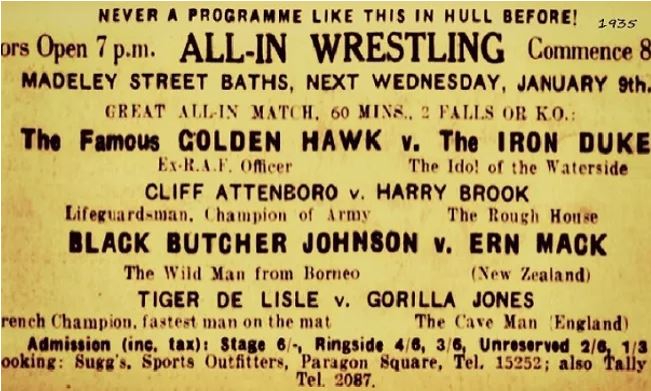
By 1935 professional wrestling in Britain was reaching new heights of popularity with dozens of tournaments taking place up and down the country each night.
The sport whose revival began as an adjunct to boxing tournaments was not just standing on it’s own feet, it was now thriving. This success was achieved without the support, or rather in spite of, the national press, who by 1935 mostly ignored the sport, tired of the more unsavoury elements.
Maybe unsavoury elements such as the wrestler who became so angry during his match in Wolverhampton when the ropes broke that he assaulted the referee, threw water over the crowd and stormed off to the dressing room. A priest was hurriedly brought from a nearby Roman Catholic Church to calm the man down. The question remains open; was this the case of an astute promoter calling on the help of a friend in high places, or was God moving in mysterious ways?
Even worse were the scenes reported from the first wrestling tournament in St Leonards on 23rd January. The Hastings and St Leonards Observer reported wild wrestling scenes, “Such was the scene, the worst in local sporting circles for many years, which brought forth loud and long bursts of booing from the crowd.” The newspaper went on to describe, in graphic detail the deplorable antics of Herbie Rosenberg, “The sneering, jeering Jew” from Chicago, as he was defeated by Atholl Oakeley, concluding “Hastings had its first taste of the country’s most brutal sport and apparently liked it.”
With wrestling becoming increasing popular sportsmen from other fields, particularly boxing and rugby, were attracted to the ring. Tommy Tucker, the heavyweight boxer from Bamber Bridge, hung up his gloves and turned professional wrestler. One of the most famous was the former professional heavyweight boxing champion Reggie Meen who turned professional in March, making his debut against Johanfesson at the Granby Halls, Leicester. Six thousand fans were reported to have witnessed the match, with hundreds more left waiting outside, twice storming the doors of the hall to gain entrance to the already full stadium. Meen gained a submission in the first round and Johanfesson retired from the bout during the interval. One reader of the Daily Mirror questioned whether the newspaper would provide as much coverage of his wrestling contests as they did of his boxing matches. Walter Stringer, the Hunslet rugby player followed the path of Douglas Clark, whilst oddest of all was the speedway rider Reg Thorne.
Reg Thorne was one of the world’s top speedway riders, champion of Australia and reputedly earning £100 riding for Manchester. In 1930 disaster struck and Ron was involved in a terrific crash. Although he eventually recovered physically he had lost all confidence and retired from the sport. His therapy was to take up professional wrestling. The cheers of thousands of fans gradually restored Ron’s confidence and in April, 1935, he felt ready to return to his former sport.
One exception to the national press’s disregard of wrestling was The Daily Worker, the forerunner of the Morning Star that focussed on social and trade union issues. The Daily Worker had been disparaging of wrestling in the early 1930s, but by 1935 was beginning to show more interest, mostly in wrestling tournaments that either contributed to the socialist cause financially or were part of a socialist event. The newspaper championed the cause of Harry Rabin, of the Stepney Workers Sports Club, described as the worker-wrestler and forecast championship honours for the man they reported as unbeaten. The newspaper reported a wrestling tournament that raised £600 for socialist funds. In one wrestling contest a man wrestler accepted the challenge of a woman wrestler, “…In quick time the girl comrade showed by a fine throw that women can play their full part in the fight of the workers.”
In April a workman wielding a pickaxe cut through a cable and caused a long and widespread electricity blackout in much of London. Whilst the most dramatic impact was a fire caused in a Regent Street cinema there was a more prosaic effect at Lane’s London Club where a wrestling tournament was taking place. For forty five minutes the crowd sat in darkness making wisecrack comments and then reluctantly accepted their money back and tried to find their way home through the darkened streets.
Sir John Gilmour, the Home Secretary, announced to the House of Commons that he was to inquire into the legality of professional wrestling shows held on Sunday. A few weeks later Harold Lane received a summons under the Sunday Observance Act 1780, for staging matches at Lanes Club. On 21st November Sir Percival Clarke acquitted Lane on the technical grounds that the prosecution had failed to prove their case. Promoter Alf Allen was granted bail when he was charged with “keeping a place of place of entertainment,” namely the Chelsea Palace Theatre, where All In Wrestling had taken place on Sunday 13th October. The case was adjourned until after the passing of judgement on Harold Lane. Three weeks after Lane had been declared not guilty Alf Allen was acquitted.
Despite more paying customers and more tournaments than ever before the tarnished reputation of wrestling made the development of the sport an uphill struggle at times. The Brighton Dome was refurbished and in November it was announced that following it’s re-opening boxing and wrestling would no longer be allowed. In March Blackburn Town Hall Committee recommended that the Council should reject an application to hire the King George’s Hall for the purpose of wrestling. Six tournaments had already taken place, attracting up to 3,000 fans, but there was opposition on the grounds of brutality. Fortunately, for wrestling, the council rejected the advice.
All In and Freestyle wrestling continued to co-exist, possibly a case of what the promoters thought they could get away with in each town. Hull, for instance proudly proclaimed “Real All In Wrestling – Strictly under New York All In Rules, nothing barred;” whilst the Majestic Skating Rink in Preston and Chelmsford Corn Exchange stressed the Freestyle nature of their rules. The Wolverhampton Express & Star welcomed the change of promoters and overnight swapping of All In rules for Freestyle in the town. Wrestling was introduced to the inhabitants of Bath at the beginning of October. In the inaugural tournament at the Drill Hall there are no reports of any rough house tactics with the local paper describing the sport as a “strenuous art” that thrilled the audience. Two weeks later it was a very different report as the newspaper declared “It’s All In” and the knocking out of the referee, Tiny Carr.
Douglas Clark retained the World Heavyweight Championship he had won by beating Laurent Gerstamanns in 1933. Canadian challenger Jim Burnett failed to take the title in their match at the Olympia Hall, Bradford, on 22nd March, with Clark winning by two falls to one. Jack Pye was a challenger for Clark’s British heavyweight title, losing over four rounds when he was knocked out at the same hall. In July an audience of 5,000 watched the first open air wrestling tournament in Bradford at the Greenfield Stadium. Heavyweight champion Douglas Clark was in action once again, this time defeating Golden Hawk, a former RAF man known as “The Gentleman Grappler,” by two falls to one.
Having defeated Garnon to establish himself as British champion Douglas Clark’s World Heavyweight Championship credentials were now disputed by Alaskan Jack Sherry.
Jack Sherry had been brought over to Britain in 1934 by Atholl Oakeley and continued to defeat all those set before him. In August he was booked to wrestle in the West Country, in Camborne and Penzance in Cornwall. On 2nd August Sherry made his Cornish debut against the former British heavyweight champion Bulldog Bill Garnon at Camborne. Sherry defeated Garnon by a fall and a submission to nil, thus setting the scene for the big fight three days later. Cornish style champion for many years Francis Gregory had been a professional for less than two years, but was already established as a West Country favourite. On 5th August Gregory was Sherry’s challenger for the World Heavyweight Championship at the Penzance Cricket Ground. Referee for the match was erstwhile British champion, Atholl Oakeley, whose wrestling career was almost inactive since his loss of the title to Garnon. The match was over five ten minute rounds. In the fifth round, shortly after Gregory had been thrown from the ring and fallen heavily Sherry went on the offensive and Oakeley stopped the contest, Sherry retaining his title.
Another nemesis of Oakley’s, William Bankier, also continued to spread his influence, extending his territory to Plymouth where he presented Freestyle wrestling in partnership with John Mortimer at the Connaught Drill Hall, Portsmouth.
Elsewhere in Europe the tragic story of Wrestling’s First Martyr cast a dark and lasting shadow.
In December the Yorkshire Light Heavyweight Amateur Championship took place, catch as Catch Can style, in Bradford. Third place was taken by a twenty year old from the Thornbury Club, name of Les Kellett.
The decade was heating up.
 Wrestling Heritage