
Wrestling Heritage welcomes memories, further information and corrections.
With war clouds gathering across Europe the sport of professional wrestling, a diversion where fans escaped from the reality of the hardship of life in 1930s Britain, was not immune to the evil forces gaining momentum across the Continent.
The martyrdom of Jim Wango has already been explored, but it wasn’t just in Germany, there were disturbing developments closer to home as right wing opinions gained a foothold. It seemed that no aspect of life was immune, not even wrestling.
The Fascist news sheet “The Blackshirt” carried an article entitled “Wrestling As A Jewish Propaganda Ramp.” The author divulged his warped opinion that wrestling “is nothing but a Jewish money grabbing ramp.” He told of “Jewish all-in wrestling haunts” in which German wrestlers were defeated to discredit the German nation. Such views clearly demonstrate that some (fortunately rare) aspects of British life were more abhorrent than anything that went on in the all-in wrestling ring.
It wasn’t just in Britain that wrestling promoters encountered an occasional hitch to the on-going development of their business. In July a riot was reputed amongst the sixteen thousand spectators at the Palais de Sports in Paris following the defeat of Frenchman Henri DeGlane by Portugal’s Al Perreira. It took over an hour for police to restore order as the interior of the hall was wrecked by the tearing up of rows of seats, display cases smashed and fire hydrants turned on. Whilst newspapers unhesitatingly reported acts of aggression amongst the fans there was a new angle taken by at least one promoter. Wrestling was advertised at Manor Place Baths, start 8.00pm, doors open 7.30pm. Nothing unusual in that you may think. The advert went on to announce that prior to the wrestling there would be music played by accordionists and clarinetists to soothe the audience!
Wrestling made the front pages of the national press in November with the marriage of Bob Gregory to Miss Valerie Brooks, otherwise known as Princess Baba, the daughter of the white Rajah of Sarawak. Princess Baba reported that daddy was none too pleased at the prospect and threatened to stop her allowance. The marriage was set to be a tumultuous affair from the start, the stuff of fairy tales that captured the imagination of the British public. The national press avidly reported every turn of the whirlwind courtship like a modern day soap opera. New developments were reported almost daily: the eventual stoppage of the allowance, the defiant response of the wrestler, the couple fleeing to Paris, Baba’s sobbing as she watched Gregory lose at Lanes Club and presumably more cheerful demeanor when she was at ringside to see him defeat Wolbach Rubbens in Antwerp in a European championship match. Newspapers dutifully reported the dramatic (allegedly) spontaneous dash one night from Lane’s Club where Gregory was wrestling, to Euston Railway Station, catching the train to Liverpool. On arrival in Liverpool they called on promoter William Bankier (he of Apollo fame) to help them obtain a special licence to marry. Alas, it was to no avail and with hopes dashed the couple postponed their plans, but not for long. Three weeks later, on 20th November, the pair married at Marylebone Register Office, London. In the Marriage Register Bob Gregory listed his occupation as Physical Culturalist. Promoter Harold Lane was one of the official witnesses and was reported to have given the couple a wedding present of a house in Wimbledon!
At the end of December it was announced a Hollywood film company was to make a full length film of Gregory and the Princess’s romance.
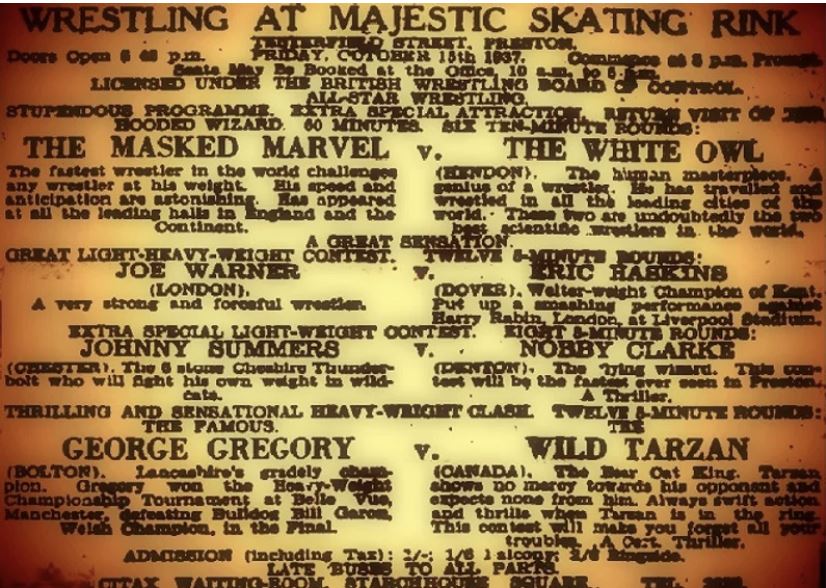
Whilst questions were raised of how wrestlers could avoid maiming one another if it was as violent as it appeared there was no doubt the sport was a dangerous occupation. Twenty-seven year old Michael Flack, who had wrestled for six years as White Owl, died of an abscess in the loin on Christmas Eve,1937, following a professional wrestling contest. The inquest was told Flack had received a couple of serious injuries in the previous six months and had been admitted to hospital following his last bout, a week before his death. Bob Gregory, who said he considered himself a friend of Michael Flack, said he had ceased employing the wrestler on his tournaments some months earlier and had advised him to retire due to his deteriorating eyesight which was making him increasingly vulnerable to injury. The coroner returned an open verdict.
Seven years after it’s re-emergence onto the British sporting scene professional wrestling, despite it’s immense popularity, continued to encounter controversy; in Scunthorpe the council rejected an application for free-style wrestling tournaments to be staged in the Baths Hall whilst in Manchester questions were raised why wrestling was permitted on Sunday but cinema attendance was not. There were increased protests from the Manchester branch of the Lord’s Day Observance Society when one of the regular Sunday tournaments at the Stadium Junction was sponsored by St Malachy’s Roman Catholic Church, Colyhurst, raising £100 for church funds. In Leeds, where wrestling had been permitted since 1931 the subject was re-opened when Alderman Walker, leader of the Conservative group, and a number of other councillors attended a tournament and proposed wrestling at the Town Hall should be banned from the beginning of 1938. In contrast Barnsley Council reviewed their earlier decision to permit wrestling and “…came to the conclusion that it is an altogether clean sport, and we were unanimous in saying that it was quite a proper sport to be held in Barnsley.”
In 1936 William Bankier had lost a libel action brought against him by Bill Garnon and Jack Sherry by questioning the legitimacy of their Word Heavyweight Championship Contest. In May, 1937, Bankier appealed against the decision on the grounds of new evidence that had come to light. Bankier contested that Sherry had claimed he was World Champion by default because American champion Strangler Lewis was not there to oppose him! Strangler Lewis had subsequently filed an affidavit stating he had defeated Sherry on the four or five occasions they had met, the last occasion being in New York in 1932. Lewis asserted that at no time was Jack Sherry the World Heavyweight Champion. Lord Justice Greer dismissed the appeal, describing it as a “hopeless application”
In the first and final quarter of the year British Heavyweight champion claimant Douglas Clark was continuing to maintain his presence as one of the best, possibly the best of heavyweights, though Bert Assirati would have had something to say about that. King Curtis, Anaconda, Van Dutz and the rest of the best all tried in vain to overcome the champion. Clark came up against a tough opponent when he faced Klondyke Jim Burnett at Morecambe. Clark fell behind in the third round when Burnett forced a submission with a hammer lock, but used his power to come back in the fourth round, using his Cumberland and Westmorland style background effectively with his “Cumberland Hipe,” a ferocious throwing of the opponent which knocked out the Canadian. For six months Clark was away from British shores, making his fourth visit to Australia. He embarked on 2nd April from London bound for Brisbane on the P&O ship Mooltan.
In Australia Douglas met the top wrestlers available, notably a series of rough encounters with Australian champion Billy Meeske. Their match at Broken Hill for Meeske’s Empire title was described as the wildest and roughest match of the season, with both men biting, punching and kicking. All was relatively calm until Clark took secured the first fall in round two. The crowd were enraged when Meeske began the hair pulling and jumped on a prostrate Clark’s face with both feet. Meeske’s aggression led to an equalising submission in the third round. With both men punching Clark drew blood but Meeske responded with more punching that dazed Clark and led to the winning fall by the Australian. Clark protested against the decision but Meeske took the honours and retained the title. On 1st October Douglas arrived back in London aboard the Narkunda.
Mitchell Gill and George Clark were also first class wrestling ambassadors in 1937. Gill was in Australia and using the name Mike McGill. He too faced the top men of the Australian circuit of the time: Meeske, Tom Lurcich, Fred Atkins and Tony Lamaro. George Clark found success in Canada, where the press dubbed him Dazzler Clark. At the Mutual Street Arena in Toronto Clark defeated Californian Jack Santon in straight falls. It took Clark less than twenty minutes to secure victory and the press reported that fans bellowed abuse at the American. Santon’s leg was twisted by a painful Indian Death Lock for Clark to take the first fall. The American limped back to the ring after a ten minute break, but lasted only three minutes before succumbing to a leg scissors that brought an end to the contest.
Evergreen Billy Riley, still parading the World Middleweight Championship, continued to defeat all set before him. Not just lighter men like Dick Wills but heavier opponents such as Lancashire’s Jack Atherton and Scotland’s Tony Baer.
The Greek-American champion Jim Londos was in Britain and proved a great success, with 6,000 fans packing the Empress Stadium in London to witness him destroy George Pencheff in a match advertised as “modernised Catch as Catch Can” style. Barefooted Londos, billed as “Champion of Champions” was dominant in a clean and gruelling struggle which he won with a reverse leg lock in the 49th minute. Following the contest fans carried Londos shoulder high to the dressing room.
Karl Pojello remained European Champion, though promoters seemed undecided whether this was as a Light Heavyweight or heavyweight. He continued to defeat all before him, including former champion Bill Garnon (now claiming only the Welsh title), powerful Yorkshireman Bert Mansfield, Cornish champion Francis St Clair Gregory, veteran Henry Irslinger, and the Russian George Boganski.
George DeRelwyskow had led the way in 1936 by putting up a spirited defence when clergymen had spoken out against all-in wrestling. Wrestler and promoter Johanfesson took the view that more direct action was necessary. When the Reverends Ward and Benison of Grantham, who had earlier protested against the barbaric nature of the sport, attended one of Johanfesson’s tournaments, (presumably just to make sure), the wrestler challenged the two clergymen to get into the ring and face him in an all-in wrestling bout. The challenge was not accepted.
Seemingly neither the evil forces of Europe nor the mysterious workings of God were supporters of what had become Britain’s fastest growing indoor sporting entertainment. With controversy never far away professional wrestling continued the relentless evolution that would lead to further expansion in the years to come. What could possibly get in the way?
 Wrestling Heritage