
Wrestling Heritage welcomes memories, further information and corrections.

March 12th 1938 was a milestone day for British wrestling. For the first time ever British wrestling was broadcast on television. The BBC had only been broadcasting for 16 months and programmes could only be received by a few thousand homes around London for three hours a day, four on Saturday and not at all on Sunday.
Earl McCready of Canada wrestled Percy Foster of South Africa in a match described as an exhibition of Catch as Catch Can wrestling.
Further demonstrations of the sport were to take place during 1938, with competitors Harry Anaconda, George Modrich, Leo Lefevre and Chick Knight. Details of these and other wrestling shows broadcast by the BBC are documented in The Other Side of Wrestling.
In July the BBC National Programme (radio) broadcast the Empire Catch as Catch Can Heavyweight Championship contest between champion Earl McCready and Tim Estelle.
In and interview with the British press Canadian Earl McCready, who had been wrestling in Australia and New Zealand, said that he planned to clean up British wrestling and hoped to play a part in getting the sport into Britain’s schools and colleges curriculum. The reporter wrote that there had been little or no wrestling in Britain since the days of Hackenschmidt! Where had he been for the past seven years?
There were some parts of wrestling that were in need of cleaning up. On 20th May national newspapers, who very rarely reported the legitimate aspects of the sport, clearly felt duty bound to make it a front page story that mud wrestling had come to Britain. At the end of a regular wrestling bill Karl Pojello faced Manuel Garcia in a ring filled with clay that was covered with crude oil and sprinkled with soot. The audience were reported to have enjoyed the occasion, having paid 12s 6d (62 ½ p) for the privilege of being splattered with mud, unless they had paid an extra 9d for a paper cape. A few weeks later Londoners at the Devonshire Sports Club, Hackney, were introduced to the novelty of female mud wrestling, again reported by a national press that neglected the orthodox aspects of the sport. Those thinking things could not get any worse paused for thought with a report from Minneapolis, USA, that two wrestlers had fought in a ring filled with a ton of ice cream. Strawberry, chocolate and vanilla if you’re wondering; and yes it was called Sundae wrestling. Years later Oakeley claimed to have staged only two mud contests before getting back to the serious business of wrestling. Maybe so, but the however few in number the matches simply provided more ammunition for the critics of wrestling.
The genuine skill and power of the likes of Assirati, the two Clarks, Gill, Garnon, McCready and many other stars of the ring struggled to contend with the nonsensical novelties introduced by some promoters – mud wrestling, women wrestling, midgets brought the sport increasing ridicule. Critics had always taken every opportunity to denigrate the sport but many genuine fans, and wrestlers, must have despaired at the elements introduced in 1938 that could never be described as sport.
The sky had not fallen in. The positive aspects of wrestling had not disappeared overnight and nonsense was the exception rather than the rule. The good wrestlers were still around and there was good wrestling to be seen, but these unsavoury developments lessened the esteem of wrestling and wrestlers even more (if that was possible) in the opinion of critics. The interest of the national press was re-kindled with this new opportunity to knock professional wrestling. The press amused themselves in what might come next, one suggestion being scantily garbed lovelies fighting in a glass tank, the winner being the one that drowned the other.
It was the introduction of men versus women matches that brought the issue to a head. London County Council threatened to ban all wrestling tournaments in the city unless the sport was regulated. Consequently on 15th November, 1938, the British Wrestling Board of Control was formed, along the lines of the British Boxing Board of Control. Chairman was A.F.Bell (of The Ring, Blackfriars), Vice Chairman Harold Lane, Secretary Jack Dale, treasurer F.E.Branstone, and boxing manager and promoter Victor Berliner adviser to the board. We have little evidence of the Board’s existence following it’s inauguration, though some halls, such as the Majestic Ice Rink at Preston, did advertise their matches were under the auspices of the British Wrestling Board of Control. In essence nothing had changed. Various governing bodies had been declared during the decade, but they were nothing more than veiled attempts to promote respectability by creating an illusion of structure and authority.
Less than a month later, at the beginning of December, 1938, the London County Council Entertainments Committee announced that women would no longer be allowed to take part in public wrestling matches in London. There were no plans to ban other wrestling matches. The fans of Leeds were not quite so fortunate when Leeds Corporation Property Committee carried out their previous years threat of banning wrestling at Leeds Town Hall, giving the reason that wrestling was not in keeping with the dignity of the building, a magnificent baroque/classical structure completed in 1838 and used as a model for civic buildings around the country.
Thirty years after the Russian Lion, George Hackenschmidt, had generated an earlier boom in the sport, wrestling returned to the Royal Albert Hall, promoted by the wrestler who pledged to clean up the sport, Earl McCready. It promised to be another revival of scientific Catch-as-Catch-Can style. If the report of the Daily Express on 9th August is correct the management of the hall had such confidence in McCready they even cut the cost of hiring the hall in half for the first show, with a main event between McCready and a 19 stone 6’2” tall Texan by the name Reuben Wright. The match was postponed for four weeks due to Wright sustaining an ankle injury in training, finally taking place on 23rd August. Also on the bill were Carl van Wurden, Guido Ronga, and Harold Angus. Ticket prices ranged from 1/6 (7 ½ p) to 1 guinea (£1.05). McCready and his friend, Kevin Staunton, invested £600 in the tournament, of which Daily Express reporter, John McAdam, said the wrestling was so good it had converted him to the wrestling business. Three thousand fans turned up to witness McCready win by one fall to nil in the sixth round. That just wasn’t enough to prevent McCready and Staunton losing most of their investment. For once the press were sympathetic, but McCready left Britain shortly afterwards to regain his losses wrestling in South Africa.
One venue that could pull in the punters on a regular basis was Harold Lane’s London Club, that had been staging wrestling throughout the decade. A Committee of London County Council were told that two thousand guests filled the Club three times a week to watch the all-in wrestling shows. The Committee were hearing an appeal by Lane against imminent closure. The L.C.C. Were demanding additional exits to the club, which would cost £20,000 and leave room for a capacity of just 750. Lane’s efforts were in vain and the club closed at midnight on 9th November, 1938.
In the courtroom Carl Reginsky renounced his billing as “The toughest and roughest mat mauler,” when he was sued by referee Phil Meader for assault at the Seymour Hall in Paddington. Despite denying he was “Germany’s ace bad man” the judge ruled in favour of Mr Meader, who said that Reginsky had assaulted him in the dressing room following a match in which he had disqualified him for kicking his opponent, Joe Devalto. Mr Meader was awarded £150 damages.
Boxer Phil Scott joined other gloved men like Reggie Meen to turn to professional wrestling. The boxer was trained for a month by Karl Pojello in preparation for his match against World Champion claimant Jack Sherry. The two met, albeit briefly, at The Ring, Blackfriars on 24th November. It was a sorry spectacle. Having been punched with a seemingly low blow Sherry fell to the canvas in pain. At the count of five he rose quickly to attack an unsuspecting Scott by grabbing his leg. Scott fell to the canvas with Sherry increasing the intensity of the leg lock until Scott submitted. It was all over in one and a half minutes.
Douglas Clark was still British Heavyweight Champion, at least as far as the Northern half of the country was concerned. Having visited Australia in 1936 and 1937, and despite losing to Empire champion Billy Meeske, Clark was now touted at home as Empire Champion. In February, 1938, a record crowd at the Imperial Ballroom, Nelson, saw Douglas keep the title when Irish champion Mike O’Sullivan was injured in the fourth round.
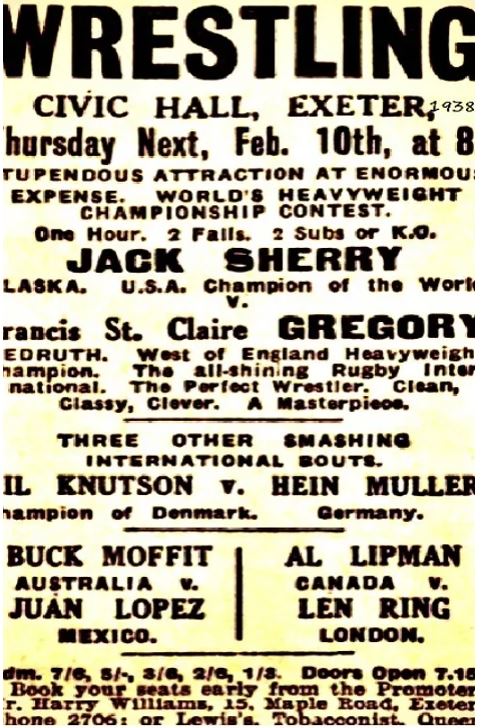
Alaskan Jack Sherry defended his World Heavyweight title in a match with Francis St Clair Gregory at Exeter on February 10th. Posters described Gregory as “The Perfect wrestler. Clean, classy, clever. A masterpiece” In March it was the turn of Russian George Boganski at Plymouth. Dave Armstrong was another that tried in vain to take the American’s title at Blackburn in October, Bonnie Alan Muir tried his best in November, with Douglas Clark facing the champion at Belle Vue in November and December. The November meeting was a genuine clash of the giants, one final cash grab following a decade of intense rivalry, with Clark losing with a badly cut eye ending the contest.
Steve Casey, one of the famous fighting family from Sneem, was back in Ireland, adding another World Heavyweight Champion to the British Isles. Steve had gone to America in 1936 and in February, 1938, had defeated Lou Thesz in Boston to win the AWA World Heavyweight Championship, with the referee Bob Gregory. Casey returned to Ireland for a short visit and defended the title against challenger George Clark in Cork. Casey had already beaten Clark twice when the Scot had travelled to America in 1937, and was destined to keep the belt until March, 1939.
One of the greatest sensations wrestling in Britain during 1938 was Maurice Tillett, The Angel. By present day standards most would conclude that Tillett was exploited with his physical deformity used to make him a wrestling star, though no one has suggested Tillet was unhappy with being catapulted to stardom or treated unfairly. Karl Pojello trained Tillet to wrestle and he proved a sensation wherever he appeared, with huge numbers of fans turning up to see him wrestle Carl Reginsky, Bert Assirati and Bill Garnon.
Meanwhile, wrestling’s romantic soap opera took numerous twists and turns, all dutifully reported by the British press. British wrestler Bob Gregory and his wife Princess Baba moved to the United States at the beginning of the year, Baba announced her desire to seek an acting career, in July she wanted to buy an island in the East Indies, which would naturally be called Babaland. Then they announced they were about to separate. The couple vowed they were more in love than ever but were under pressure due to being snubbed by their Hollywood neighbours, the way of true love was just too tough. The following week they denied a break down in their marriage, harnessing yet another page of publicity in the Daily Mirror.
 Wrestling Heritage