
Wrestling Heritage welcomes memories, further information and corrections.
During the earlier months of 1939 the British population tried to convince themselves that all would turn out well and war could be averted; after all in September, 1938, Prime Minister Neville Chamberlain had waved his bit of paper and declared that Britain and Germany would never go to war again.
How more reassuring could it get?
Mustn’t grumble.
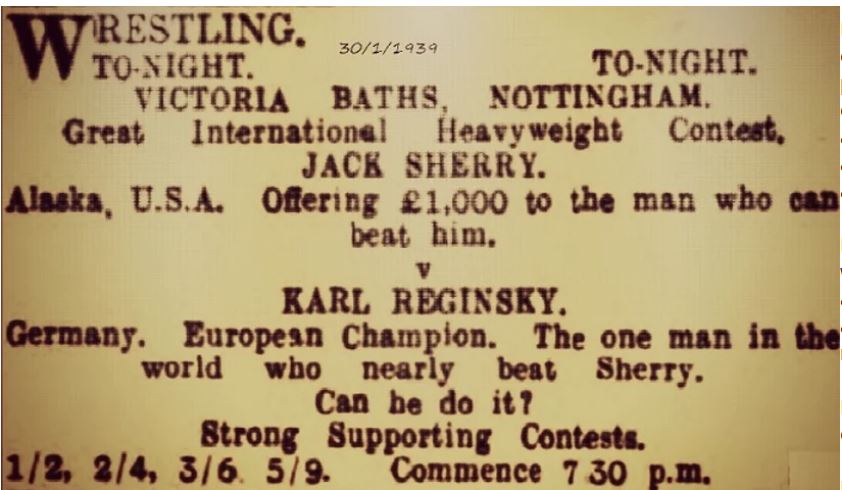
So with business as usual wrestlers travelled to and from Britain in the early months of 1939. George Pencheff, Whipper Watson, Red Brokau, Johnny Katsulos, Johnny Demchuck, Joe Devalto, Benny Engbloom, Carl Reginsky, Hans Steinke, Mike Brendel, Bob Fife, Dory Detton, Hans Lagren, Karl Pojello, The Angel and Jack Sherry were just some of the overseas workers in British rings in January, 1939.
It wasn’t one way traffic, of course, with British wrestlers continuing to travel abroad. The liner Strathmore, arrived in Cairns on 20 May, carrying George Modrich on his return home, Londoner Harry Rabin and Irishman Bill Behan.
As the year passed and gloomy reality began to dawn the population of Britain had more pressing matters on their minds than professional wrestling. Nonetheless, following the declaration of war on September 3rd nothing could provide a greater escape from the reality of the impending war than a night at the wrestling. A decade of controversy had failed to quell much of the nation’s interest in professional wrestling with weekly tournaments taking place at the biggest venues in London, Newcastle, Manchester and smaller halls around the country.
Throughout the country thousands of enthusiasts paid their money to watch styles of wrestling on a spectrum that ranged from plausible sport to utter nonsense. In the post war years promoters of a new style of wrestling would capitalise on these increasingly more unsavoury elements to add credibility to their own product. Whilst the get rich quick damn the consequence promoters of the late 1930s gave their successors a generous amount of ammunition the criticism of later years did a dis-service to the genuine wrestlers of the 1930s.
Many of these wrestlers were still around by 1939, though many admittedly no longer in the first flush of youth, and all about to have their professional wrestling routines severely disrupted.
Black Butcher Johnson was attracting the fans as greatly as ever. Doulas the Turk was still the most Terrible Turk in the world. A brilliant ex amateur from Bradford, Norman Morrell was establishing himself as a very talented professional. Whipper Watson, the Canadian who was to go onto huge success in the United States, was coming to the end of his British tour. Harold Angus was World Welterweight Champion as a result of beating Alexandre Poizat at Plymouth on February 23rd. Poizat took the lead in the third round, Angus equalising in the fifth and taking the decision with a Japanese back stretch to which Poizat submitted, in the sixth. By August Angus was also being billed as World Middleweight champion! In the United States the American Jack Reynolds was recognised as World Champion. In March 1938 Nat Frank reported, “Jack Reynolds has expressed his willingness to battle Harold Angus for world welterweight honours, provided that the ex-British Olympic star visit America for the contest.”
Masked men were increasingly popular with the tantalising possibility of their unmasking in the unlikely event of their defeat. Amongst the hooded terrors were the Red Devil, The Red Mask, Golden Ace, The Brown Masked Marvel, Blue Mask, and the Green Asp. A colourful collection. And then there was The Ghoul! The 1939 interpretation of this masked monster was said to be 7 feet 3 inches tall and weighing 23 stones, “A monstrous mammoth, nameless and homeless. Without soul or nationality.” No one could ever accuse a wrestling promoter of lacking imagination.
As war approached most of the overseas wrestlers who had been working in Britain returned home. Canadian heavyweight and Empire champion Earl McCready, who had attempted to revive Catch-as -Catch-Can style in Britain was now wrestling in New Zealand. In October he was held to a draw, thus retaining his title, against New Zealander Lofty Blomfield. George Modrich was also back home in New Zealand. Karl Pojello and his protege, The Angel, went to America with the hope that The Angel could make a fortune for both of them.
Douglas Clark was widely acknowledged as British Heavyweight Champion, though Father Time was catching up on him as he neared his fiftieth birthday.
Harold Lane, the man who had owned Lane’s London Club (with a reputed 35,000 members) had fallen onto hard times since the enforced closure of his club, was fined £5 for staging wrestling on unlicensed premises, the Beresford Arena in Haringey. Another victim of the closure of Lane’s was Glaswegian Tommy Gordon, the lease owner of the club from the owners Druce & Company. Without any rental income Gordon was unable to pay the rent and now owed Druce & Company £3000.
In February women wrestling was banned in Middlesex, following an earlier ban by London County Council. Wrestling returned to Blackburn following an earlier ban, with ACS Promotions announcing tournaments were now licensed by the British Wrestling Board of Control. In contrast Glasgow council again denied permission to promoter George DeRelwyskow despite assurances that brutal holds and grips would not be permitted.
In March the recently formed British Wrestling Board of Control introduced a new rule, that matches would end after one knock-out and not two as previously.
Pandemonium broke out in Nottingham when Atholl Oakeley returned to the ring following his retirement some years earlier. Oakeley’s opponent was the villainous “sneering and jeering” Hard Boiled Herbie Rosenberg. Trouble started with Rosenberg’s opposition to the referee of the contest, resulting in Cab Cashford being brought in as substitute third man. The crowd booed and called for a new referee as Oakeley took a beating, only for fortunes to change as Oakeley recovered to deliver two quick punches, knocking our both Rosenberg and the referee. The MC announced that Cashford had disqualified Oakeley for delivering a low blow, an announcement that led to Oakeley knocking out both Cashford and Rosenberg. To say the crowd were miffed would have been something of an understatement, with loud jeering, chanting and a refusal to leave the stadium for some time, but probably no later than the last bus.
A letter appeared in the Daily Mirror in March. The author wrote , “Mr G.F.Warren, in his recent letter, states ‘Jews are white, Africans are black.’ As I am a full bloodied African I was very interested to know that I should be black (in Mr Warren’s estimation). I have only been wrestling in England a few months but already I have had to disillusion quite a number of people about all Africans being black.” The author was Jack Cunningham. Many readers will remember Jack as one of the regular referees of television wrestling. Some will remember him as a popular barefoot who specialised in a rather spectacular monkey climb. Cunningham went on to become one of Britain’s most popular post war wrestlers until his retirement in 1964.
In June 1939 a sixteen year old from Crewe made his professional debut. Geoffrey Condliffe, using the name Jeff Condor, was ignominiously beaten at the Broadway Palace, Chester, by the world flyweight champion, Johnny Summers. The bravado of youth proved folly and Geoff Condliffe never underestimated an opponent again, going on to become one of Britain’s top post war heavyweights, Count Bartelli.
The decade neared an end. Blackouts were in place, bananas were in short supply, Britons were digging for victory, and wrestling adverts reminded patrons to bring their gas masks!. More light hearted references to the war were made, such as the advertisement for Bolton Stadium that promised “You will get more thrills and excitement in three hours than Hitler has caused this year.”
Despite the declaration of war wrestling survived and was about to demonstrate its durability. It had been a tumultuous decade, but a decade of expansion starting with nought and ending with success. Some promoters and wrestlers had brought disrepute, a few towns had banned wrestling, but by 1939 most of these setbacks had been reversed.
The do-gooders had tried their hardest to defeat wrestling.
They had failed miserably.
Could Hitler do any better?
 Wrestling Heritage