
Wrestling Heritage welcomes memories, further information and corrections.
The first full year of Britain at war. Everyone did their bit, and the wrestling fraternity was no exception. Whilst councils up and down the country had for the past decade debated the suitability of wrestling with the advent of war the sport was now very much on the preservation list.
Not only was professional wrestling one of the entertainments provided for the troops wherever they were stationed it was also considered necessary for shows to be staged publicly around the country.
In a nation at war the Government were keen to create a sense of normality amongst the population. Normality included going to the cinema, the dance halls, variety theatres and, of course, the wrestling!
Sportsmen around the country were raising funds for the war effort, and professional wrestlers played their part. In Hull a wrestling tournament was held in aid of the Warplanes Fund, with Dave Armstrong, Chick Rolfe, Vic Hessle, George Gregory, Blondie Gordon, Wally Seddon, Norman Morrell and Cyril Knowles on the bill.
Jack Pye was certainly willing to demonstrate that life in wartime was normal by continuing as Britain’s number one villain. Following disqualification against Mike Demitre at Blackpool Tower he began to battle not only referee Ted Baxter but Master of Ceremonies Tommy Moran. Just an ordinary day at the office for the Doncaster Panther until he was unceremoniously dragged out of the melee by a towel wrapped around his neck. Jack was back at the Tower a couple of weeks later against Charlie Green of Wigan. He was disqualified in the fifth round. When he was not causing mayem and endangering his opponent’s life in the wrestling ring Jack was saving lives as he served in the fire brigade.
The Daily Mirror reported that some of the toughest men in Britain were at home doing jobs more hazardous than anything encountered in civilian life. Amongst those named was Bulldog Bill Garnon, pictured (second from left above) serving in the ARP alongside film stuntmen Arthur Marotta, Leslie Crawford, and Dan Fox.
Some wrestling venues suffered damage, though the Ardwick Stadium stayed calm and carried on with the wrestling a few hours after a bomb had fallen through the roof. On January 8th fans at the Bolton Stadium were told that wrestling would cease as the hall would shortly be taken over by the Ministry of Supplies.
In April, 1940, tragedy presented itself for the other ringed sport at the Tower when Fleetwood boxer Martin Stewart died after falling from the ring. A collection at a Tower wrestling show in aid of Martin’s family raised £13, a sizable sum in those days.
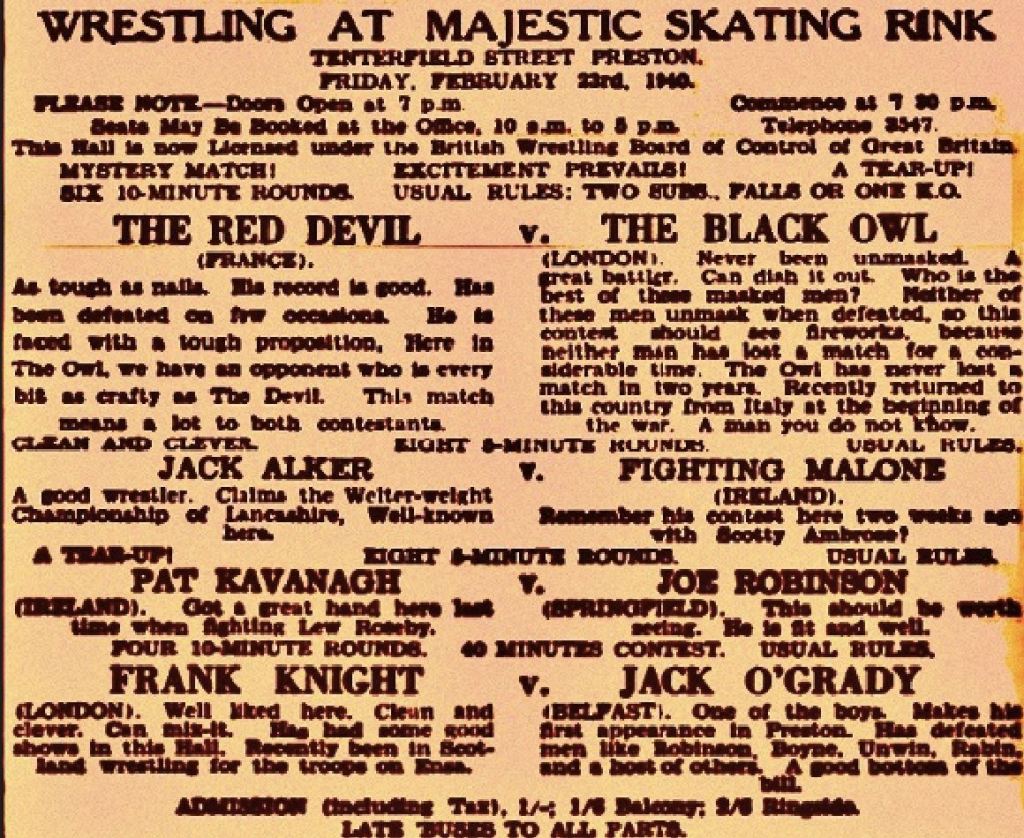
Two hooded figures faced each other at the Majestic Skating Rink in Preston. In one corner stood the villainous Red Devil, claiming to be unbeaten for two years, and in the other the Black Owl, naturally claiming an equally impressive record. The Black Owl took the advantage in the second round, gaining a fall with a body press. In the third it was the Devil on the offensive, knocking his opponent over the top rope with the Owl counted out. Fans clamouring for the Black Owl to unmask were about to be disappointed. The Owl protested …. apparently the rule of one one knock out to acquire victory (not two as previously) introduced a year earlier had not been communicated to just one man, The Black Owl. The dismay of the fans was, of course, balanced by the alluring prospect of a return contest. The Devil and The Owl faced each other once again. It was a fight to the finish over an unlimited number of ten minute rounds. With honours even after three rounds the Black Owl submitted in the fourth. The mask was removed to reveal West Jules Kiki.
London promised the biggest tournament since the outbreak of war in March at the Stadium Club, Holborn, with proceeds going to the Lion Hospital Aid Society’s War relief Fund to aid evacuated children. Those taking part included Ray St Bernard, Bulldog Bill Garnon, Jack Dale and Max Martinschutz.. Wrestling was back in Leeds, with some shows presented exclusively for members of the armed forces; it’s a good job Hitler didn’t drop by on one of those nights!
The difficulty, of course, was that most of the competitors had already been called up to serve their country, and those that had not were awaiting the call. One letter in the national press criticised the continuation of wrestling as fit men should be doing their duty. The letter provoked a quick response from wrestler Costas Astreos, who pointed out that many wrestlers were serving on the front line or in work of national importance. Promoters at The Majestic Skating Rink in Preston announce in the press,”In answer to patrons, every man on this bill is on National Service, A.R.P. etc.”
The Killers, Stranglers and Butchers of the wrestling posters were now replaced with good fighting men: Corporal Mazurki, Aircraftman Belshaw, Sergeant Foy, Sergeant Mancelli, each taking the opportunity to wrestle when service duty allowed. Chatham’s Bill Kent, who had enlisted with the Royal West Kents in 1939, was captured by the Germans. He endured a prisoner of war camp for five years, weighing just seven stones when the camp was liberated. Bill resumed wrestling following the war and survived until May, 2001, when he died aged 82.
The great Billy Riley turned 44, and greatly reduced his wrestling commitments, from now on seen in the ring most often as a referee.
Boxing and wrestling promoter John Mortimer died in April, aged 63.
Tragedy occurred in October, 1940. Harold Angus died in a shooting accident on Saturday 26th October, whilst shooting rabbits when the gun accidentally discharged. He was rushed to Doncaster Infirmary where he died at the age of just 35.
Essex County Cricketer Clem Wade had started pro wrestling in 1939 and was now making his way in the wrestling arenas of Britain, adopting the ring name Clem Lawrence. Clem, a one time policeman, was now a sergeant in the army. Other youngsters taking tentative steps included Jeff Condor (Count Bartelli) and Jim Hussey.
Our account of wrestling in 1940 portrays everyday life that was so normal. That was just what the Government wanted to portray. The reality was far different. The nation was absorbed in the hostilities of the Second World War. Families endured hardship and sorrow as lives and homes were destroyed. No one could escape the horrors of war. The wrestlers and promoters of Britain, whilst serving their country, are to be commended for the part they played in maintaining morale under very difficult circumstances. Whenever the Master of Ceremonies announced that one or more wrestlers advertised would not be appearing that evening he could at least follow it up with “Well, there is a war on!”
 Wrestling Heritage