
Wrestling Heritage welcomes memories, further information and corrections.
1941, Britain entered the third year of war, and professional wrestling demonstrated an ability to defy anything that Hitler or the do-gooders could throw at it.
Understandably, hostilities had taken their toll. The number of tournaments staged were reduced considerably, the appearances of wrestlers took second place to wartime duties, but wrestling remained a regular attraction for thousands of fans around the country. “Wrestling is the best tonic for depression” proclaimed a Relwyskow poster.
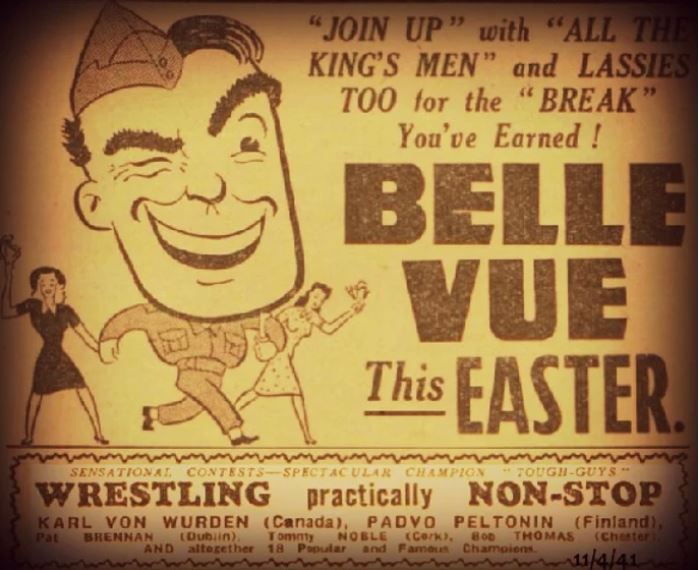
Weekly shows continued at Belle Vue, Manchester, with the publicity for imploring fans to “join up” and come to the wrestling, as demonstrated in this advert for Easter wrestling. Appearing at Belle Vue in 1941 were those men available because they were stationed locally or were home on leave, including George Gregory, Charlie Green, Vic Hessle and Jack Atherton. Professional wrestling continued to play a vital role in continuing to portray life as normal.
Last minute substitutions were inevitable as more pressing commitments would sometimes get in the way of those booked to appear.
One of the most reliable promotions for many years had been at the Majestic Skating Rink in Preston, which had succeeded in putting on profitable tournaments, without the unsavoury elements throughout the 1930s. An announcement was made on 24th March, “Owing to circumstances beyond our control we regret to announce that as from today skating and wrestling has ceased until further notice.” The announcement came to a shock for those reading the announcement in the local newspaper, a show had taken place only three days earlier. The last show, on 21st March, advertised four contests: Ray St Bernard v Dave Armstrong, Billy Joyce v Eric Askins, Cliff Belshaw v Fred Norman, Jack Alker v Scotty Ambrose. Ringside seats cost 2/6 (12 ½ p).
In October, 1941, around 1,000 people attended an open air wrestling tournament at the Wakefield Trinity Rugby Ground to raise funds for the 22 dependants of those killed in a recent coal mine disaster. In a tournament at the Dewsbury Empire Mick Howley beat Harry Smith and helped raise £200 for the Aid To Russia Fund.
Wrestling events in aid of the war effort were frequently held, a genuine gesture no doubt, but one with the added benefit of endearing pro wrestling to the authorities that be. One such show was at the Corn Exchange in Chelmsford on December 6th. Eight wrestlers, including Bulldog Bill Garnon fighting Phil Siki in the main event, and supported by Fred Unwin, College Boy, Jack Dale and Vic Coleman, raised funds for the Royal Air Force Benevolent Fund.
Promoter Harold Lane, he of Lanes Club fame and described as the Tsar of wrestling, died suddenly at the age of 54. The Manager of The London Sports Club, Lane had staged exhibition matches in November, 1930 and was quick to sign up to the new sport. One of the architects of All-In wrestling Lane had experienced many ups and downs, the ups of staging three shows a week for 2,000 fans, the lows of being charged with “keeping a place of entertainment” on a Sunday (acquitted on the technical grounds that the prosecution had failed to prove their case), and having his club closed down for having insufficient safety exits.
George F DeRelwyskow was serving in the army as an Instructor in Unarmed Combat and Silent Killing with SOE (Special Operations Executive). In 1941 he was posted as an Instructor to the SOE School in Canada Special Training School (STS) 103 which was also known as “Camp X”. George replaced W.E Fairbairn in teaching his specialty of Close Combat, Silent Killing and Small Arms.
Carver Doone was serving in the army and retired from wrestling, Douglas Clark, one of the greatest 1930s pioneers, was still claiming the British heavyweight championship but the years were beginning to take their toll and he was no longer the force that he had been a few years earlier. Some of the newcomers making their tentative first steps in the professional wrestling ring in 1941 were destined to become the big names we watched on television in the 1960s and 1970s; men that included Jim Hussey, Jeff Condor (Count Bartelli), Ken Joyce and Billy Joyce, (two of them advertised here in Preston a few weeks before wrestling ceased at the Majestic). Johnny Saint, Jimmy Devlin and Danny Lynch were amongst those born during the year.
There was a war on, but British wrestling was continuing to evolve.
 Wrestling Heritage