
Wrestling Heritage welcomes memories, further information and corrections.
Contrary to wrestling folklore wrestling had not imploded by the end of the 1930’s. Indeed, the sport continued to play a major role in the war effort and many towns remained active right through the war, mostly in the north of England and Scotland. Newcastle, Morecambe, Dundee, Newcastle, Manchester, Aberdeen, Blackpool, London, Brighton, Bradford, Chesterfield, Hull and elsewhere; there was no shortage of opportunities for the wrestling fans on the home front.
Wrestling at Dundee got going again in January, 1943, and In March the Caird Hall Dundee attracted a 3000 attendance. In wartime Britain the sport even made it’s first appearance in Lanarkshire, on 24th November at Hamilton Town Hall. Jack Pye faced Francis St Clair Gregory in the main event, with a supporting bill that included Tony Baer, Carl Van Wurden and Robert McDonald.The Relwyskow family, continued with the business, posters announcing, “Relwyskow Promotions Ltd. This great name in the world of sport is to be carried on in memory of a great promoter (Geo. DeRelwyskow) by the Relwyskow family.”
Norman Morrell ventured into a managerial role, matchmaking a show in Hartlepool in aid of the local Hospital, further illustrating that fund raising was the way to go to banish some opinions of disrepute, along with a switch to the term “Free Style” being established where needed. On the bill was a young Sergeant Beresford, destined to become Morrell’s business partner in subsequent years.
Wrestling fans at the Cambridge Road Baths, Huddersfield, contributed more than £200 to the Mayor of Huddersfield’s Comforts to the Troops Fund. The Daily Workers Fighting Fund benefited from wrestling tournaments featuring Jack Pye and Harry Rabin, championed by the newspaper as the workers’ champion.
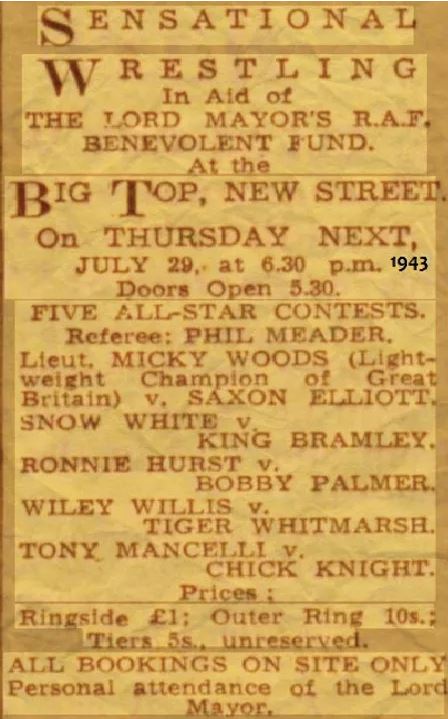
Birmingham, in common with all British cities, was heavily damaged during the Second World War. On 9th April, 1941, 200 bombers dropped 650 high explosive bombs and destroyed much of the city centre. On the main shopping street, New Street, a circus was held on the cleared ground (and was to remain until 1958). Wrestling was held at the Big Top on 29th July, 1943, a charity show in aid of the Lord Mayor’s RAF Benevolent Fund. On the bill were three names we were to become very familiar with – Tony Mancelli, Bobby Palmer and Cocky Chick Knight. Ringside seats were an eye watering £1, this at a time when a good night’s wrestling at Belle Vue could be had for a top price of 3/6 (17 ½ pence), with reduced prices for forces personnel in uniform.
It wasn’t just the professionals that were doing their bit for the war effort. In March, 1943, Olympic representative Stan Bissell, who was now teaching unarmed combat in the Commandos, was amongst the top amateurs taking part in a wrestling tournament in aid of the “Jewish Fund for Soviet Russia.” Competitors taking part came from the United States, Canada, Netherlands, Poland and Yugoslavia.
In March the Royal Air Force presented a wrestling show at Accrington Town Hall boasting “Four Grand Inter-Service Contests.” Amongst those taking part were Sergeant Green, Sergeant Hill, Sergeant Beresford, Sergeant Hessle and Sergeant Silcock. Names that sound familiar?
In October, 1943, when we would have thought the country should have had more pressing matters to deal with, the wrestling fraternity of northern England announced yet another wrestling body, the Wrestling Board of Control, was to be set up with the secretary none other than Jack Pye.
Mr Pye was another in a long line who promised the new organisation would clean up wrestling, stage British championships and keep the sport healthy and ready for the return of those wrestlers currently serving in the Forces. The new Board differed from previous boards by virtue of being an organisation of wrestlers and not promoters. From the 2nd November, 1943, wrestlers licensed by the Board would be forbidden from working on the same bill as an unlicensed wrestler.
If all that sounds fine do not lose sight of professional wrestling’s propensity to snatch defeat from the jaws of success.
No sooner had Jack and his men told of their plans to get themselves organised but Norman Morrell announced the formation of another wrestlers union, the British Wrestling Federation, with similar aims of protecting honest wrestlers, and establishing recognised champions.
Presumably different honest wrestlers and different champions.
The Federation announced they would hold a British heavyweight championship at Blackburn on 1st January, 1944 open to any wrestler in Britain. Morrell was reported to have said that £100 would be given to charity if any of the “washed up” wrestlers of the opposition “Board” could win the championship tournament on 1st January. He was reported to have criticised the Board for being a profits based organisation. It was the sort of management dispute that had dogged professional wrestling in the 1930s and would continue to do so for the remainder of the century.
Meanwhile, in the ring, with Douglas Clark retired Bert Assirati and George Gregory were now claiming the British heavyweight championship with Bulldog Bill Garnon (Welsh champion) and George Clark (Scottish champion) the main contenders. George Gregory gained a convincing victory over George Clark at Belle Vue, Manchester, in February.
Britain was at war, but there was still time for many a good fight, not just in the wrestling rings of Britain but amongst those who were destined to rejuvenate the sport following the cessation of hostilities.
 Wrestling Heritage