
Wrestling Heritage welcomes memories, further information and corrections.
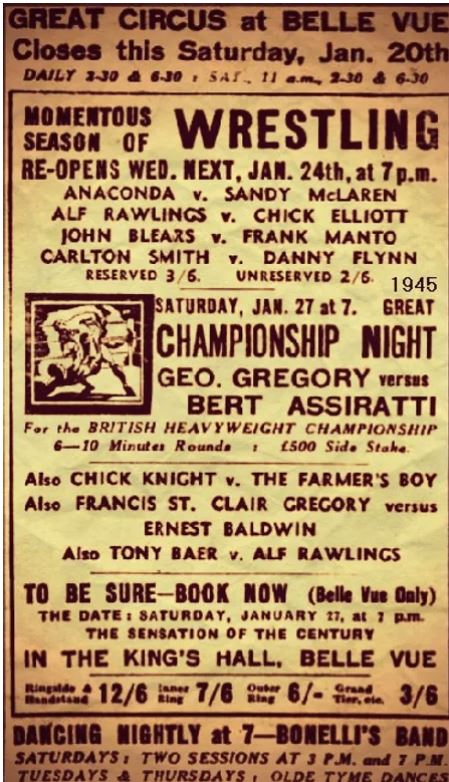
1945 began with one of the big matches of the year. On 27th January George Gregory defended the British heavyweight championship he had claimed since May, 1941. The challenger was another erstwhile champion claimant, the formidable Bert Assirati.
There was no doubt that Gregory had the backing of the partisan crowd that packed into Belle Vue, Manchester. The match was over six ten minute rounds, and opinion was that Gregory had only himself to blame for losing the title.
Assirati had taken the first fall in the fourth round in quite sensational style. As Gregory charged towards him Assirati sidestepped, only to catch Gregory as he rebounded off the ropes and take the fall with a folding body press.
In the final round Gregory inflicted immense punishment on Assirati, who was dazed for much of the round. The crowd urged Bob on to attempt a fall but he preferred to hold Assirati in a leg hold and go for a submission. Assirati resisted and the bell that rang to save him indicated the crowning of a new champion.
Assirati travelled widely following his championship success, making successful defences against both Bob McDonald and Jim Anderson at Dundee in March and May respectively.
Reports are that McDonald proved a worthy, if unsuccessful challenger, “Assirati was in difficulties during the early stages, the Scotsman gaining a fall in the second round, but the champion fought back to equalise in the third with the Boston Crab, and went off to finish his opponent with the same hold in the next round.”
Alf Lagergren, the Scottish heavyweight who was serving as a Lieutenant in the 6th Airborne Division of the R.A.F., was killed in action. A wrestler in Britain, Sweden and France Alf had volunteered for the R.A.F. shortly after the outbreak of war and had been attached to the Wiltshire Regiment before being posted to the Airborne Division.
Following the surrender of Germany on 7th May and declaration of victory in Europe on 8th May Belle Vue promoters made capital of the events with “Four Dynamic Victory Bouts” on 16th May, and more “Victory contests” three days later. The theme continued with three more wrestling presentations during the next week.
Mick McManus and Jimmy Rudd were serving in the Royal Air Force as and the pair of them put on numerous wrestling exhibitions around the country. Posted to Australia in 1945 there are unsubstantiated reports that Mick asked the promoter at the Leichardt Stadium in Sydney for a trial, resulting in his Australian professional debut against a wrestler called Tommy Steele.
Throughout the 1930s the more astute wrestling promoters had cunningly out-manoeuvred some of the more hostile local councils be re-packaging the sport and branding the dishonoured “All In” name as Freestyle. Such was the case yet again in March,1945, in Nottingham where the public baths and washouse committee state that tenders for the use of the Baths would not permit All In Wrestling. No sooner was the decree announced that a licence was granted for “Free Style Wrestling” in aid of the prisoners of war fund.
Hostilities in Europe ended in May, 1945. Maybe word had not reached the wrestling fans at the Caird Hall, Dundee, by 4th September when Relwyskow Promotions presented their opening show of the 1945-6 season. The Chief Constable complained by letter to the Police Committee of Dundee Town Council following a disturbance in which fans threw objects and rushed the ring. The cause of the disturbance were the tactics of Jack Pye in his match with Sandy McLaren, in which Pye was disqualified in the fifth round. It was unanimously agreed that the Town Clerk should write to Relwyskow Promotions expressing the council’s opinion that Pye should not appear in the hall again.
 Wrestling Heritage