
Wrestling Heritage welcomes memories, further information and corrections.

1947 and the impact of war endured; food rationing remained in Britain, peace treaties were signed between Italy, Hungary, Romania, Bulgaria, and Finland, and the Voice of America began transmitting to Eastern Europe. The Labour Government continued it’s social and economic reform programme with the nationalisation of British coal mines. At least the weather gave the people something to talk about. It was the winter of the big freeze. Intensely cold conditions affected much of the country in the final week of January with temperatures reaching as low as -21 centigrade. Snow fell in some places on twenty-six consecutive days, with even the Isles of Scilly having a covering of an extraordinary 18 centimetres. Not too cold for love to flourish, with the marriage of Princess Elizabeth to Lieutenant Philip Mountbatten.
Wrestling too was moving on from the wartime years. The British Wrestling Board of Control, formed at the end of 1946 with the intention of devising a new set of rules and recognising British champions had completed it’s work and The London Gazette of 16th May, 1947 announced that the British Wrestling Board of Control Limited was to be struck off the Companies Register and dissolved.
Some months earlier, on January 10th, the recently formed Board of Control had arranged a meeting with wrestling promoters, who were said to represent business interests in all the major cities. Maurice Webb, MP for Bradford, chaired the meeting at which promoters were introduced to the new Lord Mountevans Rules and weight divisions.
Whilst the Board of Control and new rules promised to clean up wrestling it was still a challenge in some towns for promoters to find acceptability amongst local councils. Promoter George DeRelwyskow had established a good reputation but still had his application to promote fortnightly wrestling and occasional boxing shows turned down by Perth Town Council. In March the Leeds City Council forbade All In Wrestling but allowed George DeRelwyskow and Jack Green to promote wrestling with the proviso, “wrestling should be restricted to orthodox styles and that nothing in the nature of all in wrestling in any shape or form be permitted.” On July 1st wrestling returned to Chelmsford under the guidance of promoter Percy Felton.
One event even captured the imagination of the national press, a rarity since the early days of the 1930s. It was the world title tournament held at the Harringay Stadium, London, though one newspaper did point out that there were already sixteen world title claimants, and no they were not named. The date was 18th February, 1947, and sixteen of the top wrestlers in Europe.
From the UK were Cornwall’s Francis St Clair Gregory, Welshman Bill Garnon, Northerner Jim Foy, Bert Mansfield, Eastern England’s Clem Lawrence, and the UK based Trinadian Phil Siki. Also taking part were Estonian Martin Butch, Belgian Gaston Ghevaert, Greek Milo Popocopolis, Canadian Carl van Wurden, Frenchman Ivan Martinson, and pre war stalwarts Carl Reginsky, Karl Manooign, Abdul the Turk and Issy Van Dutz,
First round results saw single fall wins for Gregory over Butch, Ghevaert over Foy, Arrirati over Van Wurden, Manoogian over Van Dutz, Mansfield over Abdul, Reginski over Lawrence, Martinsen over Siki and a win by the disqualification route for Popocopolis over Garnon
In the second round Ghaevart took the only fall over Gregory, Assirati overcame Popocopolis, Mansfield stopped Manoogian and Reginsky was disqualified against Martinsen.
Wins for Assirati and Martinsen over Ghevaert and Mansfield took the two of them through to the final and championship contest.
The final of the tournament, for a version of the World heavyweight championship was not held until 4th March. Seven thousand fans filled Harirngay Stadium to see Britain’s heavyweight champion Assirati dispose of Ivar Martinsen in just six minutes. Assirati’s clasp of the world crown lasted just seven months. Martinsen won the return contest in Paris on 13th October.
One man who benefited from the heavyweight tournament despite not taking part was Scotland’s George Clark. When Assirati withdrew from a European heavyweight title clash with champion Albert Van De Auwera due to the Harringay tournament Clark was brought in to challenge for the title at Dundee. Clark took the opening fall in the fourth round with a Boston Crab submission. It looked like a Clark win until Auwera equalised in the last of the six ten minute rounds.
Bert Assirati claimed he could defeat any boxer within three minutes. In February newspapers reported his challenge had been accepted by a former cruiserweight boxer Jack Crosby. Disappointingly the match took place in private at a London gymnasium and there were no reports of the outcome if the match did take place.
The main challengers to Assirati in 1947 were the former champion and now veteran of the ring Bulldog Bill Garnon, Dave Armstrong, Vic Hessle, Francis St Clair Gregory, Bert Mansfield and The Farmer. Claiming to be the uncrowned king of the Mat was the former miner, Jack Pye. Pye enraged fans with his tactics and was commonly thought to be Britain’s dirtiest wrestler.
The Angel Maurice Tillett returned to Britain with the Evening Telegraph declaring “He’s No Angel” as he outmatched George Clark in strength at Aberdeen. Clark was forced to submit when clasped in a bear hug, but was consequently disqualified for refusing to break the hold. When the Angel faced Abdul the Turk in November at Dundee newspapers reported that more than 1,000 fans were turned away when the hall was full. Abdul was disqualified in the third round for punching.
The tournament raised funds for the Limbless ExServicemen’s Fund/
Wrestling continued it’s tradition of supporting good causes. Beneficiaries included the RAF Benevolent fund, in receipt of £125 from a tournament in Redruth, the School Children’s Holiday Fund in Dundee, the Third Derbyshire Cadet Batatalion Welfare Fund, Derby West End Boys Club, The Hamilton Cross Club war Comforts Fund, Northumberland Aged Miners Homes Association, and Chelmsford City Supporters Club.
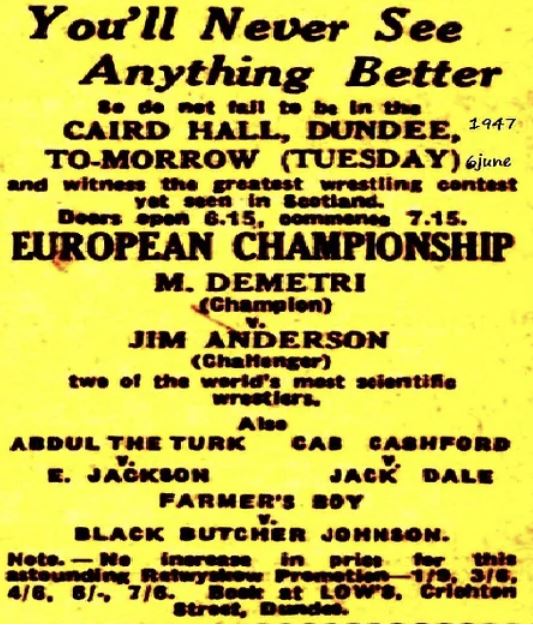
Local boy Jim Anderson faced European Cruiserweight Champion Mike Demitre at the Caird Hall, Dundee on 10th June. Anderson had already held the champion to a draw. In a sixty minute contest it was said Anderson proved a tricky customer but the result was once again a draw with Demitre retaining the title. A return championship match was arranged for 30th September, again at the Caird Hall. This was even more of a marathon, with a scheduled duration of ninety minutes, no rounds and a two minute break between falls. Kilt wearing Anderson, the crowds favourite, was piped into the ring. Demitre took the first submission after 46 minutes. Following the two minute rest wrestling resumed and it wasn’t until the 74th minute that Anderson equalised. The Scot was the more aggressive and looked a likely winner as the match edged towards the 90 minute bell. The end came as decisively as it was quick. In the 81st minute Anderson hoisted Demitre onto his shoulders, but the champion wriggled free and jerked Anderson out of the ring. Anderson fell awkwardly and failed to beat the count.
Another rare mention of wrestling in the national press, but for the wrong reasons. In October the front page of the Daily Mail reported that wrestling promoter James Angus had been fined £50 after pleading guilty for evading full payment of the entertainments tax.
Joining the Black Angel, Red Devil, Green Asp, White Owl and The Ghoul amongst the ranks of the masked men was Count Bartelli. We were not to discover his identity for another nineteen years. Geoffrey Condliffe had started wrestling, under the name of Jeff Conda shortly before the outbreak of war. On his return from war service in the Far East he took to wearing a mask, though in 1947 still occasionally wrestled as Jeff Conda.
The mystery surrounding a masked wrestler is usually concerned with his identity, the tradition being that he would unmask if beaten. The Black Angel began to appear around the country in 1945. It is widely believed he was unmasked at Newcastle on 15th November, 1947, to reveal the face of Welshman Sandy Orford. Whilst we have no reason to doubt this assertion, supported in the Archie Potts book that documents wrestling at the Newcastle St James Hall, Headlocks and Handbags, we can find no primary evidence. That aside we are pretty confident it did happen, but the real mystery is why? The match, Black Angel versus local by Dave Armstrong was unheralded. It wasn’t even main event, that place being taken by British Champion Bert Assirati and Chick Knight. Black Angel wrestled Dave Armstrong and the match ended in a draw. Black Angel voluntarily unmasked. Why? He hadn’t lost. Why had promoter Norman Morrell not promoted it as a high profile match following which the Black Angel would voluntarily reveal his identity? Another mystery of wrestling. Potts claims that it was to enable Sandy Orford to wrestle for the Welsh title. Yet Sandy had been simultaneously wrestling unmasked under his own name and defeating all the top heavyweights; he was already an established contender. Wrestling does move in mysterious ways.
To remain masked for many more years was another hooded terror gaining a huge reputation in the North and Midlands, The Ghoul. The Ghoul and Bartelli, were to be the leading masked men of the 1940s and 1950s. The Ghoul’s fearsome finishing move, “the guillotine garrotte,” which was a sort of rabbit punch, brought an end to many contests. With the sort of drama only seen in the wrestling ring the Ghoul would miraculously use the same blow once again to reinvigorate the opponent who had only minutes earlier been considered near death.
The year ended with wrestling promoters continuing to expand their business, consolidating the new found successes of post war activity, continuing to improve the image of the sport, and build the foundations of their post war success. Meanwhile, December saw strikes and riots in France, a new constitution in Italy and the enforced abdication of King Michael of Romania.
 Wrestling Heritage