
Wrestling Heritage welcomes memories, further information and corrections.

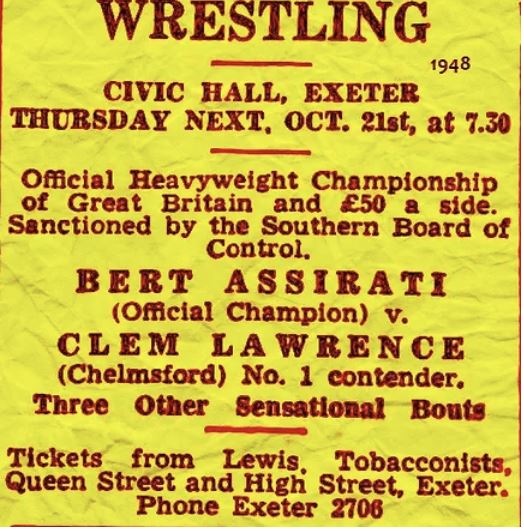
1948 and the post war malaise was deepening with no end in sight. The optimism of a world at peace and the election of a post war Labour Government was beginning to fade as rationing continued and unemployment continued to bite.
Mahatma Gandhi was murdered and the Soviet blockade began.
With only around 14,000 television sets and one channel broadcasting a few hours a day the British public didn’t even have the enjoyment of complaining about the television.
On a brighter note the railways were nationalised, the National Health Service got off to a shaky start, and the Olympic Games came to London. The so-called ‘Austerity Games’ were the first since Berlin in 1936 and took place whilst rationing was still in force in Britain. With 59 nations competing both Germany and Japan were excluded.
In July the Olympic Games raised the spirit of many Londoners. Amongst participants later gain fame in the wrestling ring were a young weightlifter named Harold Sakata (The Great Togo) and a Spanish boxer by the name of Vincente Castilla (Quasimodo). The Canadian Olympic wrestling team included Montreal’s Maurice Vachone, and the Americans Verne Gagne, Danny Hodge and Dick Hutton, along with Henri Deglane (France) and Axel Cadier (Sweden).
The new style of wrestling, the Lord Mountevans style, was changing the image of wrestling and drawing back fans who had dwindled away during wartime. Weekly, fortnightly or monthly wrestling shows were becoming part of the routine entertainment for enthusiasts around the country alongside going to the cinema and dancing. One paying customer did get more than he bargained for. The Arbroath Herald reported someone buying a ticket for the Caird Hall, Dundee and entered the hall to find it wasn’t the concert he thought he was going to listen to but a wrestling show. Mind you, it was a good week to make the mistake. At least he saw Mike Demitre defending his European Cruiserweight belt against Scotland’s Jim Anderson, and Jack Pye was on the bill too.
Fans were increasing in numbers but it remained an uphill task for promoters to convince town councils that wrestling was a respectable form of entertainment. Debate continued about whether or not wrestling’s violence was real or an illusion, sport or spectacle, pre-arranged or competitive.
Kirkcaldy Council granted a license for professional wrestling on the grounds that it was neither All-In or Freestyle. Councillor John Kay asked what type of wrestling there was other than All-In or Freestyle? The query remained unresolved but permission was granted when the Chief Constable, said to be an authority on such matters, gave assurance that nothing objectionable would take place.
The Mayor of Eastbourne sounded embarrassed by the sports success, which he hoped would be short lived. His comments were heard when it was revealed that Eastbourne, whilst claiming to be more select than nearby Brighton, made most money from professional wrestling at the Winter Gardens!
Bury St Edmunds Council turned down an application to stage wrestling on the grounds that no suitable hall was available in the town.
The formation of Joint Promotions was still a few years away, but the promoters who were to come together in this wrestling alliance were already the most successful promoters in the country and exerting their influence by using contracts that required wrestlers to work exclusively for them.
Atholl Oakeley, amongst others, continued to try and revive the pre war style, but to no avail. Not for him the new fangled Lord Mountevans Rules. His wrestlers wrestled according to his “International Catch as Catch Can” rules that had been introduced to Britain by Irslinger and Oakeley in 1930. Three ringside judges decided matches that ended without a deciding fall, a count of twenty was allowed for a wrestler ejected from the ring, and championship tournaments were open to all comers.
Fans wanted something new, something faster and more fashionable and, probably the most important of all, something believable.
Some wrestlers worked both old and new style rules, for Oakeley and the promoters of the new Mountevans style. Oakeley persevered with the promotion of impressive tournament in huge venues, such as Earls Court.and Harirngay Arena. Oakely staged a seven bout bill at Earls Court in November, 1948. Main event was billed as a European Heavyweight Championship contest between Mile Brendel and Milo Popocopolis .Others taking part in the seven bout all heavyweight tournament included Estonian Martin Bucht, Con Balassis, Bert Mansfield, Frank Manto, Jim Hussey, Tiger DeLisle, Bob Robinson, and Man Mountain Bill Benny.
As 3,000 fans gathered at Blackpool Tower on Monday February 16th to watch their weekly wrestling tournament they may well have thought it was to be just another night at the wrestling. Far from it. Two hundred feet above them firemen were fighting a fire that broke out on wooden scaffolding used for maintenance of the Tower.
Boxing turned wrestling promoter Frank Woodhouse of Derby raised £2,000 for Derby Borough War Memorial Fund with the promotion of ten wrestling shows. The Altrincham Charities Entertainments Society announced in May that the shows they had presented had raised more than £1,250 for local charities. In May a wrestling show was held at Leeds Town Hall in aid of the United Nations Children’s Appeal Fund. The Lord Mayor of Leeds received the wrestlers at the Civic Hall in the morning and attended the wrestling event in the evening.
Most wrestling shows consisted of four contests, occasionally five, with a duration of five or six ten minute rounds. Without any form of regulation champions could be named at the whim of a promoter, though there were individuals at each weight widely acknowledged as the best.
Jack Dempsey was kingpin of the lightweights with George Kidd and Joe Reid giving him a run for his money. Jack Dale seemed unassailable amongst the middleweights. Bill McDonald claimed supremity amongst the light heavies, though Lancastrian Jack Beaumont was another claimant of the crown. There was no doubt at all about the Heavyweight championship. Although the heavyweight division was the most fiercely contested there was one man who stood, figuratively speaking, head and soldiers above the rest. That man was, of course, Bert Assirati. Standing only 5’6” tall Bert was as wide as a tank and powerful as the proverbial ox. Fans winced and shared the pain when Bert punished his opponent with one of his Boston Crabs. No one doubted Assirati’s superiority.
Overseas visitors included a Canadian heavyweight, Bob “Legs “ Langevin, who claimed to invent the flying body scissors move. Also coming to our shores for a long stay was American college boy, Dean Rockwell. Pat Curry went into his second year in British rings. Former ice hockey player Canadian Roy McClarty made a good impression and managed to get Robert McDonald to submit twice.
Promoters Ted Beresford, Norman Morrell, Jack Atherton and Jack Dale, continued to combine successful wrestling careers with their developing promotional business.
Heavyweights continued to reign supreme. Bert Assirati, Jack Pye, Dave Armstrong, Vic Hessle and the like were the dominant force in every sense of the word. There were signs of change, though. A young lightweight by the name George Kidd was beginning to make an impression, and others from outside the heavyweight rankings that were gaining a following included Alan Colbeck, Jim Mellor, Johnny Summers, Jack Dale, Jack Dempsey, and Val Cerino.
The experience they were gaining was to serve most of them well a few years later when television came along to transform the professional wrestling landscape some seven years later.
By the end of 1948 British wrestling was well on its way to becoming firmly established as a mainstream spectator sport. On the world political scene things were not so promising. Disagreements about post war Germany, communist governments established throughout eastern Europe, American aid to countries in the west and tough speaking from politicians on all sides meant that by the end of 1948 the “cold war” was well and truly established.
 Wrestling Heritage