
Wrestling Heritage welcomes memories, further information and corrections.

1949 brought more signs of the recovery from war with the ending of clothes rationing.
For many people progress remained pitifully slow and there was resentment against the continuation of food rationing. There were positive changes, though, and 1949 brought the first full year of the National Health Service, with 97% of the population having enrolled by January 1st. Elsewhere in the world new nations were coming into existence, and 1949 saw the birth of the Republic of Ireland, Federal Republic and Democratic Republic of Germany, as well as the People’s Republic of China.
For wrestling fans the world was a far more colourful and optimistic place. The progress of the early post war years was not just consolidated but gained pace. New venues were continuing to open up with three big cities, Glasgow, Bristol and Bath staging wrestling events for the first time following the war. Numerous wrestling promotions took place six nights of the week throughout the country. The press were commenting on the number of women who attended the shows with enthusiasm, whilst one complained that it was not a suitable place to take children. One woman dismissed the violence because wrestlers were only trying to pin their opponents shoulders to the mat whilst in boxing the protagonists aimed to knock each other cold. A fair point madam.
The wrestling bills of the 1949 were beginning to have look that would be familiar to those who would begin enjoying the sport in the 1960s. Four matches were the norm, each over five or ten minute rounds, and with many names that we would to continue to enjoy twenty years later: Mick McManus, Mike Marino, Jim Hussey, Jack Dempsey, Alan Colbeck, George Kidd, Les Kellett, Eddie Capelli, Chic Purvey, Alf Cadman, Cyril Knowles, Dennis Mitchell, Johnny Kwango, Don Stedman, Bernard Murray, Billy Joyce, Count Bartelli. They built them to last in those days.
Mind you, some of the labels accompanying those wrestlers were not the ones the fans of the 1960s would have associated with them. Jack Dempsey being “The fastest lightweight in Britain,” Mick McManus “The speed wizard,” Johnny Kwango “With a magnificent physique,” and the “future heavyweight champion” Jim Hussey. Incidentally, as early as 1949 Jumping Jim was billed as Northern heavyweight champion, wherever that came from. It was to remain an apparently mythical belt that he would take to his grave.
It wasn’t just the wrestlers that had a familiar look. Whilst the birth of Joint Promotions formally remained three years away all the names associated with the group were already established as the country’s leading promoters: Wryton Promotions (”The World’s largest promoters”) Dale Martin (“Britain’s leading promoters”), Norman Morrell, Relwyskow Promotions, Ted Beresford (Globe Promotions) and Billy Best.
These men had already realised the value of co-operation and begun an association that for almost thirty years displayed a public face of harmony to mask any private disagreements. In March, 1949, they formed the British Wrestling Promoters Association. Secretary of the group was Norman Morrell. The BWPA prohibited the wrestlers under contract to work for any other promoters within a ten mile radius of any town in which they operated.
Some promoters, such as Alex Bannerman in Aberdeen, protested that the new association could put him out of business. Protests were futile and the BWPA members were eventually to secure their supremacy with the formation of Joint Promotions.
The growing popularity of professional wrestling was demonstrated in October when boxing promoter Arthur Green announce that he was considering stopping promoting boxing at Leeds Town Hall. Green said that boxing was only half filling the hall, which held 1,800, whilst wrestling was attracting full houses. Arthur Green said he would continue to promote wrestling in the city.
The growing acceptance of wrestling by local councils was largely due to the promoters’ continued attempt to re-brand the product. The dropping of the name of All-In had already begun in the 1930s, and by 1949 was almost unheard. Wrestler and promoter Leo Lightbody told the press that professional wrestling was now “Free Style Wrestling,” and was a long way removed from the old All-In days. Chelmsford promoter Percy Felton said, “Wrestling had such a bad reputation before the war, but now it has been largely cleaned up.” The Glasgow Herald reported that city magistrates had attended the first post war show to observe whether or not this was “the popular family sport” promised by the promoter. Whilst the observers may have been reminded of the All-In days it was concluded that the real suffering was concentrated on those too far away to observe what was going on.
Regular weekly, fortnightly or monthly shows, familiar names, credible claims and family friendly shows with the certainty it would all be over in time to catch the last bus home proved a successful formula for the BWPA. It was not one shared by everyone. Atholl Oakeley continued to try and revive his pre war success. Not for him the new fangled Lord Mountevans Rules. His wrestlers wrestled according to his “International Catch as Catch Can” rules that had been introduced to Britain by Irslinger and Oakeley in 1930. His shows were not run of the mill affairs staged weekly, fortnightly or monthly at low prices. They were lavish affairs with lavish claims made for his colourful characters and imported giants.
It was an uphill struggle, and his Harringay tournament of 29th November was dealt a blow when, at the last minute, the 31 stone Russian champion, Ivanov Georgiv, was refused permission to leave the Russian zone of Berlin. His place was taken by Irish champion Mick Casey, but the promoter lost money by offering refunds to those who wanted them.
The Daily Mirror’s appraisal of the show was more brutal than anything seen in the ring, saying that not even music hall comics could raise such a laugh and concluding that “If only the Reds had this control over all the wrestlers in the grunt and groan trade Britain would be better off.”
Despite the Russian’s absence there was no shortage of overseas wrestlers making their appearances in British rings.
Canadians Carl van Wurden and Pat Curry had been here for almost long enough to be called local boys. Another North American, Chicago light heavyweight and former University of Michigan champion, Dean Rockwell was here for a second year. By the time he came to Britain Rockwell was an American world war two hero. He was a veteran of such distinction that at the 50th anniversary of D-Day in 1994, he was chosen to introduce the American President, Bill Clinton.
Two classy Belgian heavyweights were impressing fans. Belgian Heavyweight Champion, Bert Auwera had a number of memorable bouts with the great Bert Asirati. Martin Deneef was bigger and more powerful standing 6’3” tall and weighing in around the 17 stone mark. Estonian Martin Bucht (Padvo Peltonin) was continuing to pop up in British rings as he had done since the 1930s.
Three newcomers from New Zealand came to Britain in 1949. Bob Russell, Ray Clarke and Russ Bishop had heard from fellow New Zealander Ernie Kingston about the flourishing British wrestling business. Kingston had stayed in Britain following the war and by the end of the decade was a popular and regular fixture on the British circuit.
Ray Clarke left behind his New Zealand farm and quickly established himself as a major heavyweight, tackling the likes of Jack Pye, Bert Assirati and Ray St Bernard. For Russ Bishop it wasn’t just the magnificent physique, or the hairy chest, but the superb wrestling ability that made the middleweight from Auckland such a popular wrestler.
Kiwi number three was Maori Bob Russell. Although popular with fans he didn’t make the initial impact of the other two before changing his name to Prince Banu, which seemed to do the trick. Another southern hemisphere newcomer to Britain in 1949 was an Australian going by the name of Frank Hurley. Hurley remained a regular British worker for the next two decades, frequently leaving for North America, Australia and Europe, but always returning to Britain.
Amongst the domestic wrestlers finding success none was greater than a youngster from Dundee, George Kidd. In 1949 Kidd was crowned World lightweight champion. He came back from a fall down in the fifth round to defeat Mexican Rudi Quarez, who retired with a back injury in the tenth round. Wining the World title wasn’t the only great day for George in 1949.Five months earlier he had married Hester Maclauchlan. Amongst the guests were wrestlers Norman Walsh, Les Kellett and Chic Purvey.
There was a significant event in the life of another man who was to become a significant figure in British wrestling. Kent Walton, who would become the voice of television wrestling, married Lyn Smith.
One youngster destined to make a name for himself quite a few years later came to public attention much sooner than he would have hoped. The Yorkshire Post reported that 13 year old James Rawlings, son of wrestler Alf, had fallen 15 feet from a tree and was being treated in Leeds General Infirmary.
Masked men were familiar, particularly in the north of England, the best amongst them being Count Bartelli and The Ghoul. One masked man reached the end of the road. Mike Demitre beat The Red Shadow at Peterborough on 28th December and revealed the familiar face of Australian globetrotter Con Balassis. Greater success came the way of another masked man who would later become known to British fans. On July 7th The Zebra Kid defeated Buddy Rogers to take the Ohio version of the World Heavyweight Championship.
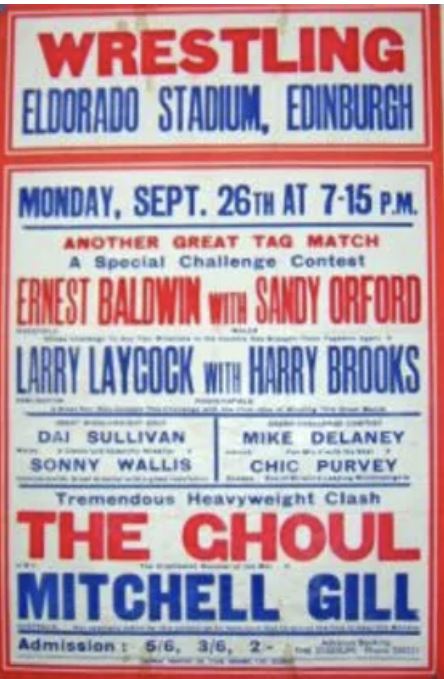
Tag Team wrestling came to Britain in 1949, not to be confused with the Team wrestling that had preceded it.. Ron Historyo has put forward a match on January 24th as the earliest reference with a challenge to find an earlier one. We haven’t, but we did discover a programme that usefully explained the new form of wrestling: “Only one member from each team will oppose each other at a time, the partners remaining in their own corners, Should either of the contestants require a relief during the bout, he must fight his way to his partner in his corner and shake his hand. The hand shake must be done over the top rope and his partner must be hold of the tag.”
Readers of this series may recall that in 1935 questions had been raised in Parliament about the legality of wrestling on Sundays with a number of individuals prosecuted in the years that followed. Well, the issue raised it’s head once again in 1949. The Lord’s Day Observance Society took exception to Jerry Jeary’s plans to put on Sunday wrestling shows in Erdington, Birminghm. The promoter was reported to have commented, “About a third of our Sunday morning crowds of 700 to 800 are women. And there’s never a word of bad language. I assure you, you can bring your grandmother. We start after church time and I resent interference.”
God may well move in mysterious ways, but we feel the almighty had a soft spot for our sport. Slowly but surely professional wrestling had started to emerge from the wartime doldrums. Promoters had established which were the successful venues and dropped the ones that had failed to attract crowds. The sport was beginning to attract youngsters to join, and later replace, the established stars. Most importantly of all, a handful of promoters had realized that success of tomorrow would require co-operation today.
 Wrestling Heritage