
Wrestling Heritage welcomes memories, further information and corrections.

Those who have travelled on the Talyllyn steam railway may well be be surprised to learn that volunteers ran the first passenger train on the line over sixty years ago, on May 14th, 1951. Those who haven’t travelled on it will probably be asking, where? As the preserved railway got underway the Labour Party ran out of steam and Winston Churchill was again elected Prime Minister in October of the year. An eighteen year old was fined in Stockholm for kissing in public! Making a debut was “I Love Lucy” on American television.
Debuts were also being made on the wrestling scene. A Yorkshireman always associated with London was Peter Rann. His hard, aggressive style made fans turn up to see him lose. Peter Rann was to become the ultimate professional, and he was taking his first tentative steps in 1951. Another wrestler joining the professional ranks in 1951 was Yorkshire through and through. Farmer Johnny Allan was to go on and become one of the big names in the mid heavyweight ranks. In 1951 his thoughts were mainly on his farm, but not for long.
Professional wrestling was continuing the post war process of establishing itself as a respectable spectator sport, with former wrestlers Norman Morrell, George DeRelwyskow, Ted Beresford and Jack Dale, along with Mancunian business man Arthur Wright, leading the way and promoting good quality shows around the country. Although the formation of Joint Promotions was a year away, these men had formed the British Wrestling Promoters Association a couple of years earlier, and some of the practices we were to associate with Joint Promotions were already being pursued, including the prohibition of wrestlers from working within a ten mile radius of any of the halls at which they promoted.
It wasn’t all plain sailing for the post war promoters; there was still prejudice against the sport in some quarters. The Deputy Mayor of Cambridge described wrestling as “A disgusting spectacle,” with Councillor Ridgeon adding that he could not think of “a more sadistic or degrading entertainment.” Cambridge council rejected a proposal to stage wrestling at the Corn Exchange.
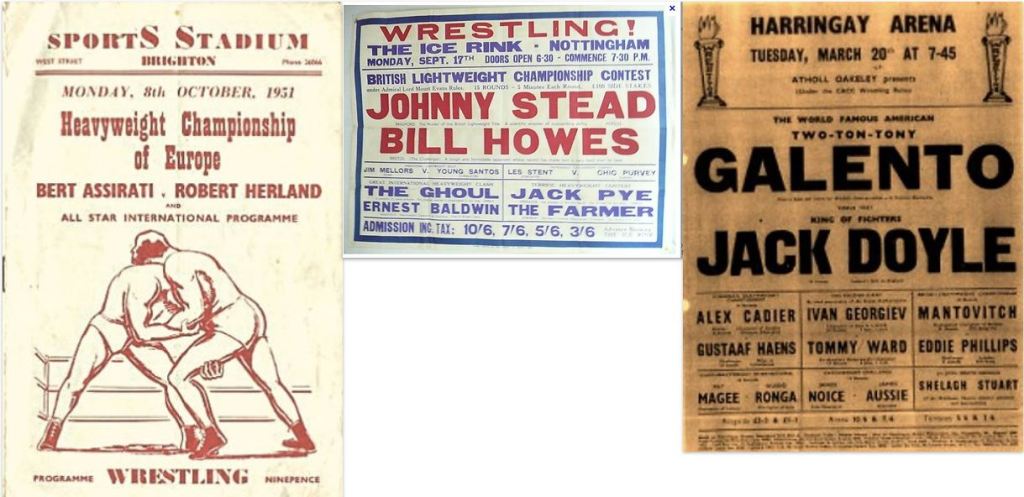
A fierce rival of the BWPA promoters was Atholl Oakeley, still promoting shows (and acting as matchmaker for others) under his Twentieth Century Catch as Catch Can Association. He persevered with big name shows at the Harringay Arena, where he continued trying to make a wrestler out of former boxer the Gorgeous Gael, Jack Doyle. Doyle’s charisma was not matched with his wrestling ability and Oakeley’s colourful shows struggled to live up to the hype created by the irrepressible impresario.
In March former boxer Two Ton Tony Galento arrived in London, brought over by Oakeley to face Doyle. The American was destined to topple the Irishman when they met at Harringay on 21st March.
In May, 1951, Oakeley brought to Britain the German heavyweight, Kurt Zehe, to face Doyle. Zehe was known as Gargantua, due to his enormous stature, which was claimed to be 8’4” tall and a weight of some 50 stones. The match was a huge anti-climax and did nothing to establish Oakley as a post war promoter.
In October Oakeley brought to Britain another world heavyweight champion boxer, Primo Carnera, to face ex Empire boxing champion Larry Gains, who was making his wrestling debut. In May, 1932, 80,000 spectators had witnessed Gains outpoint Carnera at London’s White City. Now aged 50 and 45 respectively, Gains v Carnera was not a pretty sight, with fans reported slow hand-clapping during every round. When both men fell from the ring it was one fall each. It was Carnera that climbed back in to the ring to be awarded victory, with Gains transported to hospital.
Meanwhile the BWPA and others continued to build the foundations of post war wrestling development. Their shows may have been less spectacular than the Oakeley shows, but the presentation of more low key events with a mixture of pre war veterans, new faces and overseas visitors, four or five matches with a variety of styles and an identifiable set of rules was more sustainable and was to prove successful for forty years.
On 29th May, 1951 an explosion at Easington Colliery in County Durham entombed 81 miners, with the further deaths of two rescuers bringing the toll to 83. Collections at boxing and wrestling events in the North East contributed to the disaster fund for the families of the victims.
There was sadness in February, with the death of Douglas Clark at his home in Huddersfield, aged 59 years. Douglas Clark was a legend of the 1930s, a Huddersfield and England Rugby League Forward, Cumberland and Westmorland wrestling champion and British heavyweight All-In wrestling champion. Named by Wrestling Heritage as the Top Wrestler of the 1930s Douglas Clark was virtually unbeatable by any British wrestler and dropped decisions to only the best overseas wrestlers as he neared the end of his career. Douglas Clark died on 1st February, survived by his widow, Jennie.
More sadness with the death of a joiner, William Ratcliffe, who collapsed at a wrestling show in Keighley after witnessing a win by his wrestling son Jack Ratcliffe.
1951 also saw the death of another influential man in British wrestling, albeit of a different age and in a different role. On 31st January Charles Blake Cochran, usually known as C.B., the theatrical producer, showman and one time manager of Georges Hackenschmidt, died at the age of 78. He had been admitted to hospital a week earlier after being scalded in his bath.
The Mountevans style of wrestling, just four years in existence, had swept the country and had played a major part in repairing the pre-war damage caused by extreme violence, gimmicks and a lack of professionalism. Wrestling was almost ready for the big time once again. Promoters were working together for the good of the business and within a year the single biggest step towards post war success would have been taken.
 Wrestling Heritage