
Wrestling Heritage welcomes memories, further information and corrections.

1952 witnessed the emergence of a new Queen in the United Kingdom. The death of George VI in February brought Queen Elizabeth II to the throne, though her coronation was not to be until June 2nd of the following year. A man who was to gain greater influence in his second career was married when actor Ronald Reagan tied the knot with Nancy Davis. In November the first official passenger flight flew over the North Pole on the way from Los Angeles to Copenhagen. Albert Schweitzer received the Nobel Peace Prize. Tragedy in the UK resulted in an estimated 4,000 deaths as a result of a smog, lasting six days, that covered London in early September.
The cataclysmic event of 1952 in the wrestling world was the formation of Joint Promotions. The decision of a group of promoters to work co-operatively was destined to transform the wrestling business. Whether or not Joint Promotions were to become a force of good that transformed the business into a legitimate sporting entertainment, or whether they were a cartel that stifled development and exploited wrestlers is still debated by wrestling fans. That their decision was to change the face of professional wrestling as we knew it is beyond doubt.
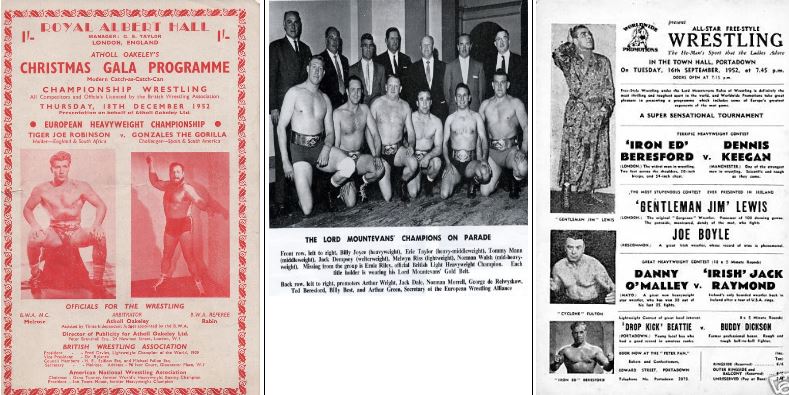
Dale Martin Promotions, Norman Morrrell, Ted Beresford, Bill Best, Jack Atherton, Arthur Wright, George de Relwyskow and Arthur Green carved the country into their own individual territories and tied wrestlers to contracts which required them to work exclusively for their members known as Joint Promotions.
Readers may recall the breakdown in relations between the Wrestling Federation of Great Britain and the British Wrestling Promoters Association in 1950. With many of the BWPA members now having formed Joint Promotions relations between the new group and the WFGB remained sour. Nowhere was this more apparent than in Aberdeen where WFGB Promoter Alex Bannerman had complained Joint Promotions member George DeRelwyskow was trying to destroy his business. The result was that on Monday night fans could pack the Music Hall and watch a Bannerman show and then, finances permitting, return the following night for a Relwyskow show.
Although dominant until the 1980s Joint Promotions were never without challengers, and one young man who would go on to challenge their promotional seriority had arrived in Britain and was working for them. An outdoor show at the Knowle Stadium, Bristol, brought together two men who would remain rivals for over a decade. One of them was Jack Dale, a master wrestler, and part owner of Dale Martin Promotions. The other was a young Australian making his British debut and going by the name of Paul Lincoln. Ten years later the two were destined to become business rivals as the Australian built up Paul Lincoln Management to challenge the might of Dale Martin and the Joint Promotions organisation. On that summer day in Bristol Dale won by a KO.
1930s wrestler Sam Rabin, who had used his wrestling proceeds to pay for his study of art, had twelve pencil drawings exhibited in a Bond Street Gallery. The subject was sport. One sport in fact. Not wrestling but boxing.
Wrestling tournaments, along with other entertainments, were cancelled in February as the nation mourned the death of King George VI.
Johnny Stead took the lightweight title with a win over Jackie Harris at Huddersfield in February. One of his top challengers was the Scot, George Kidd. Kidd challenged Stead at Newcastle in September, 1952, but the bout ended unsatisfactorily when the Scot was injured. A hastily arranged return contest two weeks later saw Kidd do no better than hold the champion to a draw, and so the year ended with Stead still the champion.
Alan Colbeck took the welterweight crown in May, 1952, but his reign lasted only a few months and he lost it to Tony Lawrence at Newcastle in November. Tommy Mann was crowned middleweight champion when he defeated Jack Dale, but again his reign ended within months and the year ended with Yorkshireman Harry Field wearing the belt.
Dennis Mitchell ruled the light heavyweight division, and kept himself busy with defences against Jim Anderson, Les Kellett, and Alf Cadman.
In the heavyweight division Ernie Baldwin was crowned Heavyweight champion when he defeated Dave Armstrong at NewcastleA string of challengers throughout 1952 included Pat O’Reilly, The Farmer, Norman Walsh and a promising newcomer weighing in at close on twenty stones, Derek Oldham.
The powerful Trinadian heavyweight, Ray Apollon, who was to go on to become one of the great post war heavyweights, arrived in the UK in December, 1952, just six months after turning professional. From that UK debut against Ernie Baldwin he was to blossom into one of the most powerful and skilful heavyweights on the British scene. Other overseas visitors included French heavyweight Pierre Boss, Turkey’s Mustapha Labriola, and Americans Pat Curry and Dean Rockwell.
Another wrestler starting out on a long career was a Yorkshireman called Shirley Crabtree, later to transform himself into the legendary Big Daddy. Bolton’s Bert Royal, still a novice, gained one of his best wins to date when he overcame Alan Colbeck.
Masked wrestlers continued to feature regularly on bills, particularly in the North of England. The Mask, the Vampire , The Scorpion, and the Phantom were regulars , but still leading the way were heavyweights Count Bartelli and The Ghoul. For a time Bartelli tagged with another masked man, the Black Knight. Their styles were hardly suited, though, as Bartelli was popular with fans and the Black Knight enraged them with his rule bending. When the Black Knight was revealed as Bob Hooton he continued his with career using the name Tommy the Demon.
Atholl Oakeley was still trying to compete with the newly formed Joint promotions organisation. Oakeley’s tournaments were often colourful affairs consisting of all sorts of characters from Britain and abroad. Oakeley had already tried to make a wrestler of former boxer Jack Doyle. In February Doyle’s attempt to regain his boxing license was rejected by the British Boxing Board of Control. Consequently, the Gorgeous Gael stuck to wrestling. On October 28th Oakeley matched Tiger Joe Robinson with Swedish Olympian Alex Cadier for the European heavyweight championship. Cadier won the championship by forcing him into unconsciousness through a nerve press on the neck in the fifth round.
Australian heavyweight Bob McMaster had come to Britain in 1947, playing rugby for his country. In Britain he had combined rugby playing with professional wrestling. In July Bob announced his attention to wrestle in America and then return home to Australia, but then surprised everyone in July by signing to play for Leeds for another season. Another man combining the two sports was the rugby player for Huddersfield, Dave Valentine, who took up wrestling. It was a short lived career as the following year his rugby club asked him to curtail his wrestling activities. On the occasion of Dave’s Testimonial match in 1956 Norman Morrell and Ted Beresford wrote: “In this sphere he found himself outweighed, inexperienced and pretty well up against it. However the streak of dogged persistence that runs through him kept him at it until after months of training he was clashing with the best. But for the Australian tour …. he might have been in the top ten British wrestlers, but Rugby naturally had first call.”
Another wrestler who swapped sports was heavyweight boxer and former British and Commonwealth champion Jack London. He had fought his last boxing match in 1949. In 1952 he was back in the ring; a wrestling ring this time, and fought a number of boxer v wrestler contests, as well as conventional wrestling matches, in 1952. This adventure lasted for only a short time until the ex boxer took up club management, re-locating to Blackpool where he had been based whilst serving in the army.
Away from the professional side of wrestling former amateur champion, George Mackenzie, now Secretary of the British Amateur Wrestling Association, gambled his £,3000 house as guarantee when he hired the Harringay Arena for the Olympic trials. Six thousand were reported to have attended but with 2,000 tickets having been given away for free the event made a loss of around £300, fortunately not enough for George to have to sell his house.
Thomas Storr, boxing and wrestling promoter who had pioneered wrestling in Colne, died in September, aged 72.
Soccer and cinema remained the cornerstone of leisure pursuits in the early 1950s. The solitary BBC television channel was still in its infancy and professional wrestling was destined to become one of the most popular post war spectator sports in Britain. If we were to seek the foundation stone of that post war success we need look no further than the year 1952 and the formation of Joint Promotions.
 Wrestling Heritage