
Wrestling Heritage welcomes memories, further information and corrections.

On June 2nd, 1953 a Queen was crowned in Westminster Abbey and the British people heard of the first ascent of Everest, admittedly a couple of days after the event. It was turning into quite a year. President Harry S. Truman had announced in January that America had discovered another new way to kill millions of people, the hydrogen bomb. Seven months later the Soviet Union announced they too had the same technology. Extensive flooding in the East of England and the Netherlands resulted in the death of almost two thousand people. England lost 6-3 to Hungary at Wembley, their first home loss to to a European team at home.
The world of wrestling was changing in 1953. It was evolution not revolution. Although the BWPA was emerging into Joint Promotions with a determination to dominate the old guard were not going away quietly and Atholl Oakeley, for whom we have so much to thank, was still a formidable rival. He could still put on the headline shows that overshadowed the routine four match shows of Joint Promotions. Oakeley’s shows at the Royal Albert Hall featured ex boxer Jack Doyle, Rank “Gong Man” Tiger Joe Robinson and the giant Kurt Zehe. In April, 1953 Gerry Hoggarth defeated Jock Ward at the Royal Albert Hall to win Oakeley’s version of the British heavyweight title. In a ten round match Hoggarth forced two submissions from Ward to take the title.
Jim Smith promoted a wrestling show at the Connaught Drill Hall, Portsmouth, with the entire proceeds devoted to the East Coast Flood Disaster Appeal. Another show at the Drill Hall raised funds to provide a party for 2,000 over 70 year olds. In Leeds, a Relwyskow Green Promotion raised funds for the Leeds and District Jewish Children’s Convalescent Home.
The Wrestlers Football Team is remembered by many readers of the 1960s, but the tradition of wrestlers playing football for charity goes back to earlier times. On August 8th, 1953, a team of boxers played football against a team of wrestlers at Derby Greyhound Stadium in aid of the Professional Boxers Association. The match was kicked off by long time wrestling fan, the Member of Parliament for Liverpool Exchange, Bessie Braddock, who was a regular at Liverpool Stadium.
In common with all forms of paid recreational activities wrestling promoters were liable to payment of an Entertainment Tax on tickets, which had been levied since 1916. In July it was announced that boxing and wrestling tournaments at Blackpool Tower would be abandoned for the winter of 1953-4 due to the heavy tax burden. As the rate of tax was stepped there were reports elsewhere that wrestling was benefiting at the expense of boxing because the lower prices for wrestling meant less tax paid.
The tragic death of a young boxer raised questions in the press of whether or not the growth in popularity of wrestling had led to a loosening of standards by which boxing was controlled.
The newly established Joint Promotions were beginning to establish themselves as the dominant force in British wrestling. Their formation had left many promoters and wrestlers “out in the cold” as it were, but for the most part the established names had fallen into line with the disciplined requirements of Joint Promotions. That meant wrestlers appearing when and where they were told, against an opponent of the promoter’s choice, and for the fee on offer. The upside for the selected wrestlers was regular work in conditions that were reasonable if not generous. In January, 1953, Dale Martin Promotions joined the consortium, giving it a national presence.
Having established credibility by the adoption of the Mountevans rules Joint Promotions continued to establish credible British title holders recognised nationally, in their halls at least. A pattern was established by the end of 1953 that was to stay in place throughout the Mountevans period, namely that championship contests were dominated by wrestlers from Lancashire and Yorkshire.
Although no longer the huge draw that he had been when introduced to wrestling by promoter Athol Oakeley the former boxer Jack Doyle retained a sufficiently high profile to receive regular wrestling work. No doubt his fees fell dramatically from the days when he had been established in wrestling on the basis of his success as a boxer. Success now depended far more on wrestling ability, which meant Jack could not even be guaranteed main event status In February, for instance local boy Bill Garnon defeated the Ghoul in the main event at Fishguard, whilst Doyle played a supporting role and was knocked out by an established wrestler, Dave Armstrong. A return visit to the Royal Albert Hall in March saw Doyle knocked out by Gerry Hogarth.
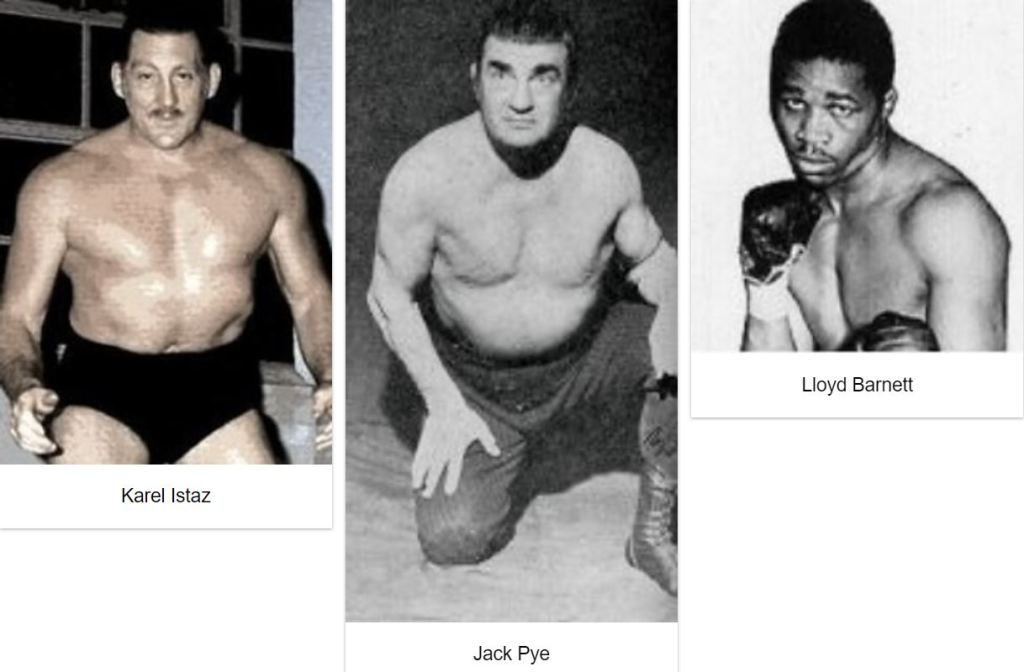
1953 saw the wrestling debut of professional boxer Lloyd Barnett, a clear indication of the rising popularity of wrestling. Barnett was no has-been, declared The People newspaper, but a boxer at the peak of his career who was turning to wrestling because he needed the monety. “Could anything be more indicative of the hopelessly impoverished state of British boxing?” asked the newspaper.
In Northern England the Pye clan had now been joined by Jack’s son, Dominic, who had a couple of years professional experience to his credit. Belle Vue, Manchester, was a regular venue for the Pyes, often with three or four members of the family on the same bill. Typical of a Belle Vue night of Pye family and mayhem was the 7th November, 1953. In the main event Jack and Man Mountain Benny ended with both men disqualified, Dominic beat Anaconda and Tommy was counted out against Tony Mancelli. Also on the bill Joe Cornelius ko’d Lew Roseby.
A not so fortunate night came the way of Jack and Dominic in November. Whilst Jack was wrestling in Liverpool and Dominic in Rochester thieves broke into their home in Cornwall Avenue, Blackpool and stole £300 in cash, three suits and a mink coat.
Two Londoners got together for the first time in a professional capacity when the Master of Ceremonies announced for the first time the team of Mick McManus and Steve Logan. Fans at Finsbury Park would have no idea of the significance of the historic occasion when they witnessed the team of McManus and Logan overcome Tony Mancelli and the Cockney Kid.
The young Belgian Karel Istaz, who had come to Britain in 1950 to learn his trade at Riley’s gymnasium, was continuing to do well in the professional rings and making almost weekly appearances at Belle Vue. Wins over Man Mountain Benny, Tony Mancelli and Jack Pye were brought to an abrupt ending with a knock out defeat against Bill Joyce.
The tradition of overseas visitors making regular appearances in Britain was set to continue. One of the biggest, in both stature and reputation, was the French heavyweight Felix Miquet. This heavyweight champion of France stood 6’3” tall and weighed over twenty stones. In a sensational, rough and tough bout at Belle Vue in April the Frenchman defeated the Uncrowned King of the Mat, Dirty Jack Pye.
Other 1953 visitors included the Belgian Fernand Bawin, who brought with him his World Welterweight belt, and whilst in the county challenged Frankie Hughes at Levenshume for the middleweight title. Also appearing in British rings during 1953 were Jean Morandi, Baptiste Benoy, Jakkel Erasmus, Zoag Ffeiner, Suni War Cloud, Jan Huard, Gene Dubuque, Franz Von Heinbeeck, Ed Weiczkorski and Hermann Reiss.
The traffic wasn’t all one way. New Zealand heavyweight Ray Clarke, who had made a name for himself during the preceding four years, packed his bags and returned home to join the police force. Alan Garfield made the first of two visits to the USA. Over fifty years later, when technology has made international travel routine for many, it would be far too easy to fail to appreciate the achievement of Garfield in travelling to the USA and working regularly for well over a year.
Other events on the western side of the Atlantic were the professional debuts of light heavyweight Billy Two Rivers in Detroit, and Canadian born Sandy Scott. There was a new incarnation of George Bollas, now known as Dark Secret.
BBC Television screened a drama of the life story of one of the world’s great showmen, C.B. Cochran, manager of Georges Hackenschmidt. Cochran was played by Frank Lawton.
On May 29th American heavyweight Man Mountain Dean died. All careers come to an end, and others to learn the lesson were American President Harry S Truman, Hungarian Premier Mátyás Rákosi, and Israeli Prime Minister David Ben Gurion, Their demise was probably of less interest to most wrestling fans.
 Wrestling Heritage