
Wrestling Heritage welcomes memories, further information and corrections.

1954, the year that Roger Bannister ran the first four minute mile. Queen Elizabeth II became the first reigning monarch to visit Australia. Hydrogen bomb testing took place on Bikini Atoll in the Pacific Ocean. At long last food rationing came to an end in the British Isles. Germany won the World Cup when they beat Hungary 3-2 in the final. All this, and the birth of a son to Jack and Trixie.
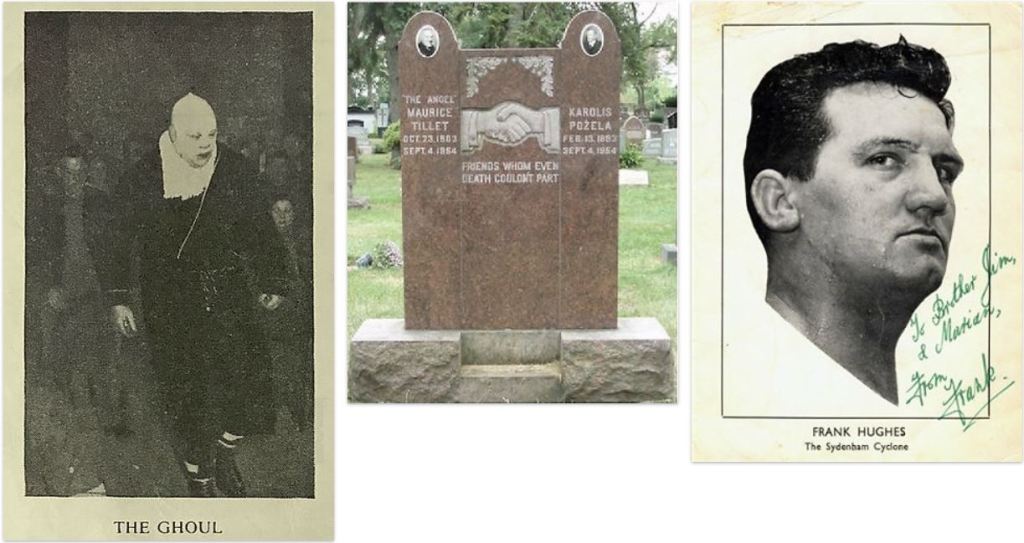
A fairy tale reached a tragic and almost mythical end. Karl Pojello, the Lithuanian heavyweight, had helped to establish professional wrestling in Britain during the 1930s. He had befriended and coached a Frenchman named Maurice Tillet, and brought him to Britain in the late 1930s. Tillet, known as The Angel, never matched his mentor’s wrestling ability and yet become one of wrestling’s biggest draws in the pre war and early post war era. Following the war Pojello and Tillet based themselves in the USA and yet continued to travel the world. Pojello had suffered lung cancer for some time and finally passed away in September, 1954. His protégé and close friend, Tillet, was devastated. Just thirteen hours later Tillet himself died of heart disease.
Meanwhile other stars were in the ascendancy, and two masked men were now firmly established amongst the country’s top heavyweights. Although they wrestled mostly in the midlands and north news of their exploits had travelled much further afield. The Australian Ring Digest of August 1950 had reported, “In England are the Ghoul, another masked man who has won over three hundred contests without dropping a decision. Also in that part of the world is Count Bartelli who is thought to be a local wrestler but has defied the efforts of all his opponents so far and his identity will remain a secret until he is defeated.”
Of the two it was the Ghoul who had the greater national exposure whilst Bartelli’s business commitments limited his activities to the north and midlands. Each had their speciality moves, The Ghoul with his Guillotine Garrotte and Bartelli with a ferocious arm hold which tended to dislocate an opponents shoulder. Their styles contrasted sharply, with The Ghoul being a ferocious and frightening character whilst Bartelli was a crowd pleaser, though not averse to extending his range of acceptable tactics whenever defeat seemed a possibility.
BBC television broadcast amateur wrestling from London’s Caledonian Hall on 16th January. This was said to be the first broadcast of the amateur sport since the television service reopened following the Second World War. A team from England beat Scotland 3-2. The rules were adjusted to make it more interesting for viewers, two falls being required instead of the customary one. In the England teams were Max Shacklady and Ken Richmond. Although a second broadcast was planned in November it was cancelled in favour of a theatre excerpt from “I Capture The Castle.”
Fourteen months following his death on 22nd November, 1954, the will of Ince’s Thomas Jones (Burgy Ben) was made public. He left £514, a tidy sum equivalent to around £10,000 in 2019.
On the championship scene many holders had been established for getting on two years, and there was no shortage of credible challengers. Eric Sands had snatched the British lightweight title from Johnny Stead in 1953, but his luck was to run out on 9th March, 1954, when Stead regained the title by the odd fall at the Lime Grove Baths, London on 9th March.
Jack Dempsey was consolidating his grasp on the British welterweight title, with successful defences against Ken Joyce and Jim Lewis. Dempsey also began the years as European champion but was given a fright when Stefan Milla took him to a draw,. A short time later Dempsey relinquished the belt because he had added the European Lightweight Championship to his collection. Alan Colbeck succeeded Dempsey as welterweight champion and made successful defences against a young Bert Royal and ex lightweight champion, Stead. In February Gentleman Jim Lewis defeated Belgium’s Fernand Bawin to claim the World Welterweight Championship.
Frankie Hughes took over as king of the middleweights, and made successful defences against Chic Purvey and Alan Colbeck. Eltham’s Charlie Fisher took over from Ernie Riley as British Light Heavyweight champion. A flurry of activity at World level saw Norman Walsh begin the year as champion, lose it momentarily to Dai Sullivan, before grabbing it back by the end of the year.
At World level Walsh was destined to lose the title he had held since 1950 when he lost to Black butcher Johnson in Aberdeen. Johnson was one of the old guard from the pre war days, whose speciality was a ferocious savate kick, which would collide with an opponents chin and knock him out. Johnson tried to add the British Heavyweight title to his collection, but Ernie Baldwin remained champion at that weight.
Overseas visitors continued to regularly visit British shores. Amongst them were Modesto Aledo, Fernand Bawin, Ted Christy, and Edouardo Wieckorski, Jan Brouwers, Roger Guettier, El Said Arabet, Suni War Cloud, Assen Georgieff, Jack Wentworth and Franz Koeller. Not all went well for France’s Robert Duranton, who made a short and unexpected expensive visit at the beginning of the year. He was fined £6, pay 1 guinea costs and £10 compensation after pleading guilty to maliciously wounding a cafe proprietor who failed to provide a requested sausage with his meal.
Also in Britain was former boxer, now wrestler, Primo Carnera. Carnera was in the country to film “A Kid for Two Farthings” but was seen wrestling by Heritage member Ray Noble. Ray was walking through the gardens at Belle Vue when he saw the former World Heavyweight Champion strolling through the grounds to drum up interest by stopping to talk to fans. Ray chatted to the huge Italian who towered above him. Shortly afterwards Carnera was towering over Margerich Anaconda, winner by a knock out.
In the other direction Londoner Chick Knight wrote a letter from Lubeck in Germany where he was wrestling. He had been in Germany since October, working in Berlin, Bremen and Hamburg and Hanover. From Lubeck he was travelling on to Dusseldorf and Munich.
Also in Germany and Austria was Bradford’s Golden Boy Dennis Mitchell, wrestling in a masked guise as Okay1. One match in Austria had an unfortunate end for his villainous opponent Killer Catman. As the 17 stone Killer punched, gouged, and bit Okay1 a woman fan jumped into the ring and began to claw at him and spit in his face. Catman jumped from the ring in search of safety. None was to be found as he was immediately set upon by ringsiders, only to be rescued by the police.
A wrestler known for his physique, Spencer Churchill, won the title of “Britain’s Best Developed Man.” In Barbados a seventeen year old took up body building and his first steps towards the Mr Universe title. Meanwhile back in London Jack and Trixie chose a name for that young son of theirs. They called him Jack after his dad, but we knew the young Gutteridge as JJ Pallo.
Here’s something to ponder. In India a female heavyweight, Hamida, promised to marry the first man to beat her. Victim number three had just failed. It makes you think …
 Wrestling Heritage