
Wrestling Heritage welcomes memories, further information and corrections.
1955 was the year that British citizens said goodbye to one Prime Minister, Winston Churchill, and welcomed another, Anthony Eden. Ruth Ellis achieved infamy as the last British woman hung for committing murder, and James Dean became an icon when he was killed in a car crash. Others reached a more natural end, and these included Albert Einstein and Alexander Fleming. In the world of entertainment Disneyland opened in California, Bill Haley and the Comets began rocking around the clock, and on 22nd September commercial television began broadcasting to a few thousand viewers in and around London. The BBC claimed that the death of Grace Archer on the Home Service just as the new station opened was pure coincidence.
Looking through our retrospective spectacles it may well seem that one of those events provided the opportunity for a watershed moment that was to change the face of professional wrestling forever. Significant though it may have been in the long term the first televised wrestling tournament on commercial television had none of the landmark features we have retrospectively bestowed. Wrestling had been re-inventing itself for a decade and spectators in the halls were at an all-time high. Television coverage was a welcome bonus but not considered an essential part of the sports development. Some would say it never was. The commercial television company, Associated Rediffusion, had existed for only a couple of months, broadcasting to a few thousand television set owners in the London area. The company was always on the look out for low cost programming and innovation that would make the BBC appear stale. When Ken Johnstone, Head of Sports, decided to give wrestling a try it hit both buttons, it was innovative and cheap.
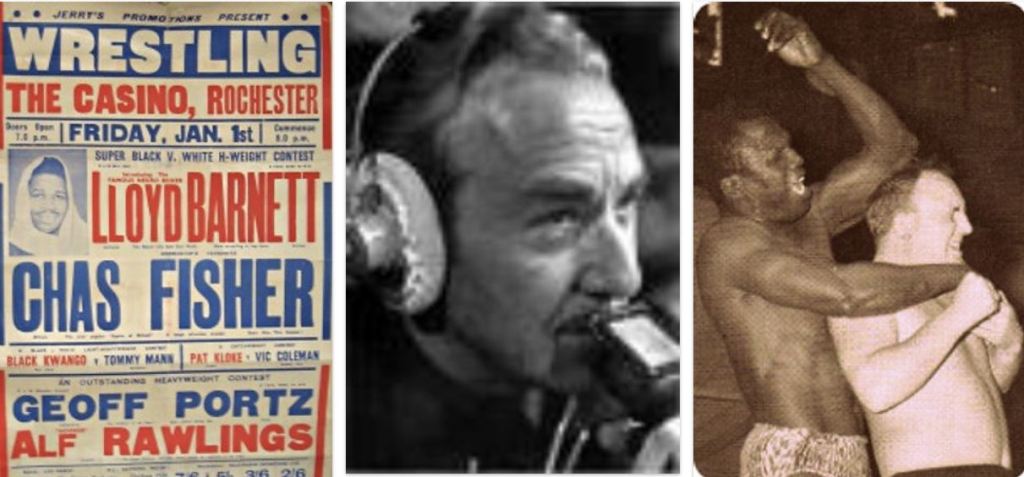
That first televised tournament, from West Ham Baths on 9th November, 1955, was a low key thirty minute affair. No one envisaged that Johnstone’s decision would lead to wrestlers becoming household names and the power of television attracting even greater numbers to live presentations. The commentator, a disc jockey by the name of Kent Walton, knew nothing about professional wrestling, and received last minute tutoring from a young wrestler called Jackie Pallo. A respectable image of wrestling was cultivated on that first night with Dale Martin Promotions carefully choosing those who were to appear. Mike Marino and Francis St Clair Gregory opened the show, followed by Cliff Beaumont and Bert Royal.
However much viewers enjoyed that first bite of the grappling game they would have to wait until the following year before they received a second helping.
Meanwhile in halls throughout the country professional wrestling had re-established itself as a major spectator sport, but with fewer of the negative images of the pre-war era. The Mountevans champions were well established with credible title holders in each weight class.
Tommy Mann clinched the World Middleweight championship, which he was destined to hold for seven years. World Mid heavyweight champion, Black Butcher Johnson, scaled down to Light Heavyweight and defeated Norman Walsh to take the World Light Heavyweight title.
Away from the championship trail there was an assortment of tremendous bouts to entertain the enthusiasts. A young Bert Royal began the year in style when he defeated Mick McManus in January at the Wimbledon Palais. Tommy Mann gave away over a stone to beat Steve Logan at the Royal Albert Hall. The young German Wolfgang Ehrl gained a rare win over George Kidd in November. At Willenhall Baths Wryton Promotions proclaimed
“For the first time ever in Willenhall! The roughest and toughest wrestler ever to enter the ring. After two years in the USA…Alan Garfield.”
Heavyweights like Garfield continued to dominate most bills and monopolise main event contests. The Norman Morrell promotion at the New St James Hall, Newcastle, on 6th August, was typical of Northern shows, with four heavyweight bouts on the bill. African witch doctor, Masambula beat Terry Ricardo, Welshman Sandy Orford overcame Wigan’s Francis Sullivan, Norman Walsh KO’d Charlie Fisher, and in the main event the masked Ghoul knocked out Dai Sullivan. Television may have been about to change all that, but for the time being the heavyweights ruled the roost.
Lloyd Barnett pursued the fairly well worn path of a boxer turning to wrestling. More unusual was the journey’ albeit short, of Preston based Gustaaf Haens. He turned away from wrestling and made his boxing debut on Fred Bamber’s promotion at Preston on 17th January, 1955. His opponent was Dennis Lockton and Gustaaf lost the four round contest on points. It was a short career, just the one match according to boxrec.com. He returned to wrestling and was last seen in 1959.
In Germany it wasn’t the best of times for Atilio Cuffini, known as “The Bull of the Pampas.” A former member of President Peron’s elite Guard “The Bull of the Pampas” saw red when he was sentenced to one month’s imprisonment for attempting to smuggle cigarettes into Germany.
One old timer who died in 1955 was Burnley’s Peter Bannan. Bannan, one of the great Lancashire Catch wrestlers of the twentieth century. To describe him as a colourful character may be something of an understatement. By the end of 1920 Bannan had eighteen convictions , usually for drunkenness or assault.He was described by the Police as The Most Dangerous man this side if the Atlantic. This culminated in July 1928 with him getting six months hard labour for assaulting a policeman. Ron Historyo has studied Bannan in depth, and the wrestler is included in Ron’s Wrestler of the Golden Age series. He was, said Ron, “One hell of a wrestler and much unknown about him , but like a lot of gifted people he also was a stick of Dynamite. Had he been an exemplary figure I think perhaps he would have had a statue in Burnley Town Centre.
As always the wrestling bills of 1955 featured a multitude of overseas stars, adding colour and interest to each evenings tournament. Swiss heavyweight champion, Paul Berger, proved something of a sensation as he defeated most opponents. The mighty Ray Apollon proved one foe too far for the Swiss, though, when Apollon knocked him out in Luton.
Other visitors included Australian heavyweight champion, Roy Heffernan, Italians Roberto Ricetti and Naldo Bernado, Czech Zilha Romano, Turkey’s Ali Riza Bey, Germany’s Hermann Iffland, Frenchmen Eddie Weicz, Lucien Fleurot and Jean Le Gall, Spaniard Rafael Blasco, “The Flying Dutchman” Piet Van Dooran, Australian Leo Demetral, Austrian Johann Dillinge, Canadians Jacques Dubois and Chief Thunderbird, and South African Martimeus Jacobs.
No one could say that the world of wrestling was a small world. That world was continuing to grow ever larger, with the first step having taken place when Kent Walton welcomed fireside grapple fans on that cold November night. No one imagined where that small step might lead.
 Wrestling Heritage