
Wrestling Heritage welcomes memories, further information and corrections.

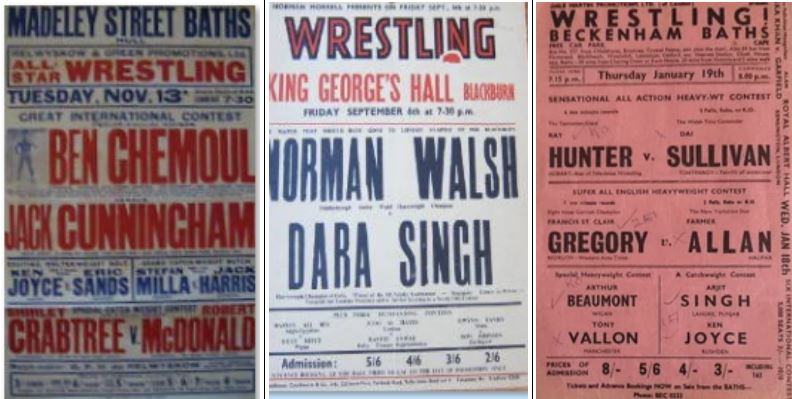
1956, the year that British Rail abolished third class travel, or at least re-named it second class, which had been abolished in 1875. Five years after going missing the British spies Guy Burgess and Donald Maclean turned up in Russia. Elvis topped the charts with “Heartbreak Hotel,” and heartbreak in Hungary when attempts to leave the Warsaw Pact ended in a Russian invasion. There was domination of another kind in the world of British wrestling.
By 1956 the Joint Promotions dominance of British wrestling was virtually complete. Various independent promoters continued to operate, particularly in the industrial North and Midlands, but most of the established wrestlers had opted to sign up for exclusive work with the new body. In the majority of cases they had been keen to do so. After all Joint Promotion’s members had proved themselves to be amongst the most reliable of employees, providing regular work and payment in reasonable working conditions. Levels of pay were not high because ticket prices were kept to a level which would attract lower paid workers. This mass market appeal did mean that most wrestlers could have worked most nights of the week if they chose to do so, and few other sports, if any, could offer that amount of regular work.
There was also the lure of national exposure through the new medium of television. Associated Television had trialled wrestling towards the end of 1955. Potential viewing figures were tiny by later standards as commercial television was a regional service restricted to London and the Midlands. Few people had television, and of those that did many had sets which did not have the necessary tuner for multi channel reception, and could receive only the BBC.
Nevertheless, the powers that be must have declared the trial a success because wrestling returned to the small black and white screens in January, 1956. Many of those appearing in the January show, which was transmitted from Lime Grove Baths, were to go on and become the biggest names in wrestling, thanks not only to their skill and charisma but also the power of television. Geoff Portz, Farmer Johnny Allan, Johnny Kwango, Ray Apollon and Francis St Clair Gregory were amongst those appearing on the second show, and all but the older Gregory were to remain stars of the ring for the next twenty years or more.
It was quite remarkable just how well known some wrestlers had become by 1956 without the power of television, and with little press coverage. Alan Garfield, Jack Pye, Count Bartelli, Bert Assirati, Francis St Clair Gregory and others were already familiar names to the British public, and had the drawing power to fill arenas prior to the days of television. Most main events consisted of heavyweight contests, but Joint Promotions had begun to introduce more wrestlers at all weights.
The domination of the championship belt holders by wrestlers from the North, and particularly South Lancashire, was astonishing. We can only think that the Joint Promotions determination to preserve the credibility of their champions outweighed any desire to create a more even national distribution. It was a pattern that was to persist for forty years.
The opening show of 1956 at the Royal Albert Hall saw the giant Mongolian Iska Khan defeat he turbulent one, Alan Garfield. Tasmanian Rebel Ray Hunter pulled off something of a surprise with a win over Francis St Clair Gregory on the same bill. Dale Martin promotions had now established the Royal Albert Hall as the nation’s premier wrestling venue with six bout spectaculars that were to become the benchmark of excellence for decades to follow. A month later Dennis Mitchell won the eight man international heavyweight tournament, beating Alex Wenzel, Judo Al Hayes and Jim Olivera in the final. In March Alan Garfield returned to top the bill, this time losing to Gerry de Jager. His fortune changed later in the years with a win over Geoff Portz.
Joining the established masked men of the North and Midlands was the Dark Owl, with impressive wins over Ray Apollon and Black Butcher Johnson. Masked man Count Bartelli, now undefeated for ten years, was out of action for much of the summer due to injury.
As a still rapidly developing business professional wrestling was always searching for novices to replace the more experienced wrestlers. It was a failure to meet the huge demand for talent that had led to the lowering of standards in the 1930s. Joint Promotions avoided the pitfalls by setting up their own gymnasiums around the country to cultivate young talent. This strategy was successful in the most part and all the newcomers had sufficient wrestling knowledge to justify their place in the professional ring.
The ranks of British born and bred wrestlers were supplemented by the arrival of others from overseas. Amongst these was Eugene Stezycki, the Polish heavyweight who had worked in Britain since 1954. His record until now had been undistinguished, but outstanding performances against Bert Assirati at Brighton on 22nd July, and again at Belle Vue a few weeks later, took him into the big time. In the months and years that followed he became a frequent opponent of Assirati, and the feud continued when they both moved to the independent circuit a couple of years later.
Two other newcomers to Britain from eastern Europe in 1956 were the brothers Tibor and Peter Szakacs, who left their native Hungary during political unrest in that country. Tibor turned professional when he arrived in Britain, with brother peter making his debut a couple of years later.
A successful Canadian heavyweight named Gordon Nelson arrived in Britain still unaware of the success that was to follow during the next decade.
As was now a well established tradition many overseas wrestlers toured Britain in 1956. Amongst these were the American, Texas Buddy Cody, Germany’s Wolfgang Ehrl (who defeated Eddie Capelli at the Royal Albert Hall) and Rudi Saturski, South African Jerry de Jager, Frenchmen Remy Bayle and Jean Boyt, Spaniard Rafael Blasco, Swiss Paul Berger, and Hungarian Gideon Gidea.
Most of these overseas visitors were to return time and again to British shores as the country had now become an essential finishing school for young professionals from all over the world.
 Wrestling Heritage