
Wrestling Heritage welcomes memories, further information and corrections.
1957 began with a new Prime Minister, Harold McMillan, for Great Britain, and an old President, Dwight D Eisenhower, returned in the United States. British television was allowed to remain open between 6.00pm and 7.00pm, previously being required to close for an hour in what was known as “the toddlers truce.” Stanley Matthews played his last international match. The signing of the Treaty of Rome established a Common market in continental Europe.
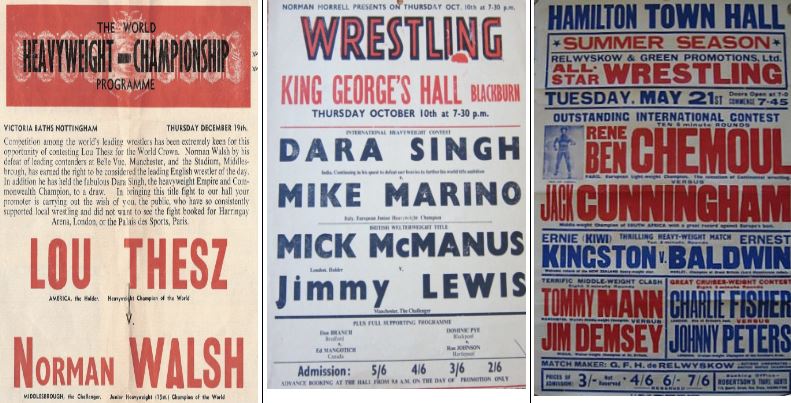
In the wrestling world the big event of 1957 was the arrival of the most significant figure in professional wrestling since the visit of Frank Sexton, though we hasten to add that the credentials of the 1957 visitor far outstretched those of the A.W.A. champion of some six years earlier. Lou Thesz had until recently been the last universally recognised heavyweight champion of all time. A loss to Edouardo Carpentier in June, 1957, had removed that collective recognition. Another loss, this time against Dick Hutton, the month before he arrived in Britain, had even removed NWA acknowledgment, but Thesz still arrived in Britain with the reputation of a living legend, and produced a World heavyweight title belt to defend.
Thesz arrived in Britain on the SS United States, which was the fastest, largest and most luxurious passenger liner built in America. The ship had captured the Transatlantic “Blue Riband” on her maiden voyage July 3, 1952 making the eastbound crossing in 3 days 10 hours 40 minutes. The American wrestler’s visit to Britain was part of a world tour that had included Australia, Singapore and Japan.
Thesz made his first title defence on British soil on 11th December, 1957, against the Indian champion Dara Singh. It was a tremendous tussle, going the distance, and matching the expectations of the five thousand fans in the arena. Singh had already wrestled with some success in the USA, where he had wins over many stars, including Stanislaus Zbysko. His unprecedented popularity in India allowed him to proceed to later careers in film and television. Thesz was to remain in Britain for three months, defending against top contenders all around the country.
Other new arrivals during 1957 added colour and interest to the still developing British wrestling scene. Hong Kong’s Leong Lee Fu and Japan’s Masachiko Kimura combined judo and wrestling techniques. Kimura was considered one of the greatest judoka exponents of the time and had become the youngest fifth dan blackbelt in 1938, when he was just eighteen years old. Kimura made a couple of Royal Albert Hall appearances, beating Judo Al Hayes in May, and returning for victory over Jim Hussey in October. Kimura had formerly lost to the legendary Japanese heavyweight Rikidozan, and later claimed to have been double-crossed as a drawn result was planned.
Spanish heavyweight Abel Castec returned to Britain and defeated Francis St Clair Gregory at the Royal Albert Hall. Texas Jack Bence and Buddy Cody again challenged Britain’s heavyweights, and were now joined by another American, Big Ed Gardenia, who would hand flowers to the ladies before displaying less gentlemanly traits inside the ring.
The wild, unruly Peruvians, Inca Peruano and Juan Botano, also did little to endear themselves to the fans. Four French heavyweights made a lasting impression. Globe trotting Bernard Vignall, who had wrestled extensively in North America, was one of them. Another was the stylish Michel Allary. Stylish in other ways was the “Orchid Man,” Robert Duranton, he of the silk gowns, long blond hair and irksome valet, Firman.
The greatest of them all was the twenty stone powerhouse, Felix Miquet, whose string of victories over Britain’s top heavyweights was interrupted when he was knocked out by Ray Apollon at Cardiff.
Miquet’s dimensions were matched by Spanish heavyweight, Pepe Cortez, who was another visitor of 1957, and went on to find further success across the Atlantic with the name Hercules Romeo.
Also visiting Britain were Jack Laski, Gene Murphy, George Blemenschults, Wolfgang Ehrl, Andre Drapp, Fritz Mueller, Modesto Aledo and Rudi Schumacher.
Going in the other direction, and taking tentative steps in the professional ring was a young Ian Campbell. He wrestled in Canada during the Autumn of 1957, making regular appearances in Calgary, Winnipeg, Regina ad Edmonton against North American heavies that included Stan Kowalski, Jack Pesek, Dan Miller, and Stu Hart.
With the cavernous Harringay Arena nearing the end of its life expectancy (it closed in 1958, and not 1954 as sometimes reported), Dale Martin Promotions had established the Royal Albert Hall as Britain’s premier wrestling venue. Glancing at the 1957 RAH results uncovers a phenomena that is intriguing but not entirely surprising to regular readers of Wrestling Heritage.
We are referring to the tendency of northern visitors to oppose each other rather than their southern counterparts. Hardly a month went by without further examples of this poor matchmaking, unless there was a more sinister explanation. Jack Dempsey beat Bob Steele (January), Norman Walsh beat Gwyn Davies (February), Eric Taylor beat Tommy Mann (March), Alan Colbeck beat Carlton Smith (April), Billy Joyce KO’d Masambula (May), and Eric Taylor beat Ed Mangotich (October).
There were exceptions, of course, but we remain mystified why these occasional Northern visitors should be matched against each other. Amongst those that countered the trend were a trio of Mick McManus wins over Mel Riss (January), Al Nicol (October) and Jack Dempsey (May).
The McManus win over Jack Dempsey was the most noteworthy, as McManus snatched Dempsey’s British welterweight title and was destined to hold on to it for the best part of a year. Dempsey, holder of the belt for four years, had been a prolific champion in the first quarter of 1957, having put the belt on the line against Mick McManus, Carlton Smith and Jim Lewis. The new champion gave Lewis another crack at the belt later in the year, but again it was a night of regrets for Gentleman Jim.
The future looked promising for British wrestling with the post war revival encouraging youngsters to take up the sport. A young Scot named Ian Gilmour joined the professional ranks, as did one Kid Tarzan Jonathan, who was destined to transform himself into Adrian Street. On the amateur scene a Mancunian took the British Light Heavyweight title and was runner up in the heavyweight class, He made a decision which was to change the landscape of the heavyweight division for more than a decade. His name was Billy Robinson.
 Wrestling Heritage