
Wrestling Heritage welcomes memories, further information and corrections.

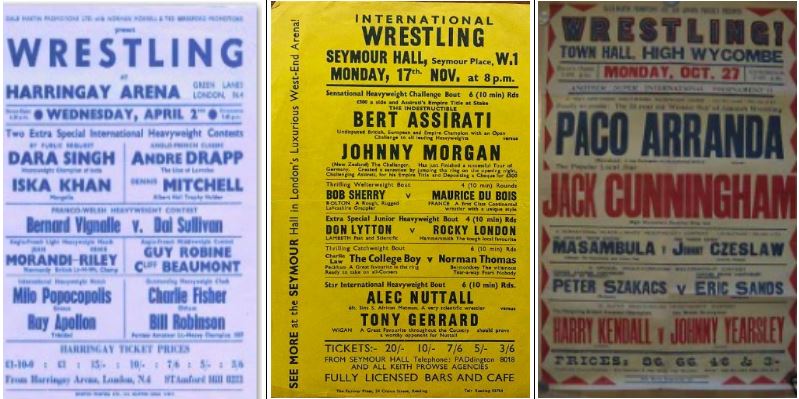
With more than a decade having passed since the conclusion of the second world war the politicians of Europe were seeking a long term commitment to peace. Consequently January 1st 1958 saw the implementation of the Treaty of Rome and the early development of what was to become the European Community. Across the other side of Europe Nikita Khruschev became President of the Soviet Union, and the Cold War edged towards some of its frostier of moments. The youngest player to compete in the World Cup, Pele, led Brazil to the FIFA World Cup. The seventeen year old scored in every one of his nation’s matches.
The wrestling world had its own rising stars, and in 1958 two wrestlers destined for international fame were achieving their finest moments in the amateur ranks. Tony Charles represented his country in the Empire Games and Billy Robinson was gaining European championship success. Both were planning a career in the professional ranks.
In the professional ranks the Mountevans championship belts had been established for six years, and although some good wrestlers worked outside the Joint promotions sphere the Mountevans champions were generally recognised as credible and worthy champions.
Lineage of the British lightweight title is unclear, possibly vacant, but there are unconfirmed reports of the title being won by Melwyn Riss in December. Earlier in the year Jack Dempsey had taken the welterweight title from Mick McManus at the Royal Albert Hall. The lineage of the middleweight belt is also unclear; Tommy Mann billed as champion in January, Jack Beaumont billed as champion in March, Tommy Mann billed as champion in April and still so in November. Eric Taylor remained unassailable in the Heavy Middleweight division whilst Ernie Riley was light heavyweight champion. There was a momentary scare for Riley when he defended his title against Judo Al Hayes at Wolverhampton in September. Hayes darted from his corner rolled across the ring and pinned the champion in the opening seconds of the first round. The bout ended in a draw and Riley kept his title.
Dennis Mitchell held the Junior Heavyweight title, and Billy Joyce reigned supreme in the heavyweight class after Joint Promotions had again stripped Bert Assirati of the title. Assirati continued to be recognised by promoters outside the Joint Promotions organisation.
On the European scene Frenchman Julien Maurice continued to hold the title he had won in 1956. Alan Colbeck successfully defended his European crown on a number of occasions before losing it to Jack Dempsey in October. Rushden’s Ken Joyce disputed Colbeck’s claim and made defences against Carlton Smith and Eddie Capelli. Ernie Riley and Mike Marino held the light heavyweight and mid heavyweight titles respectively.
Bert Assirati put the European belt on the line against frequent rival Eugene Stezycki. Their title bout at the Seymour Hall, London, ended with both men bloodied and referee Harry Geoghan raising Assirati’s arm in victory.
British champion Jack Dempsey continued to be recognised as world welterweight champion. At Wolverhampton Bert Royal made a spirited, but unsuccessful, challenge for the World Middleweight crown held by Tommy Mann. Norman Walsh, holder of the World Light Heavyweight title, added the mid heavyweight belt to his collection when he defeated Vic Hessle for the title soon after Hessle had relieved Mike Marino of the belt.
Away from the championship scene the country seemed flooded with visiting overseas stars. The biggest name amongst them all was the American World Heavyweight Champion, Lou Thesz, who had arrived in Britain the previous Autumn. Thesz was arguably the most important post war visitor to our shores, but fans were disappointed when his extended tour was cut short by a sudden return home in February, 1958.
Also wrestling in Britain during 1958 were the popular Frenchman Michel Allary, and a host of others including Jean Morandi, Henri Bury, Jimmy Brown, Felix Kerschitz, Erich Koltschak, Juda Ischa Israel, Pedro Bengochea, Alex Wenzl, Hans Behrens, Jean Bataan, Manuel Araujo, Jose Calderon, Dene Stockton, Serge Reggiori, Yves Amor, Roger Delaporte and Jose Renas.
One of the biggest visitors of them all, in terms of both stature and reputation, was the Texan Bud Cody. He was a giant of a man from Dallas with a wild temperament and he made a big impression with the British fans. Another Texan wrestler, Jack Bence, made a possibly greater impression when he KO’d the popular local boy, Mike Marino at the Royal Albert Hall. Marino waited a year, but he had his revenge!
Fiery Scot Ian Campbell, who had wrestled around Canada the previous year moved south into the United States and was guided by American heavyweight, Buddy Rogers. He would enter the ring with in full Scottish regalia to the sound of bagpipes playing and the American crowds loved it. Peter Maivia and Georges Gordienko were amongst his opponents at the time.
Many of the wrestlers who were to gain nationwide success as a result of television exposure were still in the early days of their wrestling career. In September Alan Dennison made his professional debut against Don Branch. Heavyweight Johnny Da Silva turned professional shortly after representing New Zealand in the Empire Games. Peter Szakacs followed in the footsteps of brother Tibor by turning to wrestling for his livelihood. Linde Caulder made his debut against Frankie Bell. Jim Breaks stepped inside the ring for the first time, his opponent being Bernard Murray. Bobby Barnes and Johnny Czeslaw were also newcomers.
Professional wrestling was continuing to increase in popularity throughout the country and few towns in Britain were denied a Joint Promotion tournament, let alone the independent promoters who were particularly active in the North and Midlands. Wrestling tournaments continued to be televised by ITV, fortnightly on a Saturday evening, though there was a break during the summer months. The growing significance of wrestling as a sporting and social phenomena was demonstrated by the inclusion of a storyline on the hugely popular Hancock’s Half Hour, in which Sid James played the part of a wrestling promoter.
Finally, the occurrence of one event totally unconnected with wrestling that was to have a significant impact some twenty years later. Burl Ives starred in the 1958 screen adaptation of Tennessee Williams’ “Cat on a Hot Tin Roof.”
The name of his character was Big Daddy.
 Wrestling Heritage