
Wrestling Heritage welcomes memories, further information and corrections.
1959 began with Che Guevara entering Havana, followed three days later by Fidel Castro. Charles De Gaulle took charge in France, and Harold Macmillan was re-elected in Britain. Motorists took to the road along the new M1 and passengers took the last tram in Leeds. Barbie entered the world, and sadly Buddy Holly made his exit. The film “The Nun’s Story” was released and we continue with our story of wrestling.
Our story so far has been something of a fairy tale. Post-war promoters had co-operated to bring about a renaissance of the professional wrestling business, creating new jobs for all, it seemed, and vanquishing the less reliable of the promoters for good measure. Wrestling fans were assured of good quality shows and were happy to hand over their money at the box office every week or fortnight in just about every town in Britain. Those that didn’t want to leave their living room were able to watch the country’s top wrestlers on television from the comfort of an armchair.
Idyllic. No wonder Mr McMillan was telling the British people they’d never had it so good. Well not quite idyllic in the opinion of a sizeable group of the wrestlers themselves. The problem from the wrestlers’ point of view was that too much of the money handed over by the fans and ITV was staying in the promoters’ pockets and the wrestlers themselves were not being sufficiently rewarded for filling the halls every night of the week.
Gentleman Jim Lewis, who was President of a small group of wrestlers that formed the Wrestlers Welfare Association, was reported to have said at the time:
“ A wrestler has got to get on his bended knees to some of these promoters if he wants to get a square deal. The syndicate pays fees which we consider unfair and a measly share of what the promoters earn….If a fighter has a complaint he has no one to go to, and the promoters just don’t want to know.”
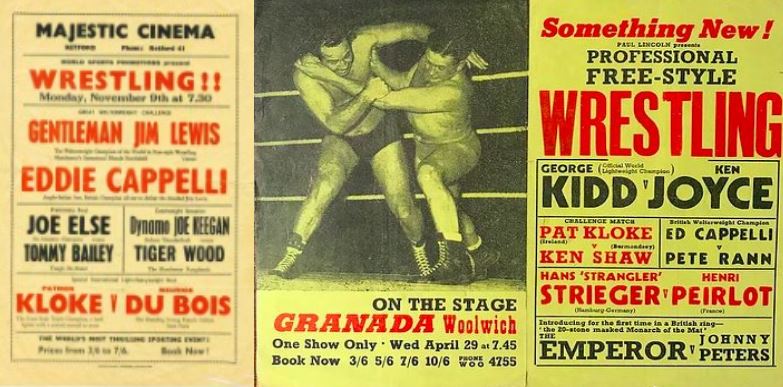
The Wrestlers Welfare Association received national publicity in March when a group of its members, including Peters, Popocopolis, and Kidd, withdrew their labour from a show at the Seymour Hall, London (see poster).
Behind the scenes things were stirring. Exactly whether or not a young Australian wrestler by the name of Paul Lincoln visualised the groundbreaking achievements that lay in his future, or whether he had simply had enough of being underpaid and overworked when he had left Joint Promotions in 1958, we will not know – until he decides to get in touch and tell us.
We do know, though, that Lincoln was sufficiently disillusioned to leave Joint Promotions, and he was not alone. In 1959 a host of big names decided to work outside the Joint Promotion regime, and many of them, like Lincoln, also began to promote their own shows. George Kidd, Eddie Capelli, Bert Assirati, Carlton Smith, Milo Popocopolous, Johnny Peters, Black Butcher Johnson, Danny Flynn, Dominic Pye, College Boy, and Fred Woolley were amongst the big names that could now be seen on the independent circuit. Add to these newcomers such as Doctor Death, Peter Rann, Linde Caulder, Tug Holton and Johnny Saint and we can begin to appreciate the colossal change in the landscape of British wrestling.
Hooded newcomer Doctor Death joined established mystery men The Mask and Count Bartelli, though working on the independent circuit meant there was no chance of their meeting. When Bartelli met the Blackfriars Thunderbolt, Tony Mancelli, at the Willenhall Baths on 9th January the stipulation of the bout was that Bartelli would not use his world famous dislocation hold. The contest ended in a draw.
Heavy fog caused havoc to wrestling tournaments at the beginning of January. On 13th January visibility was down to five yards and fans at the Civic Hall, Wolverhampton, had to wait until 8.30 pm for the start of a revised programme. Their patience was rewarded with the addition of an extra bout to the following bill two weeks later.
Once again British rings included a host of visiting stars. Not just the locally domiciled overseas born wrestlers like Johnny Czeslaw, the Szakacs brothers and Joe Zaranoff, who were now as British as steak and kidney pie, but a multitude of genuine overseas visitors.
Texas Jack Bence was in Britain once again, enjoying a series of tremendous battles with Bolton’s Bill Howes. On 18th February Mike Marino gained revenge over the American when he knocked him out at the Royal Albert Hall, thus reversing a defeat from the previous year.
Another visitor, who really riled the crowds by describing how good he was and what he was about to do to our hapless heavyweights, was another Texan, Buddy Cody. He clashed with visiting German Horst Hoffman on that same Royal Albert Hall bill.
Making his first British appearance was the Greek American George Bollas who wore a striped mask and called himself the Zebra Kid.
Even in this era of heavyweight dominance 1959 was the year of overseas heavyweight indulgence.
Add to the above trio another German, Axel Dieter. The popular Berlin heavyweight made fleeting visits to the UK during the late 1950s and early 1960s, although his greatest successes were reserved for the other side of the Atlantic. Having been trained by Bela Barothy and Axel Cadier the twenty-six year old German’s first visit to Britain came in 1959, four years after having turned professional. Others included Lucian De Groote, Otto Acron, Gil Voiney, Jim Hady, Billy Two Rivers and possibly the greatest of them all, the Black Prince from Trinidad, Ray Apollon.
At the other end of the weight spectrum were visiting American midgets Sky Low Low, Ivan the terrible, The Black Panther and Red Feather.
All was quiet on the British title front with established champions Mel Riss, Jack Dempsey, Harry Fields, Eric Taylor, Ernie Riley and Norman Walsh keepiing a firm grasp on their belts. The Junior heavyweight division was replaced by the Mid Heavyweight division.
Light heavyweight champion Riley had to work particularly hard to keep his championship belt. At the start of the year a young newly turned professional with an impeccable amateur record showed Riley what the future held in store.
That man was Billy Robinson, who challenged the champion at Willenhall on 6th February and lost by the odd fall. Heavy Middleweight champion Eric Taylor twice moved up a weight to challenge Riley.
Another youngster, Al Hayes, also had a couple of cracks at Riley’s crown. One of those challenges, at Wolverhampton Civic Hall, was a no rounds, one fall, fight to the finish. There was drama early in the contest when both men crashed from the ring and failed to beat the count. The referee declared that as this was a fight to the finish, and there was no clear the winner, the contest should continue. Riley eventually ran out winner by the only fall needed.
Only in the heavyweight division was there any change in belt holders. Billy Joyce was champion throughout the year until Ernie Baldwin took the honours in November. Amongst those making an entrance to the professional ranks in 1959 were Barry Douglas, Bob Taylor, Johnny Saint, Clayton Thomson, Robin Howard and Jerry Morgan.
With newcomers such as these, the extension of television coverage, and the challenge of Paul Lincoln Management the 1960s were destined to become the most successful ever decade for professional wrestling. Fans had it all to look forward to. Doctor Death, The Wildman of Borneo and Barbie too.
 Wrestling Heritage