
Wrestling Heritage welcomes memories, further information and corrections.
1960 was the year that John F. Kennedy was elected President of the United States. It was also the year that television was deemed to have played a significant part in an election campaign. The first televised debate between Kennedy and Richard M. Nixon had contrasted the youthfulness of Kennedy with the establishmentarian Nixon. It is retrospectively considered to have been a turning point which led to the election of America’s youngest President.
Significant events were also taking place on British television.
In December, 1960, David Barlow mended his bike in the living room of 3, Coronation Street whilst his dad grumbled that a university education was giving eldest son Kenneth fancy ideas. Florrie Lindley moved in to the corner shop and Ena Sharples tangled with Elsie Tanner in the opening episode of the famous soap.
Fans of grappling know that perceived wisdom is wrong and that the world’s greatest long running soap had, in fact, begun eleven months earlier than Coronation Street, when professional wrestling had been given a weekly place in the ITV schedules.
Although broadcast weekly from January, 1960, wrestling (like ice cream sales) was to remain seasonal and the small screen’s favourite sport was to continue with a summer break for a few more years to come. Mike Marino, Bert Royal, Joe Cornelius, Mick McManus and Les Kellett were already familiar figures to television audiences. The expansion to weekly shows was to create a host of new opportunities for television exposure.
The North American native Billy Two Rivers had proved a popular newcomer when he had made his television debut defeating Ray Hunter in November, 1959. Television viewers wanted to see more, and Two Rivers returned to the small screen to meet Wigan’s Francis Sullivan early in 1960. Others who began to make an impression on television fans were heavyweight newcomer Billy Robinson, Tony Charles and Al Miquet.
We wonder whether the Joint Promotions members fully understood just how important television exposure was to be in seeing off the challenge of the independent promoters led by Australian wrestler Paul Lincoln. We noted in “A Year of Wrestling: 1959” that some of the biggest names in the business had chosen to work outside the Joint Promotions organisation.
Personal charisma, creativity, courage and business acumen were the qualities that enabled Paul Lincoln to challenge the might of Joint Promotions in the early 1960s. It wasn’t just Paul Lincoln, though we cannot underestimate the part he played and confidence he must have given to others. Established wrestlers that included Danny Flynn, Fred Woolley, Jack Taylor, George Kidd, and Grant Foderingham also left Joint Promotions and began to promote their own shows. We like to imagine the clandestine discussions that might well have taken place in Joint Promotions dressing rooms in the preceding couple of years as disenchanted wrestlers discussed what might be if only they had the courage to do what they were now doing.
The 1960 independent promoters began to attract a growing number of established stars who were also disillusioned with Joint Promotions. Add to those listed above well known names that included Jim Lewis, Jim Holden, Dominic Pye, Harry Bennett, Carlton Smith, Black Butcher Johnson, Shirley Crabtree, Max Crabtree, Milo Popocolis, Bert Assirati, Jim Foy, Johnny Peters, Bill Coverdale, Cyril Knowles, Fred van Lotta, Eric Sands, Don Mendoza, and Tony Zale.
They supplemented these known stars with newcomers who were to gain greater fame in the years to come. Amongst these were Johnny Saint, Les Thornton, Terry Nylands, Johnny Eagles, Hans Streiger, Ivan Penzecoff, Linde Caulder, Reg Trood, Zoltan Boscik, Jon Cortez, Leon Fortuna, Leon Arras, Jack Rowlands, Peter Rann, Quasimodo, Bob Kirkwood, Bruno Elrington and Bobby Barnes.
No one could say that the independent promoters were lacking in talent.
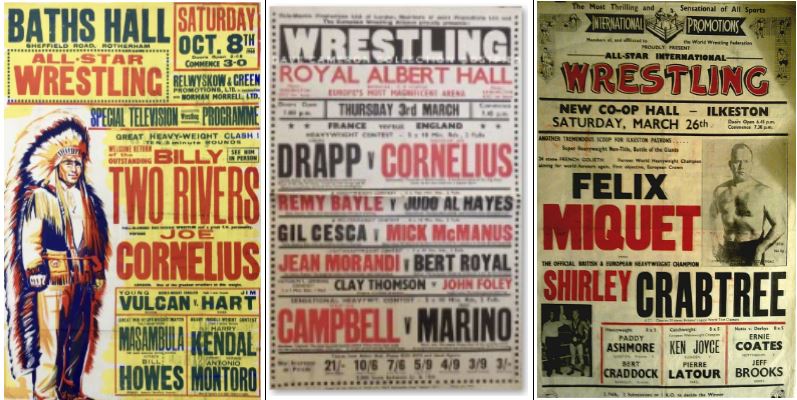
It wasn’t just the nurturing of new talent and lure of established stars that enabled the independents to begin gnawing away at the Joint Promotions stranglehold. Attractive posters made effective use of colour and photography, imaginative matchmaking, and colourful characters were to make Joint Promotions appear old fashioned and flat footed in the early to mid 1960s.
Nowhere was this any more apparent than in the small matter of championship contests. To their credit Joint Promotions successfully portrayed the Mountevans belt holders as legitimate champions, and no one could doubt that each was arguably the best at their respective weight. Our readers understand, though that wrestling is more than sport, it is sport and spectacle. Once again in 1960, however, the year passed without any changes in the championship line up. The champions may well have been credible, but they were becoming well and truly dated, and southern fans were rightly disgruntled at the continued regional domination by the northern establishment.
Wrestling Heritage would never criticise or question the skills of the 1960 champions: Mel Riss (Wigan), Jack Dempsey (Wigan), Tommy Mann (Manchester), Eric Taylor (Bradford), Ernie Riley (Wigan), Norman Walsh (Middlesborough) and Billy Joyce (Wigan). We would, though, question the wisdom of promoters who allowed the championships to stagnate and regionally divide the country.
There was, of course, some colour in Joint Promotion rings, but the independents began to make the Joint Promotion colour seem a little faded.
One man who brought much colour (even if it was black and white) to Joint Promotion rings in 1960 was the mighty Zebra Kid. For a man of his girth he was remarkably agile and skilful, even having a hand in training British Olympic wrestler Dennis McNamara. The twenty-four stones masked man had arrived in Britain in 1959, but continued his tour of Britain, France and Greece throughout 1960. In Greece he is reported to have defeated Andreas Lambrakis in an Athens contest watched by 43,000 fans.
Masked men had been frequently seen in the north and midlands, but were practically unknown on Dale Martin bills. The Zebra Kid, with his distinctive striped gear, did wrestle throughout the south on Dale Martin shows. He was also atypical because unlike most masked men his record was never perfect, and we have his first recorded loss against Mike Marino in May, 1960.
Another colourful character making a return to British rings in 1960 was the former World Heavyweight Boxing Champion, Primo Carnera. Carnera had visited Britain six years earlier, an occasion recalled by Ray Noble in Blood, Sweat and Speedway. Other visitors to British rings that brought more than a splash of colour were the Texan heavyweights Jack Bence and Buddy Cody, Trinidad’s Ray Apollon, and the Hawaiian Bolo Hakawa.
Leaving the country for a short time was the popular New Zealand heavyweight Johnny Da Silva. He crossed the Atlantic where he drew with the British Empire Champion, Whipper Billy Watson in Hamilton, Ontario. Another Canadian connection was made by Paul Diamond. Born in Toronto twenty-five years earlier Paul travelled across the Atlantic in the opposite direction to make his professional debut in Dale Martin rings in 1960.
Less colourful than the likes of Da Silva, Carnera and the Zebra Kid but no less significant, and making outstanding progress, was a young Mancunian named Billy Robinson. With only a couple of years experience to his credit Robinson was already talked about as a future champion. At the beginning of 1960 he challenged Mike Marino in Barrow for the latter’s World Mid Heavyweight crown, and in December tackled his mentor and rival, Billy Joyce at Belle Vue for the European heavyweight title.
Whilst Joyce was well established as British and European champion things were not going so well for erstwhile champion Bert Assirati. Assirati had already been stripped of the title by Joint Promotions, but in 1960 the independent promoters also withdrew recognition of the Islington Hercules. The independents named Shirley Crabtree their new champion, thereby creating the animosity between Assirati and Crabtree that was to last throughout the first half of the decade.
Considered by many to be the fight of the year was the return contest, between Ian Campbell and Mike Marino, on 20th April 1960, at the Royal Albert Hall. Marino finally knocked out Campbell in a bitter contest in front of a packed crowd. Blackmarket tickets changed hands at almost forty times their face value of one guinea (£1.05).
Despite all those events for millions of fans the fact that wrestling was now broadcast weekly was the big event of the year. Well, that and the start of Coronation Street.
 Wrestling Heritage