
Wrestling Heritage welcomes memories, further information and corrections.
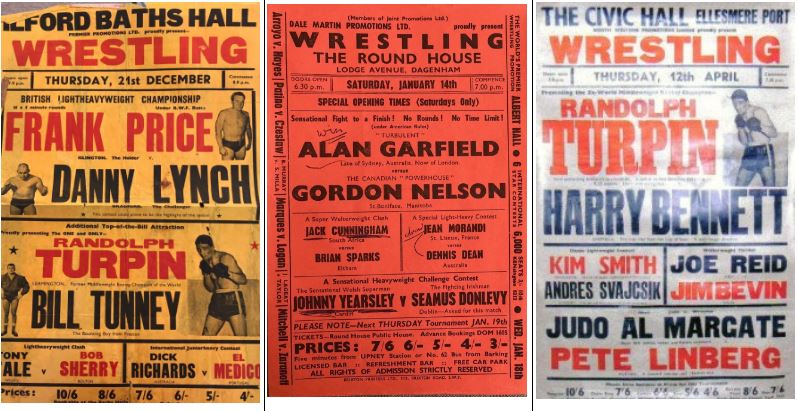
January 1st, 1961. The rot set in as the farthing ceased to be legal tender! Grandmothers around the nation lamented that this would be the end of civilization as we knew it! The Beatles made their first appearance at the Cavern Club. Yuri Gagarin was the first human to enter space. East German builders erected the Berlin Wall in double quick time and were never to work so fast again. Ken befriended Barbie. Arguably the greatest visitor to British shores arrived since World champion Lou Thesz some four years earlier.
The distinguished visitor was the American heavyweight Luther Lindsay. Few visitors, if any, could boast a KO win over Mike Marino at the Royal Albert Hall, or destruction of Josef Zaranoff on television. Lindsay could boats of both.
World Heavyweight Champion, Lou Thesz, said of Lindsay,
“The best black wrestler ever. Luther had a fantastic body and limitless energy to compliment his skill. Like many other industries, wrestling was not open to African-American wrestlers during his career, so it was an amazing accomplishment for Luther to even learn his craft. His place in history is not because he was black; it is in spite of the fact he was black.”
Other strangers on our shore in 1961 included Gorgeous Terry Garvin. He would pose arrogantly and taunt the fans, who were eager to let him know their views on his flamboyant appearance and flagrant disregard for our principled Mountevans rules. Garvin enraged the British fans as he strutted his stuff during his 1961-2 tour.
Britain was a popular destination for American heavyweights who seemed to appreciate the experience gained wrestling in the United Kingdom. The “Singing Wrestler,” Frankie Townsend was in Britain around the same time as Garvin. A former marine, and now wrestler, Townsend released a record, “I’m the Greatest,” whilst he was in Britain.
Ricky Waldo, a heavyweight from Norfolk, Virginia, USA, was also here upsetting fans with his disregard for the Mountevans rules. Many of his bouts ended in his disqualification, and no exception to this was his only televised bout in which he lost to Bill Rawlings.
New Zealand’s Keita Meratana was a colourful visitor. As he climbed into the ring fans waited with anticipation for the ritual ward dance which heralded the opening bell. Once the bout began Keita showed himself to be a wrestler of considerable skill, and gained popularity during his visit.
South African heavyweight champion, Willem Hall, began appearing in British rings in July, making a big impression on fans with a combination of aerial displays and combative style learnt in his pre wrestling pro rugby days.
Other visitors included Frikki Alberta, a tall, bearded South African, the Lebanese heavyweight Sheik Wadi Yousef Ayoub, Mexico’s Tomas Riande, French heavyweight Gil Voiney, and the muscular Italian heavyweight, Dino Bravo. Still in Britain at the start of 1961 was the colossal masked man Zebra Kid. The greatly anticipated clash of the masked men took place at the Victoria Hall, Hanley, when the striped one met the popular well established masked man Count Bartelli. Despite his girth and near ten stones weight advantage it was the fans’ favourite Bartelli that emerged the victor and the Zebra Kid was ceremoniously unmasked for the first of many times. Shortly after suffering this rare defeat the Zebra Kid returned to the USA where further defeats, against both the distinguished and not so distinguished, began to pile up.
There was a welcome respite for the masked man in June, 1961, when he managed a rare win over Lou Thesz in Long Beach, California. Thesz was to avenge this extraordinary defeat in August when he reversed the decision at the Olympic Auditorium in Los Angeles. In the Autumn the Zebra Kid travelled to Japan, but his two month tour ended on November 7th with another unmasking by the legendary Rikidozan.
One home grown legend celebrated his sixty-fifth birthday, and fifty years in the sport, in style. There was a gathering of the great and the good in the Lancashire town of Wigan to celebrate the achievements of the iconic Billy Riley.
Riley’s protégés continued to dominate the championship scene, and one of the busiest of these was British welterweight champion, Jack Dempsey. Dempsey’s successful 1961 defences included championship contest wins over Mick McManus, Jackie Pallo, Bob Steele and Al Nicol. For once, though, the independent promoters put forward a plausible challenger that disputed Dempsey’s claim to the welterweight crown.
Scotsman George Kidd, now wrestling for the independent promoters, was billed as their British welterweight champion. Whilst not questioning Kidd’s skill we can see no justification for his claims other than the independent promoters wanting to find a credible alternative to the Joint Promotion’s champion. Alternative champion Kidd made successful defences against Eddie Capelli and Ken Joyce.
Another Wiganite, and another protégé of Riley’s Snakepit, was heavyweight champion, Billy Joyce. Joyce had by now moved out of the shadows of the long time champion Assirati and was recognised as the great champion that he was. In 1961 he made successful defences against Ernie Baldwin, Albert Wall, Norman Walsh, Bill Howes, Geoff Portz and Dennis Mitchell. The credentials of a true champion. In their search for a credible alternative the independents recognised Shirley Crabtree. Do we need to comment?
In the last week of March another top heavyweight transferred his allegiance to the independent promoters. Judo Al Hayes wrestled Iron Man Steve Logan for Dale Martin Promotions on Saturday 25th March, and the following Monday made his independent debut at Finsbury Park against Doctor Death.
Towards the end of the year the independent promoters made their biggest catch to date when Paul Lincoln enticed another of wrestling’s legends to leave the Joint Promotions circuit. In December the World Mid Heavyweight Champion, Mike Marino, made a smooth transition to the independent circuit. On the last day of November he was in action for Dale Martin Promotions against Wigan’s Francis Sullivan, and two days later made his Paul Lincoln debut against Quasimodo.
More British youngsters were beginning to enter the professional ranks, and although the flourishing independent circuit created more opportunities the benchmark standard of gaining professional status was as high as it had ever been. In the first decade of the twenty-first century it is hard for anyone other than those present at the time to appreciate just how difficult it was to enter the professional ranks.
Amongst the newcomers was Tooma, a muscular light heavyweight with leopardskin trunks, a huge grin and bags of enthusiasm. He turned professional, in 1961, at Abergavenny, and wrestled in the UK during the early sixties. Hungarian Steve Sipos also showed promise following his 1961 debut, but we are left to wonder just what happened to him.
Yorkshireman John Ure turned professional in November, losing to Don Branch, and seemed to have a promising career until he disappeared from the scene in the mid sixties. Another heavyweight making his debut, and one who was not to disappear for many years to come, was Steve Bell (Steve Veidor).
Other promising newcomers included the blond-haired light heavyweight Bob Sweeney, Scotland’s technician Clayton Thomson and Blackpool’s Gerry Hogan.
One youngster continuing to make his mark was Manchester’s Billy Robinson. In March he beat Alan Garfield, Gordon Nelson and Dazzler Joe Cornelius all in one night to win the Royal Albert Hall Trophy. On the same bill the British welterweight champion Jack Dempsey defeated the recently self-proclaimed Mr TV Jackie Pallo by the best of three falls.
Less fortunate was former British Heavyweight champion, Ernie Baldwin, who spent much of the year out of action with a broken leg. Poor old Ernie. A broken leg, no income, and now he didn’t even have two farthings to rub together.
 Wrestling Heritage