
Wrestling Heritage welcomes memories, further information and corrections.
January 1962 saw the rejection of The Beatles by Decca Records, showing that everyone makes mistakes. Brazil beat Czechoslovakia 3:1 to win the World Cup. The world heated up as the Cuban missile crisis brought the threat of nuclear war closer. In Britain things stayed pretty cool with the start of “The Big Freeze,” a succession of below freezing nights that lasted from 22nd December, 1962 until 5th March, 1963.
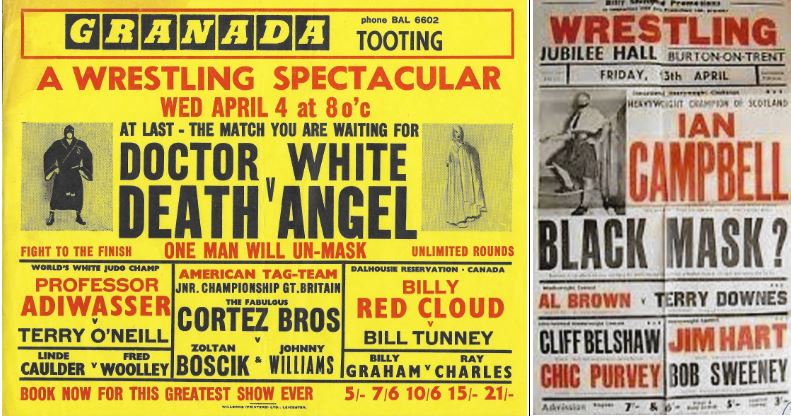
1962 also saw the coming of age of wrestling’s young pretender. The innovative Paul Lincoln Management filled the vast Granada Tooting with appreciative fans eager to witness the outcome of one of the most anticipated bouts of the decade. The setting could not have been any more fitting; it was a distinguished venue for an illustrious event. The modern Italianate styled entrance, it’s four tall pillars topped by Corinthian capitals led to a Gothic style interior with stained glass windows, sculptures and painted murals of medieval figures.
The villainous Doctor Death, a masked man who had antagonised fans for the previous three years had finally accepted the challenge of his virtuous challenger, The White Angel. The contrast could not have been greater. The villainous, savage, Doctor Death, was the master of his own creation, the vicious “claw hold” in which he placed pressure on the base of his opponent’s spine. He seemed capable of withstanding enormous punishment and would use any means to win. Opposing him was the white masked, clean wrestling hero of the fans, The White Angel. Three thousand fans packed the cathedral of wrestling venues in the hope of witnessing good conquering evil, or at least conquering Doctor Death.
The story went that The White Angel had deposited £500 with promoter Paul Lincoln for a fight to the finish. The challenge was repeated publicly wherever either of the two masked men appeared in the ring. Promoter Lincoln used his immense public relations skills to get the fans clamouring for the match to take place. This was a huge achievement when it is remembered that neither wrestler benefited from television exposure. At the time even Lincoln himself was said to be unaware of the White Angel’s identity, which seems more than hardly likely as Lincoln was not only the man paying his wages but also the man who wrestled as Doctor Death!
The fairytale ending should, of course, have resulted in victory for The White Angel. Even in the highly controlled world of professional wrestling life in not always a fairy tale. At the end of the contest, a no rounds fight to the finish which had ended by a knock-out, the defeated wrestler shook hands with the victor and dramatically removed his mask. The White Angel was Judo Al Hayes, a successful heavyweight who had recently left the Joint Promotions camp to work for Paul Lincoln and other independent promoters.
Doctor Death and the White Angel were not the only two feuding wrestlers to get to grips with each other in 1962, though the clash of Jackie Pallo and Mick McManus was far less conclusive, and marked the beginning rather than the end of an on-going grudge.
It was on Easter Saturday, 21st April, as McManus awaited the entrance of opponent Bob Anthony that Highbury’s self-styled Mr TV jumped into the ring and challenged McManus. A man who was never short of words Pallo proclaimed his superiority over McManus and announced that the Southern Area champion had repeatedly avoided facing him, a claim that could hardly be justified as the two had met many times in preceding years.
The challenge struck a chord with fans and the bout was arranged (with highly suspicious urgency) for just two weeks later, the FA Cup Final Spectacular of 5th May. The bout proved an all-action affair from the start with each contestant appearing to have the edge at various times in the opening two rounds. The opening fall came in the third round. Pallo’s favourite move the piledriver was executed to perfection. Surprisingly, though, it was McManus who used the move to such devastating effect and the New Cross tough guy took the lead.
Pallo tried desperately to get back into the contest, but could make no headway until the fifth round when Jackie gained an equalising submission with a Boston Crab. The sixth and final round saw both wrestlers simultaneously out of the ring, Pallo entangled in the ropes, and McManus coming close to being counted out. When the final bell rang, concluding a draw, the fans seemed almost as exhausted as the wrestlers themselves! It was a terrific contest and that final bell signalled not just the end of a contest but the beginning of one of British wrestling’s greatest feuds.
The return contest came two months later, the main event of June’s Royal Albert Hall programme which also saw Tibor Szakacs win the eight man international heavyweight tournament. Once again the result was an inconclusive draw and the grudge was destined to continue.
Another notable 1962 contest was the one in which Bolton’s Billy Howes defeated the French man Jacques Lageat to take the European Mid Heavyweight title. The bout was surprisingly shown on television, something of a rarity for championship matches in those days. Although Howes was the more aggressive of the pair in the opening rounds it was Lageat that took the opening fall with a Reverse Double-leg Nelson in the fourth round. Howes equalised in the seventh round and took the deciding fall with a Body-slam and press in the ninth of a twelve round contest.
The only change to the landscape of the British championships was when Salford’s Bobby Steele relieved middleweight champion Tommy Mann of the middleweight title for five months between May and October.
Dale Martin Promotions continued to present undeniably the country’s best tournaments at the Royal Albert Hall. Jack Dempsey successfully defended his British welterweight title against Londoner Eddie Capelli in the February show. George Kidd defeated Pepe Lopez by two straight falls in September, and Texas Jack Bence was held to a draw by Billy Howes in a thrilling December contest.
Not quite as illustrious as the Royal Albert Hall, but quite something at the time was the opening of a new venue, destined to become nationally known through television, the 2000 seater Fairfield Hall, Croydon.
With events such as those reported all seemed well in the world of wrestling. There were, however, a couple of clouds on the horizon.
After years of growth “The Wrestler” magazine blamed the popularity of bingo for a fall in attendances in the North West, with only Blackpool and Liverpool maintaining audience levels of the previous year.
There was also the matter of negative publicity when national newspapers alleged that 5% of professional wrestlers were members of the Variety Artistes’ Federation, again challenging the perception of wrestling as a legitimate sport. Whilst Paul Lincoln Management recognised the rights of professional wrestlers to join professional associations, Joint Promotions unsurprisingly remained steadfastly opposed, and refused to employ any wrestler who was a member.
There were signs that Joint Promotions were beginning to take the challenge of Paul Lincoln and the independents more seriously than they had previously. A Joint Promotions programme stated:
“… the control exercised by Joint Promotions Ltd is absolutely basic to the appreciation of the popularity of wrestling today and fundamental to its continued progress.”
There was a slight move against the flow early in 1962 when an arrangement between Joint Promotions and Max Crabtree’s Twentieth Century Promotions brought the independent promoter into the Joint Promotion family and the return of Crabtree, Eddie Capelli and George Kidd to Joint Promotion rings.
Numerous youngsters who had made their professional debut with the independents also began working for Joint Promotions, no doubt lured by the promise of national television exposure. Those making such a transition included Bobby Barnes, Terry Nylands, Al Miquet, Leon Arras, Johnny Eagles, Reg Trood, Henri Pierlot, Linde Caulder and Jim Moser.
Others stepped into the ring for the first time, and these included former rugby league star Sam Evans, popular Kent wrestler Tony Bates, and Yorkshireman Jeff Kaye. Still two years away from his professional debut, but in 1962 representing England as an amateur against Switzerland was Gillingham’s Wayne Bridges.
As was now routine overseas wrestlers visited Britain throughout 1962. Amongst these were American Jaime Dula, French giant Gil Voiney, South American El Grandee Apache, Japanese middleweight Akio Yoshiaro, Belgian heavyweight Charles Verhulst, South African Reg Radcliffe, Switzerland’s Pierre Bernhart, Mexican middleweight Joachim LaBarba, and German heavyweight Otto Acron.
Going in the other direction Alan Garfield and Pat Barratt visited the USA,
Ricky Waldo toured Japan, Lucky Simunovich was in Italy, and Ray Apollon, Billy Robinson, Prince Kumali and John da Silva wrestled in India.
Amateur wrestler Eddie Mason rescued three people from the Thames and was presented with a plaque by Freddie Mills, the former boxing champ.
On a sadder note Matthias Rosges, the scientific German heavyweight visitor to the UK in 1960, was murdered by shooting in Dusseldorf.
Meanwhile Parlophone records put right the wrongs of the past and signed up the Beatles in September 1962. The world would never be the same again.
 Wrestling Heritage