
Wrestling Heritage welcomes memories, further information and corrections.
1964, and Britain was changing fast. The Beatles, who were transforming music in Britain, took their popular culture to the USA and became the only group to ever simultaneously hold the top five positions in the US singles chart. Offshore radio station Caroline was the first of many pirate stations that challenged the broadcasting establishment in a way that would result in a complete overhaul of British radio and the launch of Radio 1. BBC2 took to the air for the first time, bringing the total number of channels to three and more dire warnings that too much television would result in declining standards. The Labour Party came to power for the first time since 1951 when Harold Wilson led the party to victory in the October General Election.
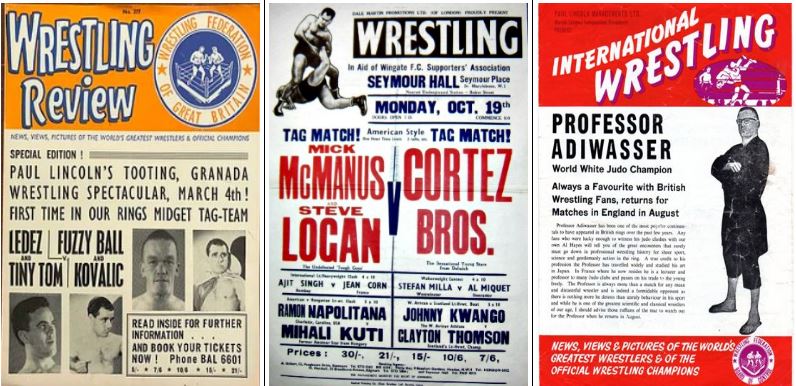
The world of wrestling was undergoing its own quiet revolution, but one that would nonetheless change the wrestling landscape forever. Australian heavyweight wrestler Paul Lincoln had for some years been promoting tournaments that challenged the giant Joint Promotions organisation. By 1964 his tournaments were having a significant impact on Joint Promotions. His publicity skills outshone Joint Promotions, his matchmaking skills were more creative, and his shows brought a breath of fresh air to a business that was showing the first signs of staleness. Naturally, Joint Promotions, refuted all of Lincoln’s claims and retaliated by saying he relied too heavily on colourful characters, masked men, giants and wrestlers who depended more on showmanship than skill. Whilst Lincoln’s shows were undoubtedly more colourful than the established promoters his wrestlers were nevertheless of a calibre equal to those on the Joint Promotions shows. Indeed many Lincoln wrestlers, such as Mike Marino, Al Hayes, Ray Hunter, Ed Mangotitch and Don Stedman had previously topped bills for Joint Promotions. Other youngsters, such as the Cortez Brothers, the Campbells, Wayne Bridges, and the Borg twins were nurtured by Paul Lincoln before becoming big names for Joint Promotions. International stars like Ricky Starr, Togo Tani and Crusher Verdu came over to Britain for Paul Lincoln before moving on to Joint shows. One of the biggest names of all, though, was the villainous masked man Doctor Death, whose mask concealed the identity of Lincoln himself. Not only did Lincoln outmanoeuvre Joint Promotions by signing up some of their biggest stars he was also unique amongst the independents in acquiring some of the biggest and plushest venues in the country, mainly through a deal with the Granada and Essoldo cinema chains.
However great the Lincoln challenge it remained a fact that Joint Promotions remained the dominant force in British wrestling. They promoted by far the most shows, still controlled most of the big names, and had the exclusive rights of ITV wrestling, which was now broadcast weekly.
Londoners Mick McManus, Jackie Pallo and Joe Cornelius were the biggest names in wrestling. None of them were national title holders, though, as it has always been one of the peculiarities of wrestling that the most successful wrestlers in terms of attracting paying customers are not necessarily the ones holding the championship belts. The less charitable have claimed that for the champions their title honours were a substitute for the charisma that they lacked and was held in abundance by the non title holding stars of the ring.
During the Mountevans era, though, the title holders were always credible champions, and could legitimately claim to be the best at their weight.
Mountevans title holders were those who wrestled exclusively for Joint Promotions, and though the independent promoters (that is those outside the Joint promotion organisation) had their own champions, they could not claim to be Mountevans champions.
Whilst the biggest names, which included Jackie Pallo, Steve Logan, Mick McManus, Joe Cornelius, and Johnny Kwango were all wrestlers from the South of the country the Mountevans champions were all from the North! There was little change in the championship line-up throughout 1964, with the only title changes being in the top two weight classes. Mountevans champion at lightweight was Bradford’s Jim Breaks throughout the whole of 1964. The welterweight crown was held by Wiganite Jack Dempsey. Middleweight champion was Bolton’s Bert Royal, who was the son of a famous heavyweight, Vic Hessle. Heavy middleweight champion was Bradford’s Eric Taylor. Wigan’s Ernie Riley, another son of a famous father was Light heavyweight king.
Only at mid heavyweight and heavyweight were there any title changes. Even there fans had to wait until December to see Farmer Johnny Allan temporarily relieve Norman Walsh of the mid heavyweight title. Wigan’s Billy Joyce was British Heavyweight champion at the start and end of the year, but did drop the title for six months to Shipley’s Geoff Portz. Portz shocked Joyce with a win at Bradford on 9th March, and was no doubt more than shocked when Joyce regained the belt in September with a straight falls win at Middlesbrough.
Dempsey and Joyce were double champions, also holding the European championships at their respective weights throughout the year. At middleweight young Mancunian Bobby Steele started the year as champion but in May dropped the belt to Tommy Mann.
Bill Howes, born in Bristol, but by now adopted by his new hometown of Bolton, was European Mid Heavyweight champion. George Kidd and Bert Royal held world honours at lightweight and middleweight respectively. Mike Marino, the sole Londoner amongst the champions, had held the World Mid Heavyweight title since 1961. By 1964 he was wrestling for Paul Lincoln and the independent promoters. He defended the title against Dai Sullivan at Murrayfield and Wayne Bridges at Leamington Spa, both Paul Lincoln shows.
Wrestling fans were shocked in July with the sudden death of Robert (Bill) McDonald, the Stornaway light heavyweight. Here was one of the greats, a man who had been at the top for years, suddenly taken away following a long illness, and leaving a void on the wrestling scene.
One seemingly inconsequential event of 1964 occurred in a small West Midlands market town in the winter of 1964. Inconsequential the event was not, however. The posters outside Willenhall Baths for 13th November, 1964, advertised the first appearance of a then unknown, and unseen, masked man called Kendo Nagasaki. He knocked out veteran Jim Hussey and never looked back..
Visiting overseas stars included Japan’s Teizo Okadu, Chati Yokouchi, Togo Tani, and Great Togo; Portugal’s Carlos Rocha; France’s Luc Straub, Andre Drapp, Andre Bollett and Gil Cesca; Spain’s Vincente Castella and Luis Enrique Edo Juan; Poland’s Warnia Zarzecki; South Africa’s Tim Geoghegan, Jan Jacobs and Frikki Alberta; America’s George Drake, Texas Jack Bence, Ski Hi Lee and Cowboy Ken Ackles; Greece’s Vassilios Mantopolous; Germany’s Horst Hoffman; Canada’s Georges Gordienko, Billy Torontos and Billy Two Rivers; and Hungary’s Josef Molnar. Settling in Britain with unfulfilled plans to begin promoting was the American George Bollas, better known as The Zebra Kid.
Whilst Harold Wilson and his Labour Government clung to power with a tiny Commons majority there was nothing precarious about the hold that British wrestling had on millions of fans. Wrestling was about to reach the peak of its astonishing popularity.
 Wrestling Heritage