
Wrestling Heritage welcomes memories, further information and corrections.
In much the same way as H.H. Pope Paul VI and the Archbishop of Canterbury went some way to patching up differences in 1966 with His Grace’s visit to Rome, Paul Lincoln clearly came to a satisfactory arrangement with Joint Promotions. Whether he went cap-in-hand à la Ramsay remains unclear to this day.
A momentous year in many ways with the excitement of the new Severn Bridge, mini-skirts, and the tragedy that was the Aberfan landslip. An exciting set of postage stamps celebrated 900 years since the last successful invasion at Hastings, and the town sealed its place in further history as a multi-venued wrestling centre. Perhaps the highlight for many was the day of the World Cup Final when the wrestling slot was rejigged and we were treated to Tibor Szakacs versus Billy Robinson – in spite of whatever listings you may read elsewhere to the contrary. Wrestling waved Bon Voyage to the Johannesburg Giant, and in his place we had Rhodesian Prime Minister Ian Smith on our television news screens for what seemed an eternity.
Hovercrafts and Polaris submarines took to the waves, and how many of us recall our parents locking the house particularly securely in fear of killer-on-the-run Harry Roberts?
But bigger than any of these events for wrestling fans was the March bout between undefeated (almost!) Count Bartelli and up and coming samurai warrior, Kendo Nagasaki. Who remembers like we do that in the days before his tv exposure, we had great difficulty working out how to pronounce his name?
The backdrop to the epic encounter had been along classic lines. The masked pair had been tagging successfully and faced at Hanley a team comprising Henri Pierlot and Tibor Szakacs. The masked men fell out big time and a challenge was issued. The deciding bout saw Count Bartelli sensationally knocked out and his bloodied features revealed for the first time.
Few wrestlers can have been set on their way so graciously as Nagasaki through this wonderful publicity.
So it was as a surprise debutant to televised action that the great Count Bartelli, after his twenty-something years behind the mask, claimed the notable scalp of Billy Howes at Prestatyn, on the bill where Tibor and Bill did their business. The name of Billy Howes was, incidentally, involved in many of these important matches down the years and half a decade later he would be involved in the first ever sighting we had of Nagasaki’s face.
Perhaps making the biggest individual small screen impact of the year was the sensational ballet dancer from Missouri, Ricki Starr. In a famous Cup Final day match, appropriately from Wembley, he sensationally defeated Iron Man Steve Logan, seconded by Mick McManus, within five seconds of the final round. But even this feature day in the year’s televised grappling was a mere scene-stter for an even bigger follow-up event which we will descibe shortly.
At a group level, the New Year’s Day spectacular from the Coronation Hall Kingston-upon-Thames was even more exciting. For one thing, we had for once a good sighting of Kent Walton as he entered the ring to do the announcing.
He had been drawn through the ropes for the grand spectacle of a dozen Paul Lincoln wrestlers parading in to lay down a challenge to the television wrestlers of the day. Judo Al Hayes was their spokesman, and he was joined by largely clean wrestlers from his stable including Bob Kirkwood, Zoltan Boscik, Wayne Bridges and Mike Marino, when characters such as the Wild Man of Borneo and Doctor Death may have been even more intriguing. Read our 1966 Extra – They Think It’s All Over.
Anyway, so the die was cast and the two erstwhile feuding sects merged swiftly and seamlessly over the coming months, culminating in the grand sight of Doctor Death wrestling at the Royal Albert Hall in what must have been a momentous occasion for the business.
Yet another notable in-ring debutant in January was tv DJ Jimmy Savile, facing up to Chic Purvey in Leeds and embarking on an on-off career that would span six years and see him eventually start winning after more than two-score defeats.
In an outstanding year for new blood, Pat Roach would also start to appear in Joint Promotions rings, and Quasimodo appeared at the Royal Albert Hall. Alan Sargeant popped up seemingly from nowhere to become Welterweight champion in November and would go on to have his name spelt in various ways over the next ten years of action.
One impressive international giant on show at the tail end of 1966 was Italian Heavyweight Champion Nick Barone, a fair successor to fill Jan Wilko’s size 14s. Less impressive were international blubber bellies Crusher Verdu and Prince Curtis Iaukea.
1966 also saw the end of the perception of tag team wrestling as a gimmick with its place in mainstream promotions assured by virtue of the first really rather belated tag match at the Royal Albert Hall, on 13th May. The Cortez Brothers scored a victory over the team of Julien Morice and Zoltan Boscik.
As we frequently mention here at Wrestling Heritage, The Royal Albert Hall really was the jewel in the Joint Promotions crown, arguably of equal importance as the television contract. So any kind of involvement at the Kensington arena counts as a milestone in a wrestler’s career and a measure of his status. Even referee Max Ward cemented his place at the top by officiating in his first Royal Albert hall bout – and what a baptism of fire it was: Mick McManus versus Ricki Starr, a clash linking out of the Cup Final Day encounter mentioned previously.
Wrestling was big business in 1966 and one of its mouthpieces was a very compliant TV Times which regularly featured wrestling-related articles which, years later, we fans cherish as memorabilia. The publishers had a good route to boosting sales through the Golden Gown award. In the pre-internet days, readers would cut out the coupon and send it in with the name of their favourite wrestler of the month, and the award would be made during World of Sport. A series of blue-eyed goodies donned the Cloak and 1966 saw victors such as Vic Faulkner, Jon Cortez and Les Kellett.
A sad exit in 1966 was that of Lou Marco, the dancing doyen of referees and a stalwart defender of wrestling’s integrity. He went out on a high, officiating at wrestling’s big night as described below, before being run over by a car on the way home and suffering a career-ending broken leg.
Another not seen in our rings again after this year was Peter Fanene Maivia and we last glimpsed him in 1966 as a taxi driver in the Bond film “You Only Live Twice”. And sadly passing away prematurely was northern stylist Cyril Morris who had also wrestled behind a mask as The Professor, and had also been Rocky Wall’s first professional opponent. Rocky himself was one of four wrestlers to wear the British Heavyweight Championship belt in 1966, the others being Billy Joyce, Gwyn Davies and Wild Ian Campbell.
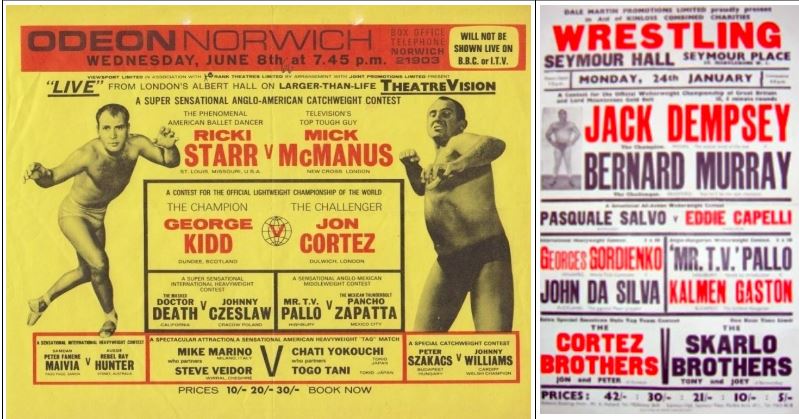
Fans ten years earlier would have thought it inconceivable that a spectacular bill at the Royal Albert Hall, with three thousand fans unable to gain access outside the packed out venue and screened live on cinema screens around the land, would have only one heavyweight bout and a supporting contest at that. The June 8th bill featured none of the above-named champions with lighter-weighted household names Pallo and McManus topping the bill alongside George Kidd, Ricki Starr and that Royal Albert Hall debutant, Doctor Death.
But it was the heavyweight tag match that goes down in the annals as one of the most controversial of all time. Chati Yokouchi and Togo Tani, a sinister couple of Japanese, even after the big-name bill-toppers who had preceded them, still managed to elevate an even greater level of heat in their final bout which lasted nigh on half an hour as they sadistically tortured golden boys Marino and Viedor in a bloody encounter. This Japanese pairing rate as some of the finest international professionals to visit the UK.
Fired with this success, further spectaculars would be arranged over the coming few years, a couple with Royal involvement, and you can read about these and more in the upcoming instalments of Wrestling Heritage’s Years of Wrestling
 Wrestling Heritage