
7
Wrestling Heritage welcomes memories, further information and corrections.
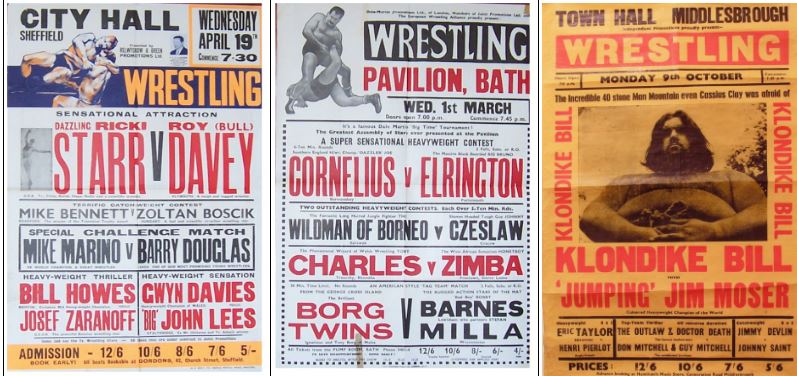
Conflicts flared worldwide in 1967: between Biafra and Nigeria, Greece and Turkey, and Israel and the Arab states. Wrestling fans were perhaps most disturbed by the fighting in Sierra Leone, synonymous with their favourite Honey Boy. Meanwhile, the wrestling world mourned the passing of Charles “Spider” Mascall,doyen of journalists for several decades and ardent defender of the sport in the face of his two bêtes noires: knockers and boxing.
Also exiting the ring but in one piece was popular Southern England heavyweight champion, Dazzler Joe Cornelius.
In November French President Charles De Gaulle stated he was not prepared to negotiate British entry to the Common Market. Just five years later wrestling’s own Martin Conroy and John Naylor would be welcoming a group of European wrestlers to celebrate the UK’s entry into that very Community.
On January 14th the sensational and scandalous tv bout between Mick McManus and Peter Preston was aired. This is much reviewed elsewhere on the Heritage site, suffice to say when referee Don Branch disqualified the Londoner, it was McManus’s first ever defeat on the small screen and his last for another ten years, though his blushes were partially spared as the transmission was faded out before the verdict, in the south of England at least.
Referee Branch would be involved in another controversy later in the year when the masked Outlaw was defeated by Mike Marino in Newcastle. In true US-style planning of 30 years later, the result was not allowed to stand as the referee was unconscious outside the ring at the time of the winning fall.
The Outlaw featured in a rare true battle of the masked men at Belle Vue where the Zebra Kid was required to show his features after a two falls to one defeat. He subsequently slipped from the UK scene, and went on to troubled times in business. Even rarer was this clear result when most match-ups of big names tended to end inconclusively and, from a fan’s point of view, unsatisfactorily.
Billy Robinson had a very good year indeed. In January he defeated Billy Joyce to become British and European Heavyweight Champion. He also inflicted one of the first ever defeats on Kendo Nagasaki, by disqualification, and with his favoured pile driver took care of formidable Russian visitor Nikita Mulkovich, right, at the Royal Albert Hall in February.
Other notable Royal Albert Hall debutants in 1967 were N’Boa the Snake Man and Barnsley’s Leon Arras, who, it should be remembered, at this time still refused to be photographed due to his teaching career and persona. Most surprisingly for many fans, it was not until April 1967 that McManus & Logan belatedly appeared in Kensington for the first time as a tag team.
Making his sole tv appearance ever, but in so doing becoming a household name, Heritage favourite The Wild Man of Borneo faced Peter Preston at the notorious Lime Grove Baths. Quite why this should have been his final appearance remains one of the many unfathomables we strive to resolve on this site. Preston went on to be a regular giantkiller on Norman Morrell bills.
Tag teams were really becoming part of the furniture now, and pairings formed and stuck together in serious long-term relationships. The Black Diamonds were at the height of their controversial powers, the White Eagles and the Dennisons travelled far and wide, the Hells Angels started to get some rhythm going, and brother teams abounded: the Cortezes, the Royals, the Borgs and in 1967 the Saints joined their ranks. Less lasting was the 1967 marriage of Elvis and Priscilla!
The trend for the Southern England Title holders to be displaced northerners really set in, with Yorkshiremen Peter Rann and Al Miquet claiming these regional middle and lightweight belts billed out of southern bases. It wouldn’t be long before first Bruno Elrington and then Steve Viedor would follow up at heavyweight just a few years later.
Miquet, just one month later, had relieved Jim Breaks of the British title, too, which meant there was a rather sudden rebalancing of power in terms of the British belts, with Sargeant, Thomson, Marino and Miquet himself ensuring that the three remaining north of England national champions were in a minority, whereas just a few months previously they had held all seven belts.
Yet another lightweight title changed hands in 1967 as Johnny Williams relinquished his Welsh version to Cardiff’s Adrian Street.
Peter Maivia broke Tibor’s nose, and Les Kellett was laid up for much of the year. Maivia, fresh from his fame in the James Bond movie “You Only Live Twice”, then moved to Paris where he was awarded the Radio and Television Silver Trophy for 1967.
A second scandal was tv wrestling being taken off air not once but twice in favour of coverage of Wimbledon tennis. But there was plenty to enjoy on our monochrome sets for the other 50 weeks of the year, not least of which was a well organised heavyweight tournament over a few weeks in which the final saw Pat Barratt once again putting poor Tibor’s nose out of joint and claiming the Lifeguard Trophy at Watford.
Irishman Barratt had a good year, reclaiming his Irish Heavyweight title from Sean Regan, clocking up a prestigious 2-0 defeat at the Royal Albert Hall over Polish opposition, and seemingly on his way to the very top, only to disappear again all too soon afterwards. Nestling intriguingly at the bottom of the October bill was an unknown name facing the multiple Royal Albert Hall Trophy winner. You’ll have to wait until our 1968 review to learn more about what was afoot here …..
1967 also saw the famous chat show confrontation on the Eamonn Andrews show with London foes Jackie Pallo and Mick McManus on the same night. McManus famously refused to share the stage with Pallo and they milked the publicity for all it was worth on the way to their famous McManus v Pallo III encounter at the Royal Albert Hall on Midsummer’s Day. As was the frustrating norm at the time, an inconclusive result was recorded, with referee Max Ward stopping the contest due to a cut to Pallo’s forehead after the Highbury wrestler had gone ahead with one of his famous piledrivers in the third round. On the same bill, the masked Outlaw claimed a notable victory over Albert Wall.
New faces on the scene in 1967 were Chris Bailey, John Kowalski and Alan Kilby, whilst Heritage favourite Wild Angus started to appear in Joint Promotions rings – his bloody tv dèbut victory over John Cox was nothing short of sensational. Meanwhile a youthful Kendo Nagasaki was seen in southern rings for the first time.
Another intriguing aspect of the year was the extensive tour of the Bholu brothers from Pakistan. Incredible hype surrounded and still surrounds their performances with alleged career highlights being defeats over fine post war heavyweights, Bert Assirati and Georges Gordienko. The trouble was, their travelling troupe arranged all the bills themselves and made quite a mess of things, the most regular criticism being that they avoided the top home wrestlers and took on lesser men half their not inconsiderable size. With no consistency to judge them by, we can only realistically give them a passing mention in this review of the year.
Also intriguing was a full 40 minute Granada television documentary on some of the leading wrestlers of the day. It featured in approximate order of prominence: Les Kellett, Abe Ginsberg, Roy “Bull” Davis, Vic Faulkner, Jumping Jim Hussey, Johnny Eagles, Billy Robinson, Alan Dennison. Others glimpsed included Martin Conroy, Steve Clements, Bert Royal, Billy Joyce, Jack Dempsey and the great Billy Riley.
The year ended with another twist in Jim Breaks’ ongoing entanglement of titles, as he relieved Alan Sargeant of the welterweight title he had held for a year, see the new champ left. On the same bill, Judo Al Hayes won a knockout tournament to step into the Dazzler’s shoes and belt.
Finally, Ricky Starr fought his last bout in the UK in Belfast after four sensational years, and it would be several years more before he would return to let a new generation of fans witness for themselves what mid-sixties Starrdom had been all about.
 Wrestling Heritage