
Wrestling Heritage welcomes memories, further information and corrections.
Another Olympic year and Bob Beaman left us all gobsmacked when he set a mammoth new world long jump record at the Mexico Olympics. The ill-fated Lilian Board was the darling of British televiewers on late night athletics tv, but just failed to match her wrestling fan predecessor Mary Rand from the previous games.
Wrestling mourned the February passing of arguably its greatest 20th century exponent, George Hackenschmidt. We also said goodbye to Martin Luther King, Yuri Gagarin, and Bobby Kennedy. And hello to Richard Milhouse Nixon as US President. Meanwhile, the Kray twins said goodbye to the outside world. Decimal coinage appeared in our pockets and airline hi-jackings took off.
Enoch Powell delivered his Rivers of Blood speech in 1968, but it was an influx of Czech wrestlers that seemed most likely for grapple gazers. The 1956 Hungarian Uprising had led directly to the appearance of a dozen or so Magyars on the scene over the previous 12 years. Now Alexander Dubcek’s Prague Spring looked set to follow suit, but the severity of the Moscow clampdown put paid to such thoughts.
The excitement of Apollo 8 going around the dark side of the moon was, if anything, greater at the time than the excitement generated by the moon landings a year later. Historians reading that comment will find it absurd, but if you lived through both, you’ll remember the incredible edge as they went out of contact and re-emerged. The year’s Star Trek offerings had real bite as a result of these real life parallel goings on in space.
The French student revolts under Daniel Cohn Bendit had more of a tangible results for grunt n groan, with an ongoing influx of Gallic grapplers of variable quality.
The wrestling year started with Peruvian-Chilean visitors Los Halcones d’Oros (The Golden Falcons) extending their stay by public demand and their shimmering cloaks continued to grace predominantly northern rings well into spring. These were a quality act, rugged rule benders and all-action performers. New to Joint Promotions rings were Jock Cameron, Pete Roberts, Gargantua and Mucky Mal Kirk, whilst veteran Charlie Fisher finally wrestled his last and went on to become a popular master of ceremonies for many years to come.
On the silver screen, never has a single movie featured so many well-known wrestlers. The film was The Touchables and just some of those featured were Ricki Starr, Bruno Elrington, Steve Viedor, Charlie Fisher, Eddie Cappelli, Judo Al Hayes and Wayne Bridges. Then the Columbia Pictures film A Matter of Honour was recorded with Jackie Pallo, Spencer Chruchill, Docker Don Stedman and Joe D’Orazio all featured. Making most impact at a higher profile level in 1968 cinemas was Yuri Borienko tangling with James Bond’s wife in On Her Majesty’s Secret Service.
Being the son of a top promoter opened the door to international travel and stardom, topped off by the choice of the best titles and trophies on offer. Northern promoter Ted Beresford’s son, middleweight Steve Clements, set off as a middle-of-the-bill name but we were soon informed of how he had surpassed himself by becoming World Champion at this weight on the Pacific coast.
In a similar vein but reverse direction, British fans witnessed first hand in 1968 the elevation of a foreign promoter’s son to the supreme accolade of the wrestling year. Rudi Saturski had long been a wrestler-cum-promoter of the famed German tournaments, regularly giving a month’s work at a time, or more, to a whole host of British heavyweights, and lighter up-and-comers, too. 1968 was payback time. His stripling of a son, barely a heavyweight at 15 stones, and wrestling in Britain as Wolfgang Starck, had embarked upon his mega push with testing trials against Tibor Szakacs and then The Outlaw at the Royal Albert Hall, no doubt to see what he was made of against true amateur greats. He was, however, presented to the televiewing public against a smaller opponent, gaining a submission victory over light-heavyweight Johnny Kwango in February.
This introduction served to launch the young Berliner into the field of eight for the 1968 renewal of the Royal Albert Hall Tournament Trophy in April. Dale Martin Promotions intriguingly excluded their top-line heavyweights from the line up, but this just meant a more varied array of talent than in some years. The young German first defeated the great Count Bartelli, the former masked star incredibly making his first appearance at the Kensington arena. After beating new Southern Area champion Judo Al Hayes in the semi-final, Starck then faced Jumping Jim Hussey in the final, and the assured experience and mentoring of the Manchester legend made for an exciting finale, before the popular German received his trophy, going on to be seen regularly around the UK for another 12 months.
Possibly the biggest disappointment of the year was the disappearance of masked star The Outlaw in June. He had had the most forceful of pushes through the preceding two years, maintaining an unbeaten run against all the top heavyweights from home and abroad, featuring on Royal Albert Hall spectaculars and becoming the first masked man ever to enjoy regular television billing. He repaid the trusting promoters by upping and leaving at his peak.
1968 also saw the publication of that finest and heaviest of wrestling tomes, A Pictorial History of Wrestling, by Graeme Kent. With evocative chronologies and spellbinding photography, this is a must-read for even the most casual of fans.
Leaving UK rings were Yuri Borienko and Pat (Ivor) Barratt But fresh blood, literally, arrived on the scene in shape of a son of a well-known veteran star: Steve Young son of Roy Bull Davis, who would go on to greater fame ten years later as Skull Murphy, a name borrowed from the above mentioned book.
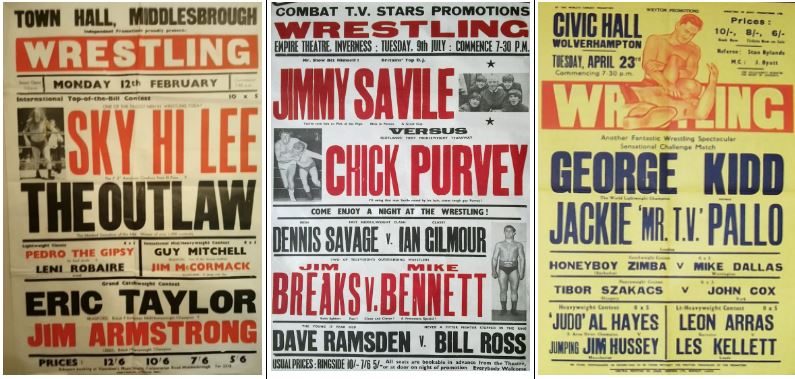
For the highlight of the year we must turn once again to the Royal Albert Hall for the second of two evenings in the presence of H.R.H. Prince Philip he must have enjoyed himself in 1963 to agree to return for this charity event. Almost as if to heed our Wrestling Heritage chastisement in the 1963 review of the year, Dale Martin Promotions this time included some northern matmen, leaving the Royals, appropriately, and the Dennisons to fight it out in tag, and Les Kellett to be an unaccustomed curtain-raiser in his bout with Bob Kirkwood. But there was a sting in the tail. The Duke of Edinburgh arrived for only the second half of the show, so the most northerly based wrestler he saw in action was Jackie Pallo! Bert Royal had even curtailed his Italian holiday to return to appear.
These bouts 5, 6, 7 and 8 were for the Capital Cities trophy, with the London quartet triumphing by 3 bouts to 1. McManus and Pallo were thus the only wrestlers to wrestle before the Duke twice in their careers. Pallo’s opponent was living French legend Jean Corne, sometime bodyguard to Brigitte Bardot.
The programme was a success for the industry in that ITV dedicated the entire Wednesday evening’s viewing (after Coronation Street!) to coverage of the show.
Jackie Pallo could claim a very indirect victory at last over Mick McManus once he had defeated British Champion Clayton Thomson in a televised bout in August. McManus had failed in his attempt to relieve the Scot of his belt some six months earlier.
A very welcome autumn visitor was 6’4″ Japanese Heavyweight Champion Shozo Kobayashi who took all before him on his extended stay. He had wrestled various British wrestlers in Japan that summer and they had brought back reports of his potential pulling power.
One of the bizarrest of reverse journeys was the 1968 Japanese tour by Kendo Nagasaki. He wisely chose not to use the samurai swordsman routine, and wrestled there as Mr Guillotine. Many a Nagasaki fan would give their right arm for a YouTube viewing of Mr Guillotine in action, even their right finger, but sadly no footage exists. He must have fared well because he delayed his return and in so doing was a no show at the opening bill of the Royal Albert Hall autumn season.
Certainly enjoying great 1968 success in Japan was British heavyweight champion Billy Robinson. It was in 1968 that US promoter Vince McMahon first started enquiring about the Mancunian’s availability. The Land of the Rising Sun also welcomed Johnny Eagles, who had perhaps reached the ceiling of his expectations at home and just a few years later would depart again, this time for good. Amongst others headed for Japan in 1968 were John Foley, Lee Sharron, Tony Charles, Wild Ian Campbell, Joe Keegan and Mike Marino, the latter shortly after inflicting the first falls defeat in the UK on Kobayashi at Bolton.
It was a quiet year at championship level, with Alan Serjeant’s regaining of the British welterweight championship from Jim Breaks being the sole noteworthy change at home. Prince Kumali had a spectacularly successful year in overseas tournament victories, even by his own heady standards.
In France, young giant Jean Ferre from Grenoble was the F.C.C.P. national heavyweight champion, gaining valuable experience before the severest tests of his career in British rings in 1969. He would later go on to worldwide fame billed as André the Giant. But, for a detailed analysis of what Wrestling Heritage writers know to be the true pinnacle of his career, go to the 1969 review.
Page reviewed 13/01/2024
 Wrestling Heritage