
7
Wrestling Heritage welcomes memories, further information and corrections.
Just as we had seen in 1968 British talent on a seemingly endless conveyor belt eastwards to Japan, so in 1969 we saw an influx of Gallic talent. Almost as if to plug the gap. Jean Corne returned to do battle with Jackie Pallo; newcomer André Lamar and French mid-heavyweight champion Jacques Legeat both graced British rings; and Albert Sanniez challenged for Breaks’ European title. In fact the flow was such that it led to the resignation in disgust in 1969 of President De Gaulle. Also visiting for the first time but billed as Jacques Mychel was the respected Belgian mid-heavyweight Olympian, best known in Britain as Bert Mychel.
1969 really was a Big year.
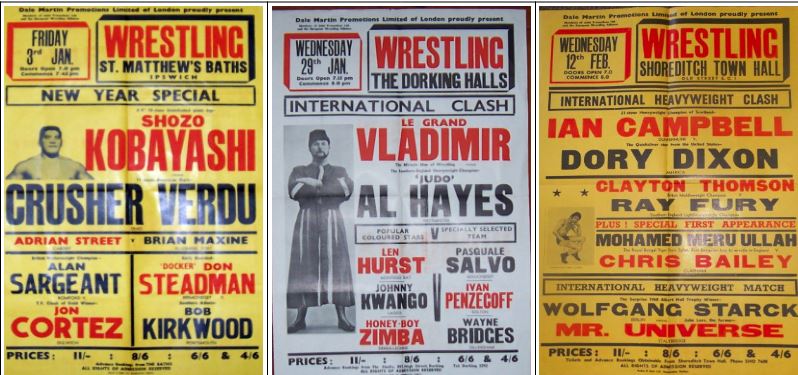
Le Grand Vladimir at 6’6″ was taller than his Royal Albert Hall opponent in January, but Wild Ian Campbell vanquished him 2 to 1. Kendo Nagasaki faced 6’4″Japanese champion Shozo Kobayashi in this appetizing Maidstone encounter, the honours shared.
Other grand scale visitors were Belgian Jean-Louis Breston weighing in at 23½ stones, and Dory Dixon. 19 stone Tokyo Joe flew in for a fortnight’s stay and featured on a televised bill from Sheffield defeating Les Thornton, doubling the number of legitimate Japanese visitors. But the brawn drain eastwards continued, with Wild Angus and even famously reluctant traveller Bruno Elrington heading off to Japan late in the year.
Tag team wrestling continued to flourish in Britain with the formation of The Artful Dodgers and The Dangermen. The Cortez Brothers stopped tagging together, but Jon was not slow in forming a new team, the Jet Set, alongside Al Miquet. Ted Heath joined the Dennisons but The Borg Twins disappeared from the scene for a few years.
Perhaps the hottest formation at the time was The Silent Ones, combining a couple of deaf and dumb stars each time, but including mostly Mike Eagers or Harry Kendall.So the sudden August retirement from the ring of Mike Eagers to become a Jehovah’s Witness was a blow to fans and promoters alike. The team never hit the same high spots again.
Two supporting tag teams of 1969 were the first and second pairings of human beings to walk on the moon on the Apollo X and XI missions. A big August party was held to celebrate the initial event: it was called Woodstock.
At seventeen years of age, Bobby Ryan was in his first full year of action. Steve Grey arrived on the scene not much older, and Johnny Saint, John Hall, Johnny South and Judo Alf Marquette all started appearing in Joint Promotions rings. Alf’s tv victory over European Champion Alan Colbeck was little short of sensational, and featured his famous arm tie, and he had Steve Logan in knots, too, at the Royal Albert Hall as in the photograph in our Autographs section, and also left. Alf tasted Albert Hall victory later in the year against Waterloo’s Tug Holton.
Another coming into prominence was Gordon Corbett who would go on with great versatility over the ensuing ten years to be a great thinking villain or a wronged blue eye. He would also have several masked incarnations, and become a successful promoter to boot.
Returning to Dale Martin rings after a three year absence was Doctor Death, but in his short trip from Australia he faced only three opponents: Mick McManus, Steve Logan and Mike Marino. Whoever would have thought just 4 years earlier, with wrestling warfare in Southend and elsewhere as described in our 1965 review, that rival promoters McManus and Doctor Death would end up sharing a ring together before the decade was out.
On the small screen, November threw up the television début of Johnny Kincaid, a baptism of fire against McManus, and the first tag appearance of Adrian Street. Although the Hells Angels had been a team for 4 years, Street’s partner on this occasion was later-to-be-Skull-Murphy, Steve Young.
Debuting on the world stage, but worthy of a mention as undercarders in our chosen context, were the new leaders of France, Georges Pompidou, and West Germany, Willy Brandt, whilst the American Golda Meir became Israel’s fourth president.
Mike Marino continued his Japanese tour, and Colin Joynson was yet another of those continuing the eastward exodus of 1968. By virtue of victory in a major Japanese tournament, Manchester’s Billy Robinson laid claim to the World Heavyweight Championship, but left the home scene somewhat snookered as he was the dual champion but absent from action the whole year.
Six months after his Japanese success, Robinson had his chance to unify the world championships in a Calgary, Canada, championship bout against Dory Funk Junior. After a 60-minute draw, it was Robinson who had to fit the belt around Funk’s waist and the two titles remained quite separate.
So the lighter wrestlers continued to be the biggest names at home, and Dale Martin Promotions tried to arouse a new feud for Mick McManus through his Yorkshire rival Les Kellett. Even fans were growing tired at this point of inconclusive results between headline stars, and the Royal Albert Hall disqualifications of first Kellett in April and then only a month later of McManus, were a premature nail in any great interest in this new rivalry. Things scarcely improved at Nottingham in December, the pair wrestling to an improbable No Contest.
On the same April bill, Bruno Elrington denied Tibor Szakacs a sixth victory in the Royal Albert Hall Tournament, and in so doing gained a spot on the end of season spectacular programme a month later.
Bigger than any of the visiting heavyweights mentioned above was Grenoble’s Jean Ferre who arrived on May 21st and, after a UK debut in Scotland against Wild Angus, had his first bout in England on television against Jumping Jim Hussey, as described in Armchair Corner on this site. Five days later he disposed of Britain’s biggest at the Royal Albert Hall, Bruno Elrington.
Jean Ferre went on to become known to US audiences as André the Giant, but British Wrestling can be proud to have had him at his still athletic peak. He spent a total of 7 weeks in the UK in 1969, spanning three short stays. Whilst he won about half his bouts, he was also frequently disqualified. The only record Wrestling Heritage has of a loss by falls was in Edinburgh against Andy Robin. With the experience and prestige of having worked with Britain’s biggest and best, frequently tagging with Gargantua, Ferre went on to wrestle in Japan, Australia and most important wrestling countries.
For readers interested in the splits amongst Joint Promotions, it is interesting to note that of Ferre’s 40 or so UK appearances, only three were for Dale Martins, the two mentioned above and a third Bristol appearance.
Televised wrestling was still at its peak in 1969 and stars like Les Kellett and Mick McManus even gave interviews on World of Sport. In the departures lounge, Anglo Italian Pasquale Salvo retired, and The College Boy sadly passed away. Roy Bull Davis made his final Royal Albert Hall appearance, exiting over the top rope from a Kendo Nagasaki throw, never to return.
1969 was perhaps the last great year of wrestlers football XIs taking on assorted teams of jockeys, disc jockeys, bookmakers, showbiz stars and boxers on Sunday afternoons throughout the land. In fact there were Northern and Southern teams and competition was keen amongst wrestlers for inclusion. Mick McManus would often preside as referee or simply by kicking off.
At championship level, the undoubted 1969 highlight was Jackie Pallo tasting success at last, defeating Bert Royal for the British Heavy Middleweight Championship. In his book “You Grunt, I’ll Groan”, Mr TV said he was relieved when he lost the belt again, but it is hard for fans not to sense enjoyment on his behalf after his lack of success in the McManus feud of the previous seven years. A further link to a feature on this site from this very bout is that Pallo won his title by virtue of the very move described in the final paragraph of our article on Speciality Manoeuvres. Zoltan Boscik claimed the British Lightweight belt from Jim Breaks in June. And the Light Heavyweight Championship languished sadly vacant.
Elsewhere on the Wrestling Heritage site we do not shirk in our criticism of the Battle Royal concept, where so many wrestlers were excessively involved that none seemed sufficiently empowered to take responsibility for carving a story through the match, and a shambles usually occurred. Well, trace the roots of this concept, in Britain at least, back to 1969, though it was initially a cost-saving choice by the promoter Max Crabtree with teams of 3 versus 3 fighting it out in singles before the closing all-in session.
Ellesmere Port welterweight Brian Maxine moved south to London in a shrewd move that would lead to spectacular success in the decade that followed. He was rewarded within a few months of his arrival with a chance to gain the British welterweight Championship and he was successful in his Croydon challenge over Alan Sargeant. Sergeant didn’t enjoy the best of years, losing a televised verdict to the diminutive French visitor Albert Sanniez.
Maxine’s Metamorphosis would continue through the early seventies and will be described fully in upcoming Years of Wrestling.
 Wrestling Heritage