
7
Wrestling Heritage welcomes memories, further information and corrections.

Once again society at large followed wrestling’s lead and just as Paul Lincoln and Dale Martin had merged in 1966 to improve attendances for all, The United Reformed Church was established along similar merger lines in 1972.
The saddest event of 1972 for wrestling fans was the October demise of The Wrestler magazine after its 149th monthly edition. Mirroring much of the mystery that still surrounds professional wrestling, The Wrestler, too, was of uncertain status. It seemed at many levels to be the mouthpiece of Joint Promotions and seldom raised the issues that questioning fans wanted aired such as the ages of the veteran stars, and how frequently wrestlers wrestled. From its base at Shoreham in Sussex, The Wrestler brought a whole world of wrestling to the fans’ fingertips, from the opposite ends of the country, from Europe and from the other continents. Great photography let us live and breathe spectacular shows, and we had glimpses of the wrestlers’ activities in and out of the ring.
It is a tribute to the writing skills of those concerned that, all along, the fan was left with the task of sifting the wheat from the chaff and deciding what information that was fed to us could be taken as genuine, and what was baloney.
Nowadays a number of fans retain complete sets of The Wrestler, and the 149 glossy editions make a very special record of those glory days.
When looking for a reason for the end of The Wrestler’s life, we need look no further than our 1970 comment that attendances were on a sharp decline, as it is certain that the vast majority of the magazine’s sales were at wrestling arena doors. Alternatively, the funereal look of Steve Logan on the final cover may have been enough to frighten readers away! Was this his Marlon Brando face – The Godfather was also screened in 1972.
Wrestling Heritage pays posthumous thanks to our forefather for some of the details recomposed in our site, and for the wealth of photographic content that we have brought to a modern-day audience. Another aspect of the discontinued availability of The Wrestler was that we lost touch with the development of wrestlers who were not featured on television but were nevertheless part of the establishment. A developing wrestler on the up in 1972 to cite as an example was Heritage friend Eddie Rose, who wrestled singly and in tag with Pete Lindberg and Ian Wilson as Les Diables Rouges, and even partnered Roy Paul as one of The Skinheads for a while.
Other 1972 departures included Pakistan and Ceylon from the Commonwealth, whilst in this Silver Jubilee year of the Queen’s marriage, her uncle the Duke of Windsor, the former King Edward VIII, died childless in Paris. Even if he hadn’t abdicated, Elizabeth would still have become queen – just 20 years later, now in 1972. Wrestling great Luther Lindsay joined him in the Dressing Room in the Sky.
There were 16 bloody terrorism-related deaths at the Munich Olympics and, as a result, the Nobel Peace Prize was not awarded this year. Fortunately, the Germans had more peaceful and flourishing wrestling tournaments.
Back in the ring after what seemed many many years’ absence were The Borg Twins, Ignatius and Tony, above, equipped now in 1972 with numbered vests for identification purposes. These vests were in fact props which just added another dimension to the jiggery-pokery possible in a tag match! The Borgs won the intriguingly named World of Sport Tag Team Trophy at the Royal Albert Hall – in a non-televised tournament.
Wrestling fans had to wait until December for the year’s highlight as Jackie Pallo finally scored his first ever victory in a high profile match against Mick McManus. This would pave the way for a revival of wrestling’s greatest feud in 1973.
The Goldbelt Maxine bandwagon rolled on. His two-tone handbills now became A4 colour leaflets extolling his musical prowess. His fan club, thanks to the indefatigable and much missed Betty Addison, became quite the most active around, and many of our Heritage friends who contribute to this site joined the membership ranks after a couple of years. The Fan Club promoted his music, too. It was never really clear to Heritage writers just how seriously we were expected to take this Maxine music, since whenever he sang it was drowned out by the boos of the fans. More likely was that the guitar was just a good prop for him to be hit over the head with. It was an innovative gimmick, copied years later in the USA.
Steve Haggetty had the unenviable 1972 task of facing Andy Robin on television when the Scot was in his most disrespectful form. This was the bout where Robin repeatedly and patronisingly patted the referee’s head, detracting from the seriousness his colleagues were trying to maintain for professional wrestling in the face of a growing band of knockers. Fortunately, Haggetty was a professional and managed to hold the bout together.
A classic case of “dropping one’s belt” occurred in January as Portsmouth’s Bruno Elrington defeated champion Judo Al Hayes on home south-coast ground to claim the Southern Area Heavyweight title, a couple of days before Judo Al would set off for an extended tour and a reincarnation stateside as Lord Alfred Hayes. Champion Bruno went on to fight his famous 40-minute no-falls draw with Kendo Nagasaki at the Royal Albert Hall.
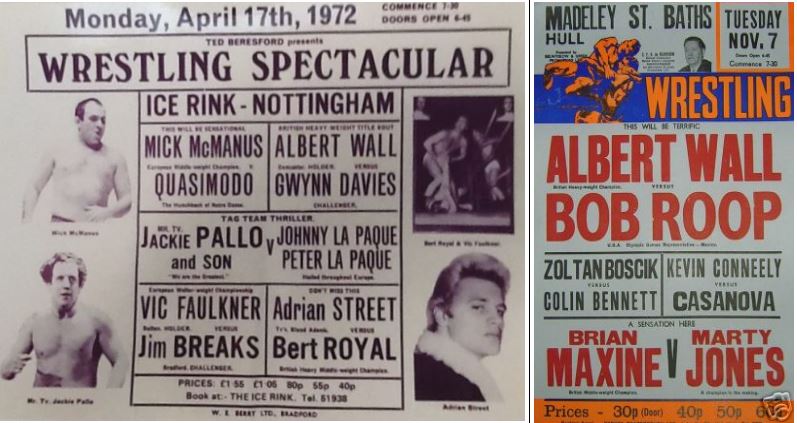
New faces in 1972 included Tiger Dalbir Singh, initially billed as Gil Singh. Meanwhile Quasimodo finished his final UK tour after a dozen years of channel-hopping that mirrored the life of our beloved magazine, as previously mentioned. He had high-profile 1972 bouts against Kellett, Royal and McManus, , as well as his sole television appearance, against Colin Joynson. Shirley Crabtree returned to the ring after a very long absence and made his first televised appearance against Salford’s Pete Curry. John Naylor started to make a lasting impact on all who witnessed his work. Marty Jones, Kevin Conneelly and John Casanova all started appearing with regularity in Joint Promotions rings.
In recent reviews of the year we have considered British wrestlers touring the USA, Canada and Japan. Following in their footsteps in 1972 was Kendo Nagasaki accompanied by manager George E. Gillette, on a tour from August to December. See Nagasaki here in Canadian action against fellow Brit, Geoff Portz, from whom he won the North American championship in September and to whom he also lost it back in his final bout at Christmas.
By 1972, however, the travel focus was more sharply set on the European continent and, specifically, the big German and Austrian heavyweight tournaments that ran, typically, for a month in a single city. The wrestler’s life was a happy one with no travelling to do. An endless list of British-based matmen had German stints, but some of those we associate most closely with Germany include, purely at random: Judd Harris, Dave Morgan, Barrry Douglas, Johnny Kincaid, Mal Kirk, Sean Regan, Terry Rudge, John Kowalski and Tony St Clair.
1972 was also the year of Tiptoe Through The Tulips, when, billed as The Gladiators, a wrestlers XI recorded the Tiny Tim classic and made national press headlines doing so. The photos and press coverage might all seem very hunky-dory amid 21st century nostalgia but at the time it was very worrying for loyal fans to see Bruno and Viedor elbow to elbow, and Kwango nestling so happily between McManus and Logan. Conspicuous by his intriguing exclusion was Mr TV himself, and the inclusion of Robby Baron gives investigative fans a very clear idea of who was calling the tune here.
Sharing the 1972 headlines with The Gladiators was Idi Amin, who had started the expulsion from Uganda of thousands of Asians.
Visiting for the first time was controversial North American loudmouth and gridiron star, Butts Logger Giraud. Butts faced all the top British heavyweights on his tour. Another controversial American, “Tricky Dicky” Richard Nixon, was re-elected as president at the end of the year but soon afterwards 5 men were arrested outside the Watergate buildings of the Democratic party……
If dropping attendances caused the demise of The Wrestler, the demise of the Wrestler also formed part of the thin end of the wedge of deterioration that would widen out over the ensuing 5 years with dumbing down and reductions in quality of all kinds. So brace yourselves for more unpleasant reading, but plenty of upbeat moments too, as we discuss the final mid-seventies Years of Wrestling that this site is interested in addressing.
 Wrestling Heritage