
Wrestling Heritage welcomes memories, further information and corrections.
On 15th February Leeds-based Gwyn Davies won the vacant British Heavyweight title from Tibor Szakacs in the final of an 8-man knockout tournament at Belle Vue, Manchester. But the most newsworthy event occurred on a Preston television presentation in February just four nights later when Masambula sustained a career-ending injury after taking a posting.
Since we wrote The King of Charisma, other comments have surfaced regarding this 1975 incident to cast a cloud of doubt over what really happened. Once again, a wrestler’s relationship with his employer, the promoter, is at the centre of the misgivings.
It is not the editorial style of Wrestling Heritage to indulge in tittle-tattle, but we will underscore a few facts here. There was no clear outward sign of injury. The promoters made nothing at all of this injury in either of two senses that might have seemed logical given that an extremely popular bill-topper was involved: they didn’t alert the sceptical world to the dangers of professional wrestling to prove it was a legitimately dangerous combat sport; and they didn’t subsequently make a fuss of the popular star. There were no collections for his family, no in-ring guest appearances, no mention of the event in the wrestling press or programmes.
Furthermore, there was no pressure from the outside world to “tighten up safety” in wrestling rings.
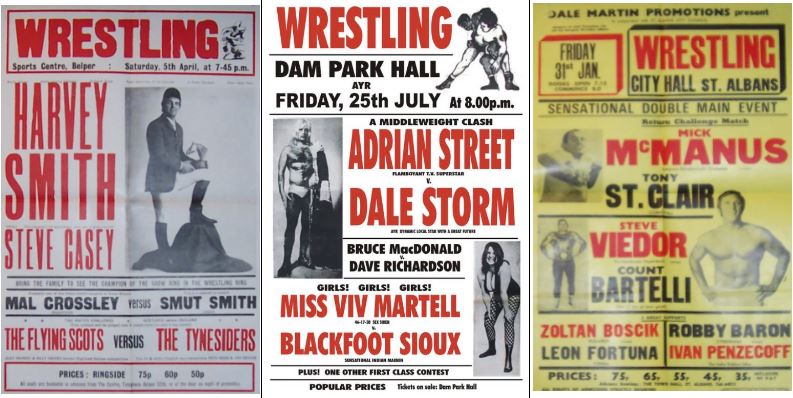
By 1975, the breakaway of big name Joint Promotions wrestlers to independent promotions spearheaded by Jackie Pallo was at its height. Amongst the 1975 disaffiliated we count Ricki Starr, Adrian Street Esq., Rocky Wall, Kendo Nagasaki, Johnny Kincaid, and The Borg Twins. Though Nagasaki and Kincaid returned to the fold, the others were completely excommunicated, abruptly, coldly. Masambula’s name had appeared on a few of these independent promotions and by 1975 he was straddling the fine line between being a renegade or reliable.
Put the pieces of the above puzzle together as you wish to try to understand the abnormalities of Masambula’s final appearance.
More puzzle-solving can be centred around Les Kellett’s month of November 1975. He faced Beautiful Bobby Barnes in Hastings on the 4th but four days later, on the famous Woking tv bill where Judo Al Hayes returned for his final UK televised appearance, Kellett was replaced by Barnes. That very night, Kellett was elsewhere, seemingly demoted to off-screen, facing Logan in Corby.
Kellett only appeared once more on a Joint Promotions bill, and as we saw with Pallo the previous year and Garfield before him, Kellett’s departure was on the fringe of Joint Promotions territory, in Dunfermline later in the month.
What caused this apparently sudden dismissal? Nestling between the Hastings and Woking presentations, Les Kellett had wrestled in Rochdale on an independent bill against Peter Preston. Since records of independent bills are harder to trace, we cannot determine how much other moonlighting Kellett had been doing, but the bare facts as we can see them now would indicate that the guillotine came down based solely on this Rochdale appearance.
Kellett’s Dunfermline opponent was Bobby Graham, and between Graham and Lee Sharron the pair appeared in over half of all Kellett bouts. All three would start to appear regularly on the independent circuit in 1976.
In some ways to close the above haemorrhage of top-of-the-bill stars, controversial V-sign show jumper Harvey Smith entered the arena in 1975. He displayed good ability, but was billed far far too often against Tally Ho Kaye. Bobby Barnes continued in single combat having been abandoned by his erstwhile Hells Angel tag partner. 1975 was the last year we saw Beautiful Bobby really going for it hammer and tongs, and he had heavy-middleweight title bouts with Bert Royal. In years to come, his hair would go dark and short, and he would even grow a moustache.
This Heavy-Middleweight division came to surprising life when another Londoner, veteran and rusting Iron Man Steve Logan did win the title at Liverpool Stadium from Bert Royal, his only competitive accolade over a long career. His reign was short, but significant.
Why do we attach such significance to Logan’s fleeting reign?
Bert Royal was an undoubted stylish technician, and the pair had faced each other on literally hundreds of occasions over the previous 20+ years, both in solo and tag action. Royal had always had a title, whether the Middleweight belt of the early sixties, or this Heavy-Middleweight version for the last seven years. So the very fact that he would be without a title for a while was surprising. But Logan by 1975 had become rather immobile and was clearly getting on in years, his televised bout with Caswell Martin this year was sad evidence of a mis-match. His brief spell as champion was neither heralded within the business nor particularly forward-looking for wrestling as a whole. So what prompted it?
We can only deduce that this was some kind of competitive accolade actually requested by Steve Logan. Logan was very popular amongst his co-workers, so maybe there was a dressing room push? The Iron Man’s Interregnum remains one of the many mysteries it is our Wrestling Heritage mission to unravel before it is too late.
The championship scene improved by comparison with the preceding two years with plenty of title bouts, but the only changes of champion were those mentioned above. Still, it was good to see stalwarts like Mick McMichael, Spencer Churchill, and John Elijah involved in meaningful title matches.
Another summer development was the arrival of Giant Haystacks in the Joint Promotions rings of the north. He couldn’t win a match! Confused promoters were very undecided as to whether he should be a friend or foe of Big Daddy.
By autumn, the sober longer-term match-making of Dale Martin had launched Haystacks on a long undefeated run during which most of the top heavyweight names on the southern circuit faced the Salfordian. It is to be greatly regretted that this super-heavyweight merely lifted his ring name from the Pictorial History of Wrestling, as had Steve Haggetty and John Kowalski and others before them. With minimal concentrated and original effort a much better ring persona could have been developed.
Jon Guil Don from El Salvador was one of the most exciting overseas visitors we have ever seen. But he was challenged for this accolade by Johnny War Eagle, the finest Redskin wrestler we had the privilege of seeing in action, and there were aplenty. So we are pleased to mark 1975 down as an exceptional vintage year for visiting talent. Even War Eagle, amidst hushed dressing room 1975 rebellions, and in spite of having had invincibility bestowed upon him like Starr and Two Rivers before, hopped ship to the independents for his final bouts in Britain. He had really acclimatized!
Guil Don, meanwhile, stepped justifiably straight into a Royal Albert Hall main event spot but was improbably defeated by the aged Iron Man, just as improbably as when Bill Ross had defeated him in Kilmarnock three months earlier. Otherwise, over the five months winter he spent in the UK, Guil Don’s record was very positive. Steve Haggetty was a regular victim, but just as with Jean Ferre six years earlier, once it became clear that Guil Don would not be returning, his results took a downturn and even Haggetty scored a one-off success. Ross, meanwhile, went on to prove just how insecurely invincible Scots felt they needed to be with a follow-up victory. In so doing, Ross merely highlighted how much to be respected were the London villains McManus, Pallo, and Logan when they actually travelled and put their greater reputations on the line in Scotland. Most southern fans never ever sighted Ross or his heavier equivalent, Andy Robin. Few complained.
As the black-jacketed Guil Don departed he was replaced, at least date-wise, by a new masked welterweight clad from head to toe in yellow. One flew Over the Cuckoos nest swept the board on Oscar night 1975 and landed, seemingly, plonk, in the middle of Dale Martin rings.
The maniacal Yellow Streak wrestled most of the lighter weighted undercarders in the south through the rest of the year, admittedly losing to Johnny Kwango, but never unmasking. Most interesting is a result from Walthamstow early in his run, the day after Guil Don’s farewell, when, we understand, The Yellow Streak defeated Chris Bailey.
On paper, this would have been impossible, but as we know, in wrestling even the impossible comes true, so we hope some fan will be able to shed belated light on that March match-up. We had gleaned the previous year that one of the earliest masked Kung Fu’s was Ian Gilmour, maybe there was another Yellow Streak? Or would a yellow hood have been a handily untraceable disguise for a high-kicking overseas employee fulfilling just one extra night’s work than the Home Office allowed …..?
Bobby Ryan emerged as an exciting title challenger in 1975, civil servant Dave Bond appeared in heavyweight support bouts, The Dynamite Kid débuted, but Chelmsford’s top welterweight and referee, Bob Archer O’Brien, left, sadly passed away, aged 58. As ever, Mick McManus represented the wrestling community at a contemporary’s funeral. Aristotle Onasis and P.G. Wodehouse joined Archer in the dressing room of the 1975 sky.
Of the five 5 Royal Albert Hall bills in 1975, McManus appeared on four, and this was surely too many even for his most ardent fans and served to block the way for emerging new bill-toppers. On the November show, McManus was even bumped from his favoured second position on the bill to allow Harvey Smith to get back up to Yorkshire that evening, and, for once, Niggly Mick witnessed an interval! After his bout with Kung Fu, he then got embroiled in an argument with Mike Marino causing a gash to Marino’s eye which led to Marino’s defeat at the hands of Big Daddy, a villain at the time. All of this was nice build up to a momentous 1976 evening, which we’ll describe “next year”.
Kensington decline continued as the magnificent magazine-like programmes of the past became flimsy and seemingly hastily put together four-sided leaflets printed on the cheapest of paper.
Fans had their second glimpse of an unmasked Kendo Nagasaki when Big Daddy removed his hood on television in Blackburn in September: more surprising than the tattooed head was how little resistance Nasgasaki put up. Big Daddy unmasked Nagasaki twice on tv, not to mention having him appear maskless on his This is Your Life tribute. Bruno Elrington, Steve Viedor and Count Bartelli all tasted rare overdue success against Nagasaki in various 1975 formats, and Mike Marino clocked up three victories against him. But Nagasaki’s most frequent opponent, Tibor Szakacs, never did. Someone should have told Tibor what was going on.
All in all, Yorkshire wrestling went topsy-turvey in 1975 with Wall, Kellett and Masambula in some peculiarly symmetrical way replaced by Davies, Harvey Smith and Big Daddy. With another Crabtree taking the key promotional throne in the land, the White Rose would continue its rise in the ensuing years, but not necessarily in ways appreciated by hitherto loyal fans.
If any item on the Wrestling Heritage site is to define and justify our existence, it must surely be this archaeological exploration of explosive events behind the 1975 scenes.
 Wrestling Heritage