
Wrestling Heritage welcomes memories, further information and corrections.

Six years after it’s maiden flight the supersonic aircraft Concorde went into commercial service crossing the Atlantic in around three hours. In North America two young men started a company that was to become Apple Computers, and the Olympic Games were held in Montreal. Not that Europe didn’t have excitement of its own. The Brotherhood of Man won the Eurovision Song Contest and in a non contest Harold Wilson resigned and handed the leadership of the Labour Party and Premiership of the United Kingdom to James Callaghan.
In the wrestling world much had changed since the beginning of the decade and some fans were becoming increasingly uneasy about the future.
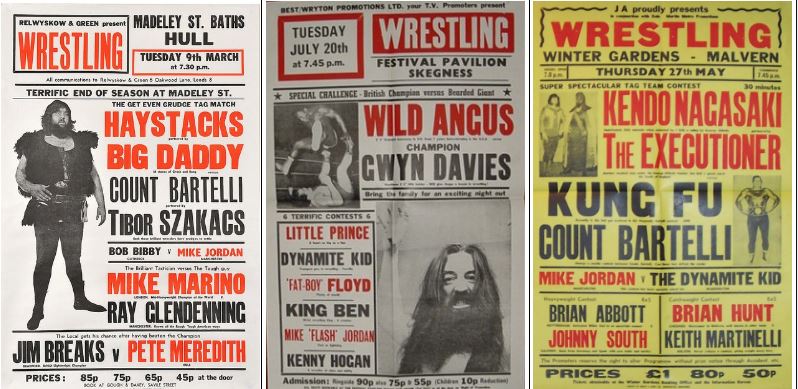
The big name in the wrestling world was now Big Daddy. With hindsight (and even without it) it seems unbelievable that the man who was to replace the old timers like Kellett, McManus and Logan as the number one attraction had himself been in the business for well over twenty years. Being the brother of the biggest matchmaker in the country no doubt gave him a helping hand.
Max Crabtree, Big Daddy’s brother, was Joint Promotion’s matchmaker throughout the north and midlands. He had proven himself to be a commercially successful independent promoter and seemed a shrewd choice when the owners of Joint Promotions sought someone to run the business. His matchmaking brought about a surge in interest and reversed the decline in attendances that had been apparent since the mid 1960s. The greatly needed influx of new wrestlers and a flair for matchmaking and promoting created renewed interest in the sport. An important part of his strategy was the transformation of his villainous brother Shirley into the children’s favourite, Big Daddy. It was the invincibility of Big Daddy that alarmed many followers. Not only did Shirley’s makeover seem implausible to fans, but the establishment of an overweight and unathletic wrestler as Britain’s top heavyweight beggared belief and damaged the credibility of wrestling as a competitive sport.
Seemingly contradicting Big Daddy’s invincibility Mike Marino faced both Daddy and Mick McManus in singles bouts in the opening Royal Albert Hall show of 1976. This peculiar double booking was the consequence of a fracas in November of the previous year and the results of the two contests were that Marino beat both these near invincibles by two falls to one. And if you thought it couldn’t get more ridiculous than this then you didn’t watch wrestling in the years to follow.
Wrestling stars in the ascendancy included Marty Jones, Mark Rocco and Dave Finlay. Although many other wrestling stars had left their rings there was no doubt, for now, that Joint Promotions were still far and away the dominant force in British wrestling.
Many of the familiar names that had left Joint Promotions were nearing retirement and were now offering their services to the independent promoters. One of them, Jackie Pallo, was not only wrestling but was himself challenging the supremacy of Joint Promotions as an independent promoter. Pallo’s shows created a lot of interest amongst fans. Some of this may well have been because of who he was, but it is also true that Pallo put on good shows with established wrestlers like Ricky Starr, The Wildman and the Borg twins. A combination of apparent business naivety and strong offensive action by Joint Promotions meant that Pallo’s challenge was destined for failure. Other wrestlers now missing from Joint Promotion bills and seen regularly on independent shows were Billy Two Rivers, Les Kellett, Peter Preston, Mike Dallas, Steve Haggetty, The Borg Twins, Al Miquet, and Adrian Street.
One legendary wrestler retired in 1976, and that was World Lightweight champion George Kidd. Kidd was an extraordinarily talented wrestler and no one matched his wizardry in countering moves. Had Kidd retired ten years earlier he would have left a void that would have been hard to fill. Sad to say that by 1976 he was well past his prime and was wrestling so infrequently that his retirement was much less of a milestone than his stature deserved. The lightweight division was so rich in talent that a credible new champion would not be difficult to find. Step forward Johnny Saint, the man who defeated Jimmy Breaks in November to take up the George Kidd mantle and take the new World Lightweight title.
However, whilst much the wrestling landscape was changing there remained a familiarity to the list of British champions. Jim Breaks headed the lightweights, thirteen years after first taking the title. He was also welterweight champion until losing the title to former champion Vic Faulkner in August. Brian Maxine was in his fifth year as reigning middleweight champion. Bert Royal headed the Heavy Middleweights. The light heavyweight division, which had stagnated prior to Billy Joyce’s 1971 annexation, was again discredited due to the inactivity of champion Joyce. Joint Promotions decided enough was enough and declared the championship vacant once again. In December Marty Jones defeated Mark Rocco to become the new British light heavyweight champion, bringing a new lease of life to this much neglected weight division. Mike Marino retained a secure grasp on the mid heavyweight belt and Gwyn Davies was champion amongst the heavyweights.
May saw the classic Steve Viedor bout in which he challenged Gwyn Davies for the British title. Viedor’s performance was one of the best we have witnessed, and was mercifully recorded and has been re-shown in recent years.
One of the big matches of 1976 was the battle of the masked men at the Royal Albert Hall. Masked man Kung Fu challenged the experienced and near invincible Kendo Nagasaki. Although talented and adored by fans most thought Kung Fu didn’t stand a chance. They were right. Nagasaki dominated the match and unmasked Kung Fu to reveal the likeable Irishman, Ed Hamill On the same bill two of the ageing Golden Boys, Mike Marino and Steve Veidor, beat Giant Haystacks and Big Daddy.
Whatever the superficial signs of success, though, the cracks were beginning to show. Robby Baron found himself unaccustomedly on the seventh bout of the evening in the Royal Albert Hall March spectacular in which Kung Fu was unmasked by Kendo Nagasaki. At best we can say strange decisions were creeping in all over the place, and on that same bill the great Count Bartelli was placed in Baron’s regular berth in the opening bout. Regardless of travel arrangements, this was not good and a sure sign the industry was not putting fans first.
Those who had been followers of wrestling for more than a few years were becoming increasingly alarmed by the growing reliance on increasingly sublime gimmicks, the emergence of oversized heavyweights like Giant Haystacks, eccentric matchmaking and the implausible invincibility of Big Daddy. Momentary renewed interest meant this was by no means the end of British professional wrestling, but it was almost certainly the beginning of the end.
4943
 Wrestling Heritage