
By David Mantell
Wrestling Heritage welcomes memories, further information and corrections.
Just when you thought it was safe to switch on the TV – QUINN WAS BACK!!!
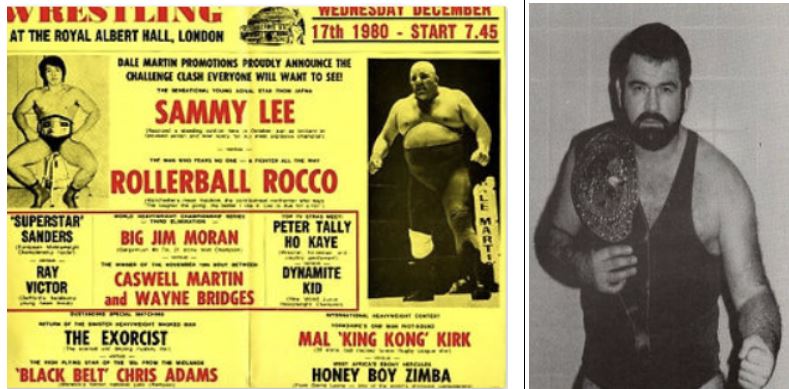
For a second year running the main storyline on ITV wrestling revolved around Mighty John Quinn and his worldwide coterie of Britain-hating friends. While he had been hanging out beyond our shores (in the German tournaments, actually!) World Heavyweight Champion Spiros Arion had kept the antipatriotic home fires burning and had been all set to humiliatingly lose his title to big Shirley when he pulled challenger Wayne Bridges on top of him. Now the man Arion had replaced on the shows was replacing Arion in turn – and looking out not only to avenge his loss to Daddy but also because his congressman (despite him being a Canadian) told him to bring back the world heavyweight title to America (despite ditto). Or so Quinn explained to TV audiences prior to his first comeback match against Caswell Martin.
Quinn taunted Bridges, calling his win over Spiros Arion a fluke, until Bridges in street clothes, ran into the ring. Bridges offered to defend his championship right then and there, taking his clothes off in preparation for an impromptu world title bout. Quinn got hold of Bridges shirt and tore it apart. Bridges got revenge by tearing up Quinn’s green cloak. An enraged Quinn nonetheless KOd Martin and then faced and beat Bridges in a non title match at the Royal Albert Hall (as a substitute for Arion) to earn a televised title match to be screened as part of ITV’s FA Cup Final coverage.
When the big day arrived, Quinn was accompanied in his corner by a luridly red/yellow/green-dressed Mr Yasu Fuji, a fellow Brit-hater who had been built up considerably as a heel in the preceeding months. When Quinn managed to win the title after referee Max Ward stopped the match on a TKO, Fuji raced into the ring to congratulate his friend in Brit-Bashing. At this point Kent Walton seemed to lose interest in the title change, proclaiming that Fuji would be “the tag partner”. Before the ring announcer had a chance to speak, Big Daddy’s music struck up and the big man strode down to ringside, looking rather cheerful despite the fact that his archenemy had just won the World Heavyweight Championsip. Kent meanwhile seemed more interested in the possibility of a Daddy/Bridges vs Quinn/Fuji tag match than the World title change that had just taken place. The truth of course was that the World title change was a setup TV angle to sell a non-televised arena show – an old trick over in America since the mid 1950s but rarely used over here, this being an exception. Unlike the previous year and the following year’s Wembley Arena shows, this year’s one – featuring that tag matchup with the predictable result and prettty much the predictable blow-by-blow – was not a televised show. It was however the wrestling poster sensation as billboard advertising was taken to new expensive extremes – I recall as a child our family car being stuck in a traffic tailback behind a routemaster bus with matching advertisments for the big fight posted to either side of the rear window.
While Mr Fuji was playing the Japanese “sneaky” villain over here just (like his namesake Harry “Mr Fuji” Fujiwara over in the States) another Japanese wrestler came over to Britain and caused rather a different stir. I missed his first fight against Cyanide Syd Cooper in Croydon due to being dragged out swimming by my dad, but my Grandad was absolutely raving with enthusiasm about the newcomer that night. “SAMMY LEE!!! WHOA!!! HE’S FANTASTIC!!!” Satoru Sayama, student of legendary Wigan Snakepit ripper Karl Gotch had come to Britain after two years in Mexico and in one night changed the pecking order around on the UK scene.
The flying kicking Lee was the one blue-eye of the period to seriously rival Big Daddy for popularity and was allowed to retain a lot of dignity when he teamed up with Crabtree, such as against Le Grande Vladimir and Mel Stuart, that was not usually permitted for Shirley’s tag partners, even scoring the deciding pinfall or, as in against King Kong Kirk, getting to fight back and hiptoss the much heavier Kirk around the ring, only finally tagging Daddy once he was already in a position of strength. This license to upstage Daddy contrasted heavily with the normal scenario in which the blue-eye would get squashed by the heels and then be rescued by Daddy from dire peril, it then being the heels’ turn to be squashed. (This was unless of course the heel happened to be “American Dream” Crazy Chris Colt at the Royal Albert Hall that year, who no-sold Daddy’s bodychecking offence and retaliated brutally – when he wasn’t wandering around randomly at ringside in a druggy daze – and, needless to say, got himself fired for his efforts.)
In time, Lee would become internationally famous as the original Tiger Mask and the original Japanese cornerstone of a UK/Calgary/Japan triangular scene of lighter weight stars. Another member of that scene was also making waves in 1980. At the end of the previous year, Young David appeared to have won the British Welterweight title from Jim Breaks, just like his cousin Dynamite Kid had done a couple of years earlier. That title change had been disallowed however due to interference in the match by David’s trainer Alan Dennison, but a rematch had been signed. The rematch however went badly for David, conceding a fall to Breaks and with his own first fall disallowed, until the final round when Smith scored an equaliser to make the bout 1-1 and force a further rematch. Dennison, who had been banned from ringside, came down to celebrate with his protege, annoying Breaks no end. Bigmouth struck – Breaks taunted Dennison and accused him of living vicariously through younger grapplers like Kid and David and daring him to come after the belt himself. Dennison took up the challenge and dethroned Breaks, becoming champion on-and off for the next couple of years. Dennison also made the final of a trophy tournament for 25 years of wrestling on ITV before going down in defeat to another Alan, Kilby. After the match, Dennison took hold of the microphone and claimed to be pleased to have lost to Kilby on account of the latter’s deafness (as though this was a handicap in the ring.)
Meanwhile one weight division down, another champion was on the run as Johnny Saint found his title in serious danger from the challenge of Steve Grey. The Peckham-based campaigner had caused a stir by upsetting Saint in a non title match and Saint had demanded a rematch in order to prove that his original loss was just a fluke. Grey however came up trumps with another 2-1 win over Saint, who in a final bid to maintain the dignity of the title after two defeats, insisted on making a defence of his championship against Grey. This third and final time was the charm for Saint who came back from trailing Grey 1-0 to winning the match 2-1. (Grey would eventually take the title from Saint years later in 1992 only to lose it back the following year.) The Saint-Grey matches were noted as particular classics of technical skill and speed and Saint vs Grey would remain a popular match-up for years to come.
The aforementioned 25th anniversary was marked not only by the trophy tournament but also by a special TVTimes pullout section detailing the wrestling game, featuring a centre spread line up of “goodies” – including Bert Royal, Vic Faulkner, Saint and Grey – and “baddies” including Giant Haystacks, Mick McManus, Bad Boy Bobby Barnes and Rollerball Rocco. Other features included an article on King Kong Kirk stuffing himself full of meat pies at Smithfield market with comments from wife Ilona about Mal’s appetite for meat pies. (Ilona would later be back in front of press interviewers in more tragic circumstances seven years later), a basic guide to holds and maneuvers and an interview with a group of wrestlers’ wives including Barbara McManus, Anne Hussey (Rocco) and, most intriguingly, Chris Adams’ then girlfriend Jeanie Clarke.
Ms Clarke was to become something of a wrestling star in her own right – already she had served as Chris’s second quite a few times (including one TV match) but she would gain even greater stardom years later in the United States when, having split amicably from Adams, she sent her new boyfriend Stephen Williams to be trained by Judo Chris (or Gentleman Chris as he then was.) Williams soon made it in the business as Steve Austin and brought Jeanie into the USWA in 1990 with him as Chris’s alleged evil ex-wife and the devious duo feuded with Adams and his actual (allegedly “second”) wife Toni. The best was yet to come however when “Stunning Steve” and Jeanie – renamed Lady Blossom and flaunting a deliberately loud annoying Essex accent, the impact of which was sadly lost on an American audience – arrived in WCW, with Lady Blossom helping Austin to beat Bobby Eaton for the WCW TV title after scratching Eaton in the eyes with her fingernails. A true female Abdullah The Butcher – and yet 11 years earlier she looked such a respectable young lady sipping her tea with Mrs Rocco and Mrs McManus!
TVTimes wasn’t the only listings magazine to give heavy coverage to wrestling that year. Years before Tough Enough, another reality show, Esther Rantzen’s “The Big Time” tried to make schoolteacher Keith “Rip” Rawlinson into a wrestling star. Elsewhere in that season, the show had turned one Sheena Easton into a popstar years before Britain’s Got Talent so the signs seemed to be hopeful. Rawlinson was featured locking up with Big Daddy on the cover of Radio Times, but when it came to the big night at the Royal Albert Hall, he was brutally stretched and hooked into hospital courtesy of Wigan Snakepit ripper “Golden Ace” John Naylor. At Rantzen’s insitence, the film was later re-edited to make it look like Rawlinson went home that night a sadder and a wiser man, but Rip’s first match was very definitely his last.
A leap year like 1980 was also the year of the Olympics – held in Moscow despite the United States’ efforts to boycott the event. The record books may say that the winner of the Freestyle Superheavyweight gold medal was the USSR’s Soslan Andiyev but as far as my six year old self was concerned, the REAL winners of the Olympic Wrestling that year were the tag team of Mighty John Quinn and Giant Haystacks as their tag team victory over Pete Roberts and JOhnny Wilson was screened during ITV’s Olympics coverage to the annoyance of serious-minded sports fans around the country.
On top of winning the “Olympic wrestling” Stax was also the easy winner in just a couple of minutes of the much touted KING OF THE RING – EIGHT MEN IN THE RING TV event in Lincoln (which actually turned out to be an eight man battle royal – just two up from previous six man battle royals shown on TV over the previous couple of years). And when Quinn was lured away to Orig Williams’ promotion at the end of the year, before he could have his rematch against Wayne Bridges, it might have been Bridges whom Joint Promotions booked to win their splinter version of the World Heavyweight title (Quinn continued to claim from the indies) defeating Big Jim Harris in a tournament final, but it was Haystacks who was set to retrieve the mantle of lead villain in the Crabtree family show and resume his feud with his former tag team partner Daddy.
The new year was lining up to be the year of the Clash of the Titans …
Suffolkpunch24 added:
Gwyn Davies retires from wrestling. Mike Marino returns to the ring.World Title declared vacant and a series of eliminations held. Wayne Bridges defeats,Sharky Ward,Caswell Martin and Gargantu.Johhny Saint defends World Lightweight Title against Steve Grey.
Ohtani’s Jacket added:
For 1980, I think Chris Colt getting fired from Joint is an interesting story. Almost all of the Breaks/Young David feud took place in ’79.The blow off match that led to the Breaks/Dennison feud was taped in Feb 1980, but the rest of the Young David stuff aired in ’79.
Tony added:
John Quinn & Tony St.Clair defecting were the biggest stories of the year and the implications. American Dream getting banned from WOS.
 Wrestling Heritage