
By David Mantell
Wrestling Heritage welcomes memories, further information and corrections.
1981 was the year of the Battle Of The Titans, the locking up of the big guns, the year when Crabtree finally locked horns with his big rival from across the Pennines … Max Crabtree, that is, not Shirley! No, the great war that kicked off in 1981 was not Daddy vs Haystacks (although we’ll get to that in a bit) but Max’s war with Brian Dixon. The greatest UK promotional battle in which the title would change hands of top promoter in the UK.
And yet it all started with a massive disappointment for Dixon. He had been co-promoting for some time with the former Mr TV, Jackie Pallo ,and by 1981 they had hopes of getting a slice of the ITV World Of Sport action. A five year contract covering January 1982 to December 1986 was up for grabs and Pallo and Dixon had approached ITV to jockey for a slice of the action. To their utter dismay, ITV simply ignored their claims and re-signed with Joint. While Pallo simply went into a sulk from which he emerged with a kayfabe-breaking expose book “You Grunt I’ll Groan” in hand, Dixon calmly set to work to undermine Joint’s self-confident claim to be THE major league UK promotion. Already in the past year, World Heavyweight Champion Mighty John Quinn had reverted back to his early bolt hole in Orig Williams’s promotion before moving on in turn to Wrestling Enterprises. Now Dixon becgan a campaign of luring away top stars – esepcially title holders – with a campaign of better money and not having to make the overweight non shooter who fled from Bert Assirati with his tail between his legs in ’66 look good.
Hot on Quinn’s heels came the current British Heavyweight Champion, Tony StClair. In his address at Orig Wiliams’ funeral in 2009, StClair would reveal that taking the belt with him was a specific stipulation of Williams’ headhunt approach to StClair. Once Tony was firmly installed in the future All Star in 1981 as British Heavyweight Champion, it inaugurated a connection between Dixon’s operation and the belt that, to this day, gives a powerful bloodline to the All Star British Heavyweight title (even if they do insist on going through periods of calling it the Superslam title these days.)
The title can be traced directly back to the title StClair brought to All Star in 1980/1981 – the same title he had regained from Giant Haystacks and first won from Gwyn Davies (who had retired in 1980). It had changed hands solidly in the ring since 1970 when Albert Wall had claimed the vacant belt abandoned by Billy Robinson for pastures new across the Atlantic, and which had been the undisputed title since 1966 when Crabtree had done his shamefaced bunk from Paul Lincoln’s original BWF. Ultimately it can be traced back to 1930 and Atholl Oakley just like the NWA World Heavyweight title can be traced back to Hackenschmidt in 1905. All Star’s belt, Dixon and his supporters can claim, is the rightful version of the title and any other version in the UK is a tuppeny ha’penny version with no roots, and it all dates back to StClair’s arrival in the promotion.
The title was to stay undisputed for a few more years as Joint and ITV did not feel confident enough to set up their own version until 1985. The version of the World Heavyweight title which Spiros Arion had arrived claiming in 1979 was another matter. Since Wayne Bridges had not received his 90 day return match from Quinn – despite him having charged the ring and demanded that the Canadian “name the day” – a tournament had been set up. After proceeding through Le Grand Vladmir, Wild Angus, Mighty Yankee Steve Di Salvo and French veteran Professor Adi Wasser (the latter now sporting a mask for no apparent reason – he had done nicely enough bare-headed for years) Bridges finally got his big match against yet another loud mouthed North American, “Missisipi Mauler” Big Jim Harris, (in the days before he claimed to be Kamala, a cannibal from Uganda.)
The big match took place at Wembley Arena where Bridges the previous year had teamed with Big Daddy to beat Quinn and Yasu Fuji. Bridges duly won his title back, but this was to be the beginning of a souring process for him as he would increasingly take on a heelish outlook in his dealings with the contenders he faced, notably against Pete Roberts against whom Bridges suffered a DQ loss on television towards the end of the year.
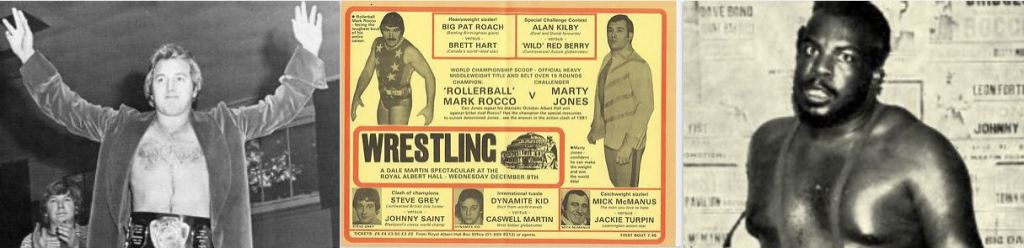
Another World title to be decided at Wembley Arena was the Mountevans World Heavy Middleweight title between Rollerball Rocco and Sammy Lee. However, there was to be a disappointment as Lee suffered a family bereavement and was forced to fly back to Japan and miss the big show. In about the nearest thing as far as anyone can make out to a defeat for the sensational Sammy, Rocco was declared the winner and Mountevans champion on a forfeit. It wasn’t really a satisfactoy way to win the title, however help for Rocco’s World championship credibility was to come when Joel de Fremery, the FFCP claimant, came over to the UK with “his” version of the title and duly jobbed it away to Rocco on TV from Southport at the end of the year. French wrestling was in a major downwards swing that year – the cancellation of TV coverage came hot on the heels of a reclassification of wrestling as entertainment by the French government which was not only embarrasing for the business across La Manche, but also landed promoters like Roger Delaporte with a huge tax bill. The title escaped all this and came to healthier climes in England. Now firmly entrenched as the Unified Euro version World Championship claimant, Rocco further solidified attention on his title with a fantastic defence against a visiting Dynamite Kid, ending in a double knockout near the end of the year (televised shortly after the new year.) And of course Rocco and Sammy Lee had not seen the last of each other as they would later battle it out under hoods as the original respective versions of Tiger Mask and Black Tiger, capturing the imaginations of the Japanese public and even taking their feud to the WWF and Madison Square Gardens in time.
Whatever Rocco’s status as a champion, his status as a despicable heel took a severe battering however when TVTimes – then undergoing a rebrand as TVTimes Magazine in an attempt to compete with the likes of Family Circle – published a legit interview with Rocco’s wife Anne about her wonderful husband, always helpful and busy around the house. No irony there – it was a gushing portait of married bliss with the perfect house-housband, complete with portrait of the Roccos busy at work around the kitchen stove together. All very good for the Roccos’ marriage but less good for Rocco’s bad guy image – it was all one reason less to hate the man! Some American promoters would hav fired a heel for an interview like this, certainly most would have kittens over it. For British Wrestling it was just another day at the office – it’s hard to take the gooddies versus baddies war seriously when Daddy and StClair post for photos with heel Jim Breaks congratulating him on a trophy win. Within a few years we were to be treated to more heat-destroying lifestytles of the bad and cheating articles such as Wild Angus’s feature on his love of fishing.
Of course, as any smartened up supporter of the biz will insist on telling us, the only title that REALLY matters is the top of the bill. And top of the bill at Wembley was, as mentioned in my opening paragraph, Daddy and Haystacks. After long years of Stax on the run and Daddy chasing after him (most recently at the Cup final where Stax and Angus had scored a fall over Daddy’s partner Alan Kilby only to be DQ’d when Stax added an extra postmatch splash on Kilby’s legs) the two Big Men and former tag partners had that follow up singles match to the double disqualification from November 1977. Like Daddy’s match against Quinn from 1979 it was held as the main event of a Wembley supershow. Like the Quinn match, it was held under Knockout Only rules (an American style Texas Death Match in all but name). And like the Quinn match, the result was a quick win for Daddy. At least Haystacks got a short period of real offence in over Daddy, kicking him around the mat even if Big D had not actually been knocked down but had simply got down to help up the injured referee. It was just about the only sustained advantage anyone got over Daddy on TV in the 1980s and it ended with Daddy moving out of the way of a Haystacks splash before eventually knocking Stax over the ropes and on to a table laden with flowers (which Stax would later claim to have slipped on and then been the victim of a fast KO count, thus keeping the feud alive as Stax demanded a rematch and Daddy did his utmost to call his rival’s bluff.
It all did good business with the family audiences but devout wrestling fans were dissatisfied and would continue to defect with wrestlers to Dixon. The Merseyside outfit’s biggest storyline in 1981 was a super showdown of a different kind as Kendo Nagasaki briefly came out of retirement, once again wearing his mask, to finally get his hands of one of the biggest out-of the ring banes of his life. Bill Clarke had been doing his imposter Kendo Nagasaki act for indie promoter Sandor Kovacs since the late 1970s and their continued promoting of Clarke as “Naggers” had at one point earned the two of them short prison sentences for contempt of court. Now in 1981 Clarke, billed in something of a compromise as King Kendo, was taking his act, over-wide visor and all, to Wrestling Enterprises. He was in for a surprise however as George Gillette himself – clad in baggy check trousers, bow tie and black jacket and looking for all the world like the Patrick Troughton Doctor Who’s cousin from the wild woods – turned up at the end of KK’s shows to challenge him to a match with the REAL Naggers. Night after night around the country the two Kendos met and night after night, Nagasaki would defeat and unmask King Kendo as George Gillette told audiences how now they had seen the real McCoy (not Kid – Mark Boothman was as yet to turn pro although his father King Ben would reach the finals of a British Heavy Middleweight title tournament due to Rocco’s World title win, only to lose in the championship match to Alan Kilby.)
Dixon had briefly gained one legend in Nagasaki – they would unite more permanently in 1986 – but he lost an important star in 1981 when World Middleweight Champion Adrian Street went off to America. Another champion, however would be lost in a more tragic way when Mike Marino, quadruple crown British/European/Commonwealth/World (Euro version) champion and backstage voice of power, died suddenly of lukaemia on the way back from a show with his protege Mal Sanders at the wheel. It was the end of the legend of the Golden Boy, the start of a 21 year vacancy for the British title until Dean Allmark in 2002 and a rotten experience for Sanders who had already had enough bad luck losing his European Middleweight title to Keith Hayward (controversially, the two would also battle for Street’s vacant World title in South Africa’s apartheid fun palace Sun City the following year.) Still Sanders did get to win a trophy in his mentor’s honour, beating Cyanide Syd Cooper (“Marino would NOT want him to win his shield” noted Kent Walton tartly) and getting the trophy presented to him by Marino’s widow.
So, war had been declared. Dixon had Quinn, StClair and briefly Nagasaki, but Joint could whitsle that at least it had Rocco and Bridges. What could go wrong there?
1982 happened, that’s what.
Suffolk Punch24 added:
Keith Hayward wins the European Middleweight Title.

