
By David Mantell
Wrestling Heritage welcomes memories, further information and corrections.

Up the top of the bill, Joint continued to coast along on the wave of Big Daddy mania and the big man himself threatened to expand beyond the world of wrestling and into the wider media. His Saturday morning childrens’ TV show Big Daddy’s Saturday Show, touted at the time as a potential replacement for the mighty Tiswas, reached the stage of having a pilot episode recorded before the big man dropped out at the last minute and it became, rather anodynely, The Saturday Show. The Crabtree family’s more bread-and-butter Saturday show, the one on at teatime, continued securely along as it began its new five year contract. And yet on the horizon the clouds were gathering. While Jackie Pallo, the former Mr TV, seethed at the new contract and reached for his kayfabe breaking pen, his former business partner Brian Dixon of Wrestling Enterprises, aided and abetted by his former boss Orig Williams, began to turn from a heel-snapping nuisance into a serious menace to the Joint empire. At the end of 1981, Joint’s credibility flagships were two world champions Rollerball Rocco and Wayne Bridges. This new year would see both kingpins move to the opposition taking their titles with them plsu another important champion, Johnny Saint.
Bridges was something of an embarrasing loss for Joint as they had gone to the trouble of splintering their World Heavyweight title the previous year following Mighty John Quinn’s defection only for their replacement champion to go and join the opposition. Added to this, Bridges had been increasingly evolving into a heel and was proving to be an important villain for Joint. He had gotten into a feud with “Super Destroyer” Pete Roberts over his version of the title. Roberts had beaten the champion in two straight falls in a non title bout and then issued a challenge for a championship match. Bridges rejected the challenge, telling Roberts “Who have you ever beaten”, to which Roberts smartly replied “I’ve just beaten YOU, Bridges, that’s who I’ve just beaten. The title match duly took place at the Royal Albert Hall with Bridges looking in serious danger of losing his belt before scoring the winner in the penultimate round, and again at Croydon where the two resolved their differences at the end. When Bridges was poached by Dixon however, his former nemesis Quinn had meanwhile dropped the older version of the title to British champion Tony StClair. So it was back to heel with Bridges as he engaged St Clair in a title unification feud at Wrestling Enterprises shows, eventually won by StClair. Meanwhile Joint were once again left without a World Heavyweight champion. No North American claimant would come over to Britain and all strands of their locally created version were now on the independent circuit, so they would turn their attentions to the continent.
Rocco was to prove to be a particularly vital gain for Dixon, who would later describe the Rollerball as his best employee, both as a worker and as a loyal friend. Before making the jump, he had already further developed his reputation as a formidable World Heavy Middleweight champion. With Dynamite Kid now out of the country, Rocco had made a high profile defence of his title against Eddie Hamill, the one time masked Kung Fu (still calling himself by that name) whom Rocco beat 2-1 in Burnsley and by default at the Royal Albert Hall when Hamill failed to show. Orig Williams had made it a specific condition of taking on Rocco that he brought the title with him and Rocco would continue to build his reputation as a champion on the indie circuit. First, however, he had unfinished business with Sammy Lee who was back in his home country with a mask on, billed as Tiger Mask after a popular comic book character. Rocco would in turn adopt the identity of Tiger Mask’s archenemy Black Tiger and carry on the war from 1981.
Hamill would also defect to Dixon and Orig around this time, but a new masked pseudo Japanese star was doing the rounds. Veteran Ian Gilmour had made his TV debut as the masked Kamikaze the previous year, giving Jim Breaks quite a scare with his unorthodox ring style before losing by TKO after falling to the floot outside the ring. Now he was back again with an even scarier red/white mask with long pointed eyes and a big evil grin – “I can hardly bear the sight of him!” complained opponent Tally Ho Kaye who ironically also saved face with a TKO after Kamikaze got caught between the ropes. Another would be Japanese masked man to make it to TV this year was infamous Kendo Nagasaki impersonator Bill “King Kendo” Clarke who came to Joint hinting that he had some sort of psychic connection with the real Nagasaki (or so Joint’s event programmes hinted) and managed to get onto the screen in a battle royal won by Daddy, as well as a Big Daddy tag under another alias, the Red Devil (previously property of one Charlie Glover, father of Brian “Leon Arras” Glover.) Teamed with American John Raven, the Red Devil Clarke was molested out of his mask by Daddy at the end of the match and ended up returning to the dressing room wearing a swimming cap.
Johnny Saint’s defection gave Wrestling Enterprises something to attract the purists and reflected the earlier defection to Paul Lincoln by his predecessor and sometime mentor George Kidd back in the 1960s. However another World Champion would soon come of age to engage the serious side of the TV coverage of Joint. Following the tragic death of Mike Marino the previous year, a tournament was held for his World Mid Heavyweight title, the jewel in his quadruple crown. Former British Light Heavyweight and Heavy Middleweight champion Marty Jones, at one time something of an archenemy of Rocco’s, took the title beating France’s Bobby Geatano in the final and earlier in the tournament beating a young man from Calgary called “Cowboy” Bret Hart. Hart, like Rocco and Sammy Lee, was part of a three way trade in lighter weight wreslers between the UK, Japan and Calgary (referred to by some American historians as the “junior Heavyweight Triangle”). Two other men involved in this triangle were Dynamite Kid and his cousin Davey Boy Smith. The latter returned to these shores still calling himself Young David but no longer the skinny youth of previous. A now rather muscled Smith was entered into an elimination match for a shot at British Heavy Middleweight Champion Alan Kilby. He ended up drawing the short straw, losing the match – and the televised title shot to another young Dave making his second TV appearance, Dave Fit Finlay, the son of the legendary 60s/70s Irish heel and Olympic coach of the same name.
At this point in March, the younger Finlay was quite the gentleman for Joint Promotions and ITV, sticking to the rules and to sportsmanship in his match with Smith (although some fans knew him better and booed him for past nefarious deeds with Wrestling Enterprises.) Come the summer and come the feud with champion Kilby however, the more familiar villainous Finlay was starting to show. Even before the TV cameras could get a look-in, Finlay had already won the title from Kilby in Bath in June before losing it back some point within the next couple of months and then regaining the title in Croydon in September. TV viewers had to settle for watching Finlay as twice and current champion defending against the dethroned Kilby in a return match from Derby that ended in a 1-1 draw. Kilby and Finlay would continue to trade the belt back and forth into the new year.
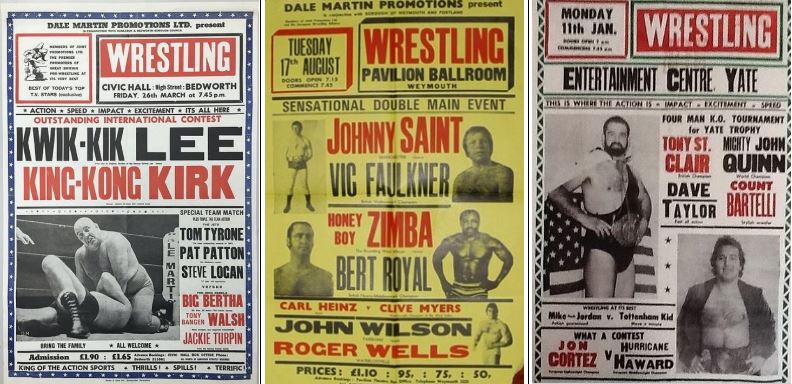
Finlay would also cause a splash in the tag team ranks with another up and coming villain making his TV debut this year. Peter Northey, the son of legendary 50s/60s heel Peter Northey aka Roy Bull Davies had been making a name for himself with Wrestling Enterprises as the blond-haired thug “Bad Boy” Steve Young. He had even got a foot in the door of the 1981 Battle of the Kendos feud, tag teaming with King Kendo in matches agains the real Kendo and his sometime mentor sometime archrival Count Bartelli. Then Young lost a hair versus hair match and his image and career took a turnaround. Young rebranded himself as Skull Murphy, a gimmick made famous originally by the late Joe Murphy for New York’s Capitol Wrestling back in the 1960s. This new Skull Murphy adopted a more demonic image than the American original, sporting black ring gear with a distinctive winged Death’s Head motif. He caused controversy early in the year by being mysteriously pulled from the FA Cup Big Daddy tag match in which he was due to team with Crusher Brannigan. Perhaps Joint were worried that the “Plymouth Dynamo Bundle of Energy” would not be such a pushover for Big Shirley, but he was replaced with Banger Walsh for the Croydon match against Daddy and another Japanese wrestler, this time a real one, future Japan UWF head honcho and martial arts legend Akira Maeda, following in the footsteps of fellow Karl Gotch student Satoru Sayama in coming to Britain and being labelled a relative of Bruce Lee – in this case Kwick Kick Lee.
Murphy and Maeda did get to eventually square off early that summer when Murphy formed a team with Finlay, calling themselves The Riot Squad – an often used team name including by the original Skull Murphy in partnership with fellow shaven headed American heel Brute Bernard. Together, Finlay and Murphy disposed of Kwick Kick and Iron Fist Clive Myers (one of Myers’ many Team(s) of Martial Arts) and towards then end of the year would be entered into a special ITV tag team tournament for a pair of belts (Tag team championship had not been accounted for in the Mountevans Rules and it would be another seven years before All Star set up the British Open Tag Team Title so a pair of tag team title belts was a novel sight on ITV. The Riot Squad disposed of Kilby and the clean Brummie version of Steve Logan in the semi finals and faced the Fighting Wilson Brothers – “Tarzan” Johnny and Pete in the finals (who had beated Myers and Maeda in the other semi when Myers missed a high flying move and landed at ringisde.) Murphy was ecstatic when he and Finlay won the pair of belts, leaping around the ring with a big grin on his face as the crowd booed heartily.
Away from wrestling, another new start in the world was the launch of Channel 4 on 2nd November. Its Welsh sister channel S4C was to be the home of Orig Williams’ Reslo programme from the station’s launch. Reslo would persist as many other phases of British wrestling history came and went. It became a shop window for the British scene after the end of ITV wrestling – even providing footage for several early 1990s VHS releases – but in the meanwhile it was able to push the envelope with what could be done on TV wrestling. Running from the old principle that you can get away with anything in Wales, especially in Welsh, because no one in London would be paying any attention, Orig’s show broke new ground by giving the ladies’ scene its first proper TV exposure with the TV cameras filming the matches of Mitzi Mueller, Klondyke Kate and the disturbingly gimmicked “Soho Sex kitten” Nughty Nicky Monroe (before she turned blue eye on Kate and became rather less naughty.) He also flirted with violent gimmick matches such as cages, ladders and chain matches. It also provided UK fans with a (for the time) rare regular glimpse of the wrestling world beyond their shores, frequently screening bouts from the CWA in Austria and even bouts from American territories.
Channel Four would end up killing off wrestling shows in 2000 after airing the infamous Mae Young “puppies” incident as part of a two year stint of broadcasting the WWF. For the time being, however, its biggest impact would come on a young wrestler from Merseyside making his debut that year, Robert Brooks. Renamed Robbie Brookside by Dixon, he would go on to great things in a career that would run into the 2010s, and has only just recently settled down into a new role as a WWE trainer. Elsewhere, 1982 was to prove to be an end as Mick McManus bowed out for the last time, suffering a defeat to comedy blue eye Gary Catweazle Cooper and getting the Ann Rocco style heat deflation treatment from a ringside fan interviewed for TV Times – “Of course he makes you angry with that big grin of his, but that’s only part of his act and all his fans know he’s a real darling!”
Rasit Huseyin Joins In….
The beginning of the Wayne Bridges-Pete Roberts feud, at Leamington Spa at the end of 1981, Bridges inexplicably lost his cool, attacking Roberts on the deck continually and then getting disqualified.
At Aylesbury in early 1982, Roberts beat Bridges 2-0, a match dominated by Bridges arguing with referee Max Ward, then taunting Roberts with “Who have you ever beaten”? Roberts simply replied “I’ve just beaten you Brides, that’s who I’ve just beaten!” Roberts then had a crack at Bridges’ title at the Royal Albert Hall, and gave a good account himself again but Bridges prevailed in the penultimate round.
They faced again later in the year at Croydon where Bridges reverted to being a face.
Also that year, Kung Fu (Eddie Hammil) returned to Joint after a 3 year absence, and had a great bout against Rollerball Rocco at Burnley, losing 2-1. Kung Fu was due to face Rocco for the title at the Royal Albert Hall, but didn’t turn up and the title match was abandoned.
However, Steve McHoy did make his TV debut and impressed despite losing the bout. The Riot Squad tag team of Fit Finlay and Skull Murphy was formed and caused mayhem at many venues up and down the country, and caused uproar at Croydon winning the World of Sport tag team belts. On the same night at Croydon came Marty Jones’ finest hour, beating Bobby Geatano of France to win the vacant World Mid-Heavyweight title.
However, 1982 also saw the the defection to All Star of wrestlers such as Rocco, Saint and Bridges.
It also saw the retirement of the legendary MicK McManus, who appeared on TV more than any other wrestler. His last bout was against Catweazle at Bedworth in May.
Ohtani’s Jacket added:
In 1982, Maeda was fairly over in his run as Kwik-Kick Lee. Marty Jones won the vacant World Mid-heavyweight championship over Bobby Gaetano. Bridges and Roberts had that feud where Bridges turned heel.Reslo started in 1982.
 Wrestling Heritage