
By David Mantell
Wrestling Heritage welcomes memories, further information and corrections.
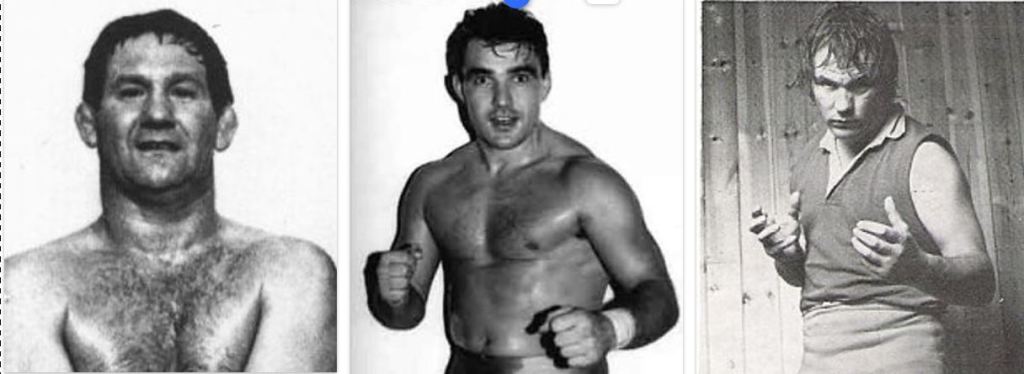
One of the most aggravating clichés about British wrestling in the 1980s (and one that is often turned against the entire history of the territory by such new school ideologues as Alex Shane and Fin Martin, not to mention wrestling-haters more generally) is the idea that this was an era dominated by flabby unskilled superheavyweight pachyderms. In fact the 1980s, particularly as the decade wore on, was to be a truly golden era for young technically skilled lighter weight wrestlers. Earlier in the decade we saw the rise of the Birmingham Steve Logan and Keith Haward, later on we would see Kid McCoy, Peter Bainbridge and others. But 1984 was most of all the year of the coming of age of the brightest young star of this era – Danny Boy Collins (above left). When we first saw him in 1983 he had given veteran British Welterweight Champion Jim Breaks quite a scare, scoring a fall off him before eventually going down two falls. But that was the raw, green newbie Collins. A year later with his skills polished (and a trip to the barbers having put paid to that awful side parting hairdo he had the previous year) Danny with his finely executed cartwheeling reversals was ready to do some serious damage. It gradually became clear that if his last year’s self had given the champion a scare, 1984 Collins totally had Breaks’ number.
The nightmare began for Breaks early in the year at a TV taping in Winsford in February. Collins and Breaks had been entered into an eight man knockout tournament in which all matches were to be scored in points to determine which wrestler was to advance in the event of a draw. Danny had got a points win in the first round against veteran crumb heel Cyanide Syd Cooper and then got an unlikely knockout against another hated villain, Tally Ho Kaye, before finding himself facing the man to whom he had given a hard time in his TV debut the previous year. Collins managed to once again score a fall and take the lead, but this time Breaks would not be able to wreak cruel revenge – instead he wreaked rather sloppy revenge, getting himself disqualified and handing the tournament win to Collins. Cry Baby Breaks was predictably livid and issued the following challenge: “If that kid can get me in a fall, a submission or a knockout, I will give him five hundred pounds. FIVE HUNDRED POUNDS!!!” The match was duly made as a one fall bout filmed in Rotherham on Leap Years’ Day and Collins duly got awarded £500 of Breaks’ money. Luckily for Breaks it was indeed a one fall contest or else Danny might be walking home with £1,000 of Cry Baby Cash. Unluckily for Breaks, he was now a compromised champion and the belt he finally took away from Alan Dennison (who sadly died this year from a heart attack in the dressing room in Southport.) had to urgently be put up for grabs to restore its honour.
That match took place in March at the Royal Albert Hall and Danny proved that his previous two wins were no flukes when he beat Breaks 2-1 to become the British Welterweight Champion at just 17 years of age. For Breaks it was the late 1970s horrors of Dynamite Kid all over again when young Billington had taken British titles off Breaks at two different weight divisions. After their first return match ended in a no contest when referee Peter Szakacs collided with the new young champion and suffered a head injury, Breaks demanded a rematch. He got it, but one should always be careful what one wishes for in case it all comes true; Collins scored a second 2-1 win over Breaks at a Nottingham TV taping (the same night as Vic Faulkner and Cooper drew in the finals of the Golden Gown tournament – Vic would win the rematch by DQ in June) opening the door for the youngster from Bristol to go on to face other contenders. With Breaks disposed of and Dennison deceased, next in line was another former champion and nemesis of Jim, namely Steve Grey. Twice during 1984, the second time in a pair of TV bout, Grey would win the title off young Collins only to lose it back in the return match. By the end of the series, Collins was a three time champion and was facing his next challenge from veteran heel Marvellous Mike Bennett who had defeated Collins in a one fall contest late that year and was now coming after Danny Boy for a championship match. Also coming after Collins was veteran former French heel turned referee turned promoter Roger Delaporte who was keen to make Danny a star in France and North Spain and was looking ready to give Collins a serious crack at European Championship status.
Collins was not the only breakout star that year – 1984 marks the earliest surviving footage of a man who would go on to be the very lifeblood of All Star Wrestling (as Brian Dixon renamed his Wrestling Enterprises of Birkenhead outfit around this time.) Robbie Brookside, less than two years after renaming himself after Channel 4’s flagship new soap, went in front of the camera, albeit the amateur camera at a Butlins holiday camp that year to face heelish opponent Sadistic Sandy Scott (“hair and makeup by Marguerite of Penzance” or so the yappy redcoat MC told the young family audience who spurned the sunlight pouring in through the windows in favour of the ring action. Scott dealt with the wretched red jacketed fool most elegantly, planting a great big kiss on the man (leaving the MC complaining about “he could do with a shave!”) Teenage Brooskide, at this point wearing a top with his trunks, was cast in the role of no nonsense plain speaking Scouse good guy, sent on the role of avenging the honour of the annoying Butlins staff man. Despite a bevy of rule bending tactics, Brookside, with an audience of kiddies behind him (chanting Easy Easy even though Big Daddy would not have touched this show with a bargepole) defeated Scott, leaving the Redcoat to inflict twofold justice. Firstly, in relation to the kiss, he poured out the entire contents of a water bottle from the corner bucket on the prone Scott. Then in relation to Scott’s heel tactics, he announced that there would be an enquiry into the match and until this was complete Scott would receive no money for the match. If I were a wrestler, I would be VERY lairy about this sort of announcement in case the promoter used it as a context to legitimately sting me, but Scott came back for more. Later that holiday season, he and Karl McGrath (ironically in real life Brookside’s trainer in the industry) combined to attack Brookside’s young second, Ian Doc Dean, but Brookie battled back, first beating Scott in another singles match then teaming with schoolboy Dean to beat Scott and McGrath in a tag match (in which bootleg DVD sellers later dubbed as being the Liverpool Lads tag team’s debut match, which it probably was, so fair enough.) Once again the stingy Redcoat decided to withhold the heels pay for simply doing their job and being heels. The point of all this is that even wrestling on a holiday camp being filmed on an early camcorder, teenage Brooskide was already establishing his credentials as a magnetic charismatic blue eye who waged war on the heels for the fans. As All Star continued to grow, so too did Robbie’s own star.
Another important young talent coming of age in 1984 was Nipper Eddie Riley (no relation to legendary Wigan Master Billy Riley or his light heavyweight champion son Ernie.). His matches against another promising youngster from this year, Ian McGregor (no relation to the chairman of the National Coal Board making the news every night in 1984 as the miners strike raged.) are fascinating technical classics in no small part due to Riley’s incredibly inventive style in countermoves. Nipper and McGregor drew 1-1 in their first TV contest with Nipper winning 2-1 in a rematch. The two youngsters would form a tag team by the end of the year. Not every breakout star in 1984 was a lighter weight however – indeed the tall Brookside was already a Heavy Middleweight, while a burly ex skinhead turned Scots Guardsman Drew McDonald who had previously gained experience as a “ringer” – faux audience challenger – on the same shoot challenge booth in Blackpool as Brookside was working as carny shooter under a mask and who would have a major feud with Robbie for several versions of the British Heavyweight title in the Noughties, got an unlikely TV breakthrough, as the blue-eye in peril tag team partner of Big Daddy in his FA Cup Final match against Giant Haystacks and Dave Fit Finlay.
In time of course Drew would go on to make his name as a heel opponent of Daddy and Finlay would have his own feud with the big man from Halifax in 1986 and we will deal with these in a couple of articles’ time as well as Finlay’s own championship activities later in this article, but we have finally arrived back at the subject of Daddy’s own ongoing storylines as all heel activity against him was being masterminded by everybody’s favourite fat bearded slob ex-clown, Gentleman Charlie McGee. We saw him last year as first his all-masked tag team The Masked Marauders and then his all bald tag team The Terrible Two came a cropper at the hands of various Daddy partners. Now in spring 1984 at the same Winsford TV taping where Danny Collins beat Breaks in the knockout tournament, the Masked Marauders gimmick came back to TV one last time as Marauder Major was defeated and unmasked by his second to reveal Scrubber Daly (although he continued with the mask at halls until the bout was screened) Charlie was there at the final death of his beloved all masked project, jumping into the ring at the end, to scream that the defeat was “a liberty” and to introduce his new Man Who Will Beat Big Daddy, a 30 Stone shaven headed monster called Tiny Callaghan. As Charlie screamed his diatribe and Daly stood and took his unmasking like a man (at least he didn’t have to have Daddy personally molest the mask off him like some others had done.) the bald moustachioed giant stood holding a parasol apparently bought from the same umbrella show as George Gillette’s one from circa 1978. It was quite a different story when he got into the ring to face Daddy however – British TV viewers’ were in for quite the experience with this wrestler and his face paint! War paint was already a bit of a novelty in America at the time due to the Road Warriors and Kamala (Jim Harris had already flirted with the paint in Britain during his Missisippi Mauler days.) and the effeminate likes of Adrian Street and Bobby Barnes were never averse to a dash of cosmetics in the ring, but the Tiny 30 Stone man was a sight to behold – his entire bald cranium pained bright yellow with a horse emblem on the top of his skull and an intricate red/green pattern across his face. Not that it did him any good – he was dealt with in the usual way by Daddy (although it was partner Roy Scott who scored both the falls over Callaghan’s sidekick Lucky Gordon) and to make matters worse earlier that afternoon World of Sport showed a snippet of Daddy efficiently body slamming Callaghan as a taster of things to come, to let the viewers know that painted Tiny was just another Man Who Could Not Beat Big Daddy. Duly cut down to size, Tiny minus his paint changed tag team partner, from the man alleged to have been the original Marauder Minor in the two TV bouts last year to the man now known to have been the one and only Marauder Major, Scrubber Daly. Wild haired Daly, clad in a black singlet with floppy black rose accessory that probably had the ladies in the audience urgently jotting down the fashion idea, gave Daddy’s tag partner Farmer’s Boy Pete Ross quite the battering before he was rescued by Big Shirley.
Meanwhile Haystacks, apart from the Cup Final, kept his distance from his old enemy and in the process found a new “friend” and tag partner and also a new archenemy that he would wage war with into the 1990s. The previous year had ended badly for Stax, as an entire TV taping and two episodes of World Of Sport taken up with a themed war between Haytacks’ Wrecking Crew and Daddy’s All Stars. Stax had been leading 2-1 at the end of the first week but two matches into the following week this had been reversed into a 3-2 advantage to Daddy, leaving no hope for Stax of overtaking with the remaining triple tag match. Worried that Stax might use this as an excuse to bolt, Daddy demanded a singles match to allow Stax the chance to even up before the grande finale. Stax instead sent Scrubber Daly into the ring who initially held his own before his efforts collapsed after some mysterious advice from Stax on the apron turned into a massive KO-scoring winning run for Daddy. The All Stars now had the overall win in the bag 4-2 but fortunately the triple tag went ahead. Predictably Stax bolted whenever Daddy came in, got himself briefly caught at the start of the second fall after knocking out Pat Patton and thrown out of the ring and generally left it to his partners Daly and Gordon the unmasked Marauders to do all the dirty work towards a defeat and overall 5-2 loss. Now in 1984 as Daly and Gordon trod the boards as The Gruesome Twosome (they would go back to being The Marauders without masks in the second half of the decade). Haystacks took care of other business, forming a tag team with Sean “Rasputin” Doyle, a student of Fit Finlay’s father Dave Fit Finlay Senior, to face Pete Roberts and Big Pat Roach (by now blue eye “Bomber Pat” following his acting success the previous year as Bomber in Auf Wiedersein Pet – “Roach enjoys being the nice guy for a change!” TV Times had declared.) The heels had got themselves disqualified but for Stax and Rasputin this was the start of a team and friendship that would ultimately come to grief in a televised battle royal in 1988 and a war with Roach which would span nine years, three promotions (Joint, All Star and Orig Williams’ BWF) a major Mountevans title (the European Heavyweight title, right now still with Maeda in Germany) an FA Cup battle Royal (in 1987) and be the tag team main event of two early 1990s videotape releases. As with Daddy/Haystacks, the angle was that Roach was the man that just might beat Stax and the Giant was rather lairy of having to face him. Unlike Daddy however, Roach was not promoted as indestructible and could get into trouble against the Giant, which made for more dynamic matches than the usual match with Daddy.
Getting back to the subject of Rasputin’s trainer’s son, Dave Finlay started the year with a major defence against Alan Kilby and then continued his feud with Marty Jones (as well as the FA Cup Final match, Finlay would also get involved in Daddy-Haystacks at the Royal Albert Hall with Jones as the fourth man.) Finlay had convinced Rocky Moran to go heel and form the Belfast Bruisers with him, only to go down in two straight falls to Jones and Vic Faulkner. Jones was at ringside for Finlay’s 2-0 defence over the clean Brummie Steve Logan, carrying a placard saying “Finlay Is A Fake” (Some hardcore supporters of the original Steve Logan, the south London Iron Man of yore, might say the same about Finlay’s opponent, but I say stuff them if they couldn’t respect a skilled young talent.) Finlay responded after the match by ripping up the sign. Talking of fakes, Finlay’s counter measure was to appear in the corner of infamous Kendo Nagasaki impersonator King Kendo (Bill Clarke, in his second ever TV match as the character) giving advice to the wannabe-Naggers as he went down 2-1 to Jones in a match with no rounds (a harbinger of things to come in the 1990s). Jones would eventually get the title back in rather odd circumstances, getting two public warnings for a piledriver and a somersault off the top rope onto Finlay (with too little time for it all to be one move) before Finlay earned a summary disqualification and loss of title for just a flying knee to Jones’ head. On a more positive note for Finlay, he would beat Chic Cullen for the British Heavy middlweight title which Cullen had won from Alan Kilby. Cullen would soon head off to All Star for a brighter life away from the ITV cameras (until 1987.)
By now, Joint was running rather skint on Heavyweight Champions. Tony St Clair was over in All Star with the British Heavyweight title and had spent this year trading the Mountevans World Heavyweight title back and forth with Mighty John Quinn. Wayne Bridges was also working for Dixon with his replacement version, still claimed as an unbroken reign since his win over Harris in 1981 at Wembley. Kwick Kick Lee, that most un-European of European champions was currently defending his title in Germany. One last throw of the dice before creating a splinter version of any title (whose holder might just defect like others had done before him) was to bring in a recognised foreign World Heavyweight title claimant. There was very little hope of bringing any of the big American World champions of the day – NWA champion Ric Flair, WWF champion Hulk Hogan or AWA Champion Rick Martel, so instead Max Crabtree turned to The Continent and brought in Otto Wanz, the Catch Wrestling Austria World Heavyweight Champion (and proprieter) who had made his name across the pond in 1982 when he briefly took the AWA title away from Nick Bockwinkel (and Verne Gagne made a tidy packet in exchange for the publicity). Now in 1984 at the Royal Albert Hall, British fans saw him turn back the challenge of Ray Steele. Wanz didn’t really excite the British fans, he was too much of a good guy to feud with Daddy and too big and strong to be his partner so there was no way Big Shirley could become part of the scene this time round. And he had it made back home in Austria so wouldn’t be able to help out like this on a regular basis. So next year it would have to be time for a splinter title. Except that this was the least of Joint’s worried. After years of sniping and pinching their champions, All Star was ready to go toe to toe in every town. 1985 would be the year that the Joint/All Star war REALLY heated up …
Rasit Huseyin Joins In
Banger Walsh for once keeps to the rules and beats Steve Kelly at Guildford. At the same venue, Marty Jones and Vic Faulkner win a tag team knockout tournament defeating the Belfast Bruisers Fit Finlay and Rocky Moran 2-0. At Worcester in February, Finlay makes another successful defence of the World Mid-heavyweight title, defeating old rival Alan Kilby 2-1, two other notable bouts there was a bout between Marty Jones and Chic Cullen, won by Jones and a riotous contest between Pete Roberts and Skull Murphy, which ended with both men being disqualified.
At Winsford later that month, a star is born, by the name of Danny Collins above left). He made his Tv debut at the end of 1983 at Leeds losing to Jim Breaks , but he avenged that defeat by beating Breaks in the final of an 8 man knockout tournament, albeit by a disqualification verdict.
To prove his performance was no fluke, Collins defeated Breaks again at Rotherham in a one fall contest, to earn himself a crack at Breaks’ British Welterweight Title. Also at Rotherham, Fit Finlay successfully defended his World Mid-Heavyweight Championship belt by defeating Steve Logan in straight falls, and at ringside Finlay was taunted by Marty Jones, with a placard that had “Finlay is a fake” written on it. Finlay ripped up the placard, but Jones was not going to give up on a re-match against his big rival.
At the Royal Albert Hall, although not televised, Greg Valentine won the Royal Albert Hall Trophy by beating Sid Cooper in the final. Other bouts included Big Daddy & Marty Jones defeating Giant Haystacks and Fit Finlay, Pete Roberts beating Skull Murphy and more significantly Chic Cullen beating Alan Kilby for the British Heavy-Middleweight title and Danny Collins deposing Jim Breaks as the British Welterweight title holder.
At Blackburn in April Danny Collins holds on to his title after referee Peter Szakacs suffers a head injury in an accidental collision with Collins, a decision which infuriates Breaks.
MartyJones earns a crack at his old title as well, defeating Finlay by a KO, when Finlay waked away from the match unable to continue. At Lichfield at the end of April, a rare bout in which Big Daddy’s partner, Roy Scott, gets both falls as they beat Tiny Callaghan and Lucky Gordon. Raslin’ Rasputin also makes his TV debut, easily beating young Scot Andy Blair. Rocky Moran beats Chic Cullen in an Ireland v Scotland tournament to earn himself a crack at Cullen’s British Heavy-Middleweight title.
In May at Nottingham, Vic Faulkner and Sid Cooper draw in the final of the Golden Gown knockout tournament, the bill at Nottingham also has an outstanding heavyweight contest between Marty Jones and Pete Roberts, which ends a draw, and Danny Collins successfully holding off Jim Breaks’ challenge in a re-match, Breaks’ last appearance on the small screen for two years.
At Walton-on-Thames in May, on Cup Final Day Drew Macdonald tags with Big Daddy as they beat Giant Haystacks and Fit Finlay. Alan Dennison also makes his last TV appearance, defeating Bobby Barnes by disqualification before his death after suffering a heart attack at Southport not long after. In August at Chester Chic Cullen defeats Alan Kilby to successfully hang to the title. In August, at Southport a rare defeat for Giant Haystacks in a tag match not involving Big Daddy, Haystacks and Rasputin beaten by Pat Roach and Pete Roberts by a disqualification, with Haystacks seemingly reluctant to come in against Roach.
In December at Dartford Marty Jones retains his World Mid-Heavyweight title in, in my opinion bizarre circumstances against Fit Finlay (below). The match ended with Jones piledriving Finlay’s head into the canvas, then going up t the top rope to somersault onto the prone Finlay, a move earned him not one but two public warnings. Finlay then kneed Jones on the side of his head, and the referee stopped the bout instantly, disqualifying Finlay and declaring Jones the winner. And finally, at Bury in the last show of 1984, Skull Murphy beat Johnny Wilson to win the Grand Prix belt.
 Wrestling Heritage