
Wrestling Heritage welcomes memories, further information and corrections
We present two wrestlers with the name Anaconda. The original was a 1930s pioneer and then a 1980’s recreation of promoter Max Crabtree
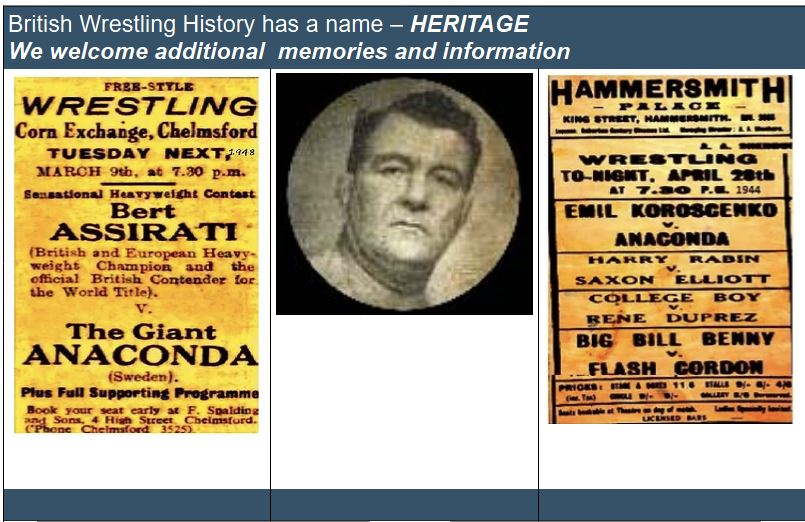
Margerich Anaconda
One of the great names of 1930s wrestling about whom there’s more mystery than any masked man. Margerich Anaconda was billed as “The Swedish Scissors King.” He appeared on the British wrestling scene in the 1930s, was seen around the country against all the top men throughout the decade and continued wrestling until the 1950s. A giant of a man, standing over six feet tall and weighing 17 stones, he was a national worker who travelled the length and breadth of Britain facing the biggest names of the time: Atholl Oakeley, Jack Pye, Ray St Bernard and Mitchell Gill.
Claims were made that he held World Heavyweight Champion Jack Sherry to a draw but we have been unable to verify this. However mythical the weight proportions or the accomplishments there is no doubt that he was one of the big names of 1930s wrestling. Anaconda also featured on BBC television (listed as Harry Anaconda) demonstrating wrestling in 1938, 1939, 1946 and 1947 with Charlie Green, Dave Armstrong, Bert Assirati Alan Muir and Harry Brooks.
We come across Anaconda for the first time in 1934, already labelled the “Scissors King” and said to originate in Sweden. A man of great strength he was also clearly a man of some skill and stamina, wrestling six ten minute rounds being no rarity. In a 1935 match at Bradford against arguably the best of the time, Douglas Clark, it was in the fourteenth round that Anaconda stormed out of the ring after the referee disallowed a fall that he believed had been fairly won.
Historian Allan Best also recalls Anaconda, “The “Giant Anaconda that I watched in the 40’s and 50’s really was a giant,with shaven head. He often played a “heavy” in films, usually based in darkest London.I know nothing of him although he was a bill-topper. The last time that I saw him was on the pier at Fleetwood I would guess around 1945.”
Understandably his ring appearances reduced in the early 1940s, but the only year we find him absent is 1943. Post war the name Anaconda remained on bills until 1954. Heritage member Ray Noble was one of our members who saw Anaconda in action. He remembers the giant wrestling former world heavyweight boxing champion Primo Carnera at Belle Vue in October, 1954. Ray was walking through the gardens at Belle Vue when he saw Carnera standing beside a massive imitation rock. Ray remembers to this day the excitement of going over and chatting with the big Italian who towered above him. Shortly afterwards Carnera was towering over Anaconda, having won by by a knock out.
Anaconda was in the 1955 wrestling film “A Kid for Two Farthings”. The the star of that film, Primo Carnera, whose ring name was The Python, a clear nod to Anaconda, also used the leg scissors. He also appeared in Hue and Cry (1947), Street of Shadows (1953) an I Am a Camera (1955).

For the in-depth story join Ron Historyo

Anaconda (Alan Taylor)
Whilst those of the Grumpy Old Men era dwell on stories of the original Anaconda we have many more younger readers who remember a villainous, bearded, tattooed heavyweight Anaconda.
The 1980s Anaconda was a brute of a man, or so he was portrayed, but certainly a giant, said to be 27 stones. Much was made of the mysterious unknown background of this man who was a former merchant seaman by the name of Alan Taylor.
Alan wasn’t just big and ferocious looking, he was exceptionally strong. One of the strongest men in Britain, in fact, and he reached the finals of the Britain’s Strongest Man competition in 1982.
He was definitely a man with a presence but it would be to expect too much for a man of such girth to display agility and wrestling. skill. Without those qualities promoter Max Crabtree saw potential and invited Alan along to Dale Martin’s gym in Brixton. Now don’t go getting the impression Alan Taylor was one of Crabtree flash-in-the-pan oversized heavyweights. That was not the case as Alan worked the halls of Britain and overseas from his professional debut in 1979 until retirement thirteen years later, and may well have continued longer had British wrestling not been in such an impoverished state.
Although initially billed as Seaman Tommy Watts within a matter of weeks Max Crabtree had re-launched his new find as Anaconda, with opponents including Wayne Bridges, John Elijah, Tony St Clair and Steve Veidor. The name Anaconda remained with Alan for the rest of his career as he travelled Britain and the world.
Talking to Wrestling Heritage about his lifestyle change to professional wrestling Alan told us, “WOW it was like a dream come true. After a lot of training I was given my first bout. I had a great time; the time of my life meeting wrestlers from the different places that I went to. It was fantastic.”
Two years after his professional debut Anaconda made his first televised wrestling appearance. Promoter Max Crabtree did him no favours at all, putting him on against Big Daddy, with the inevtiable instruction to go down to the so-called “Mum’s and Dad’s Favourite,” who just happened to be the promoter’s brother. A second televised appearance was no more favourable. On 27th August, 1988 Anaconda was conscripted to provide more fodder for the Crabtree family as he partnered Rasputin against Big Daddy and Pat Patton.
Nevertheless, with thirteen years in the wrestling business at a time of steep decline we can certainly conclude the lad did well. Asked about the highlight of his career Alan’s response was a surprising one, “One of the highlights was some times my dad (R.I.P.) came with me. He was like a big kid because he was a hard man it was fantastic watching him and his face.”
Alan Taylor died of cancer on 1st September, 2012.
Page added: 18/06/2024
260
 Wrestling Heritage