
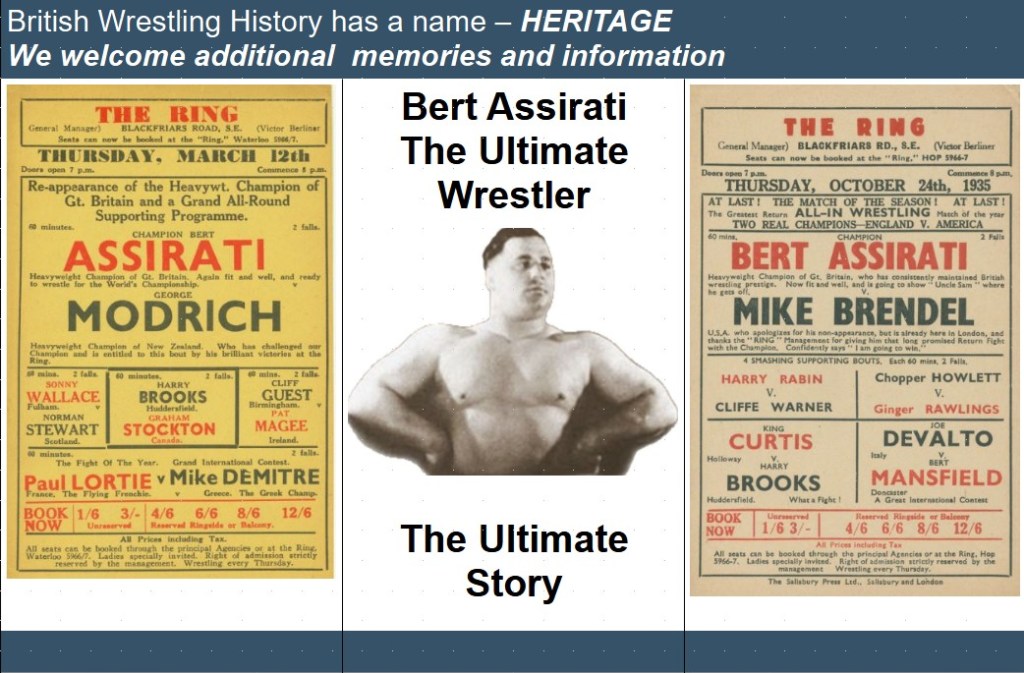

Assirati, The Ultimate Wrestler
Page 2 of 4
On 23rd April, 1932 Bert set sail from Southampton to New York on board a Cunard liner, Berengaria, listing his occupation as “wrestler.” His mission was to learn a style of wrestling which was much faster, and more aggressive than anything seen on this side of the Atlantic
Mike Hallinan has thoroughly researched Bert’s American sojourn:.
“When he arrived they were very impressed with his physique, his strength, agility, and his zest for knowledge of the new style of wrestling.
He travelled with a group of wrestlers accompanied by his manager Gardini, and he soon learnt the ropes. Most of his opponents were college wrestlers, who were very experienced, and very tough, but Bert gave a good account of himself and was unbeaten in his first thirty five matches. In some of his matches he almost caused riots, and police were called to restore order, after his largely Italian supporters were not happy with some of the referees decisions.
In some of his matches he was thrown out of the ring ten times, such was the all action wrestling that he and his opponents produced. He impressed the Dusek brothers so much that they wanted to use him all over the States, but his work permit was not renewed and he returned to England. In the seven months in America he worked the East Coast from New York down to Washington, and engaged in sixty five matches, winning most of his matches, any losses were soon avenged in return contests.
The highlight of his tour was three matches with Ray Steele who was one of the greatest wrestlers America every produced. Their first match was a real “shooting” bout, with Steele demanding big money to risk his reputation against a young up and coming wrestler. Steele won the match and declared afterwards that Assirati was a real tiger, and he had to be on top of his game to get the win. They met twice more with verdicts of a draw, and a win for Assirati. John Maxos was Jim Londos’ training partner, and fellow Greek, who was also a top wrestler. Assirati thought by beating him it would get him a shot at Londos, and so when they met he gave Maxos a damaged eye, and a bloody nose, and defeated him again twice more. He then posted a $500 dollar cheque with the New York Boxing Commission to fight Londos, but his challenge fell on deaf ears. In those days you had to have proved yourself a worthy challenger, have the money to back up your challenge, and then have the wrestling fans poll you as their next challenger to oppose the champion.
Assirati did this, his manager Gardini who had fought Ed Strangler Lewis for the title, put up the money on his behalf, he had beaten the leading contenders, and he polled 98 per cent from the fans to be their next contender. Frank Brunowicz who, like Assirati, had been in America for six months challenged Londos, and got the match, but there was no match for Assirati, and so he returned to England in December 1932 to take his place at the head of the sport in this country.
Jack Curly the Czar of American wrestling was so impressed with Assirati that he wanted him to come back as a top of the bill worker, but as the contracts and letters were being sent back and forth to America, and England Curly sadly died. And so Assirati never worked in America again.”
First hand American resources are limited, but we have found a few. The Bayonne Times of 22nd June referred to Bert as “The new sensation from America ….. considered one of the best wrestlers to come along for some time.”
First challenge for Bert was getting his correct name known. The Press were initially given the name Bert Asserty. Attempts were made to correct the name to Berto Assirati, which somehow got mangled by Master of Ceremonies Jimmy Lake to Bertram Asafetida!
We uncovered one intriguing report of an Assirati win, over Renato GardiniThe Washington Post of Friday, June 17, 1932 statted “A world record for Washington was set when Berto Assirati, a reformed circus rubber man, dumped fat Renato Gardini in 55 seconds. Assirati wrestles like an armless man chopping wood by holding the axe in his mouth and turning front flips.” The Washington Herald described Bert as “a contortionist” and Gardini as “wrestling’s only orator.” We found a win by disqualification over Abe Kashey, described as “one of the openers” in Trenton, New Jersey. Gardini jumped into the ring following the match and challenged Kashey to fight him there and then.
Bert was not so fortunate in Baltimore on 12th July. It took Vic Christy just three minutes and twenty seconds to defeat Assirati. A furious Assirati refused to acknowedge he had been pinned and punched the referee. Bert was subsequenly suspended by the Maryland State Commission.
The wrestlingdata.com website, which records around a quarter of his matches, documents six defeats. That is not to say he did not have some significant successes, most notably those impressive performances against John Maxos, Ray Steele and Rudy Dusek.
In December, 1932, the myth of Bert’s undefeated run of sixty odd matches in the United States must have crossed the Atlantic faster than the liner that carried him home. It was to be a myth that was to go unchallenged for decades, championed by no lesser men than the historian Charles Mascall.
Controversy and uncertainties surround this tour in which, for whatever reason, and despite impressing the fans and gaining some impressive results Bert failed to make it into the top echelon of the American heavyweight division. Rumours and conjecture are rife as to why Bert did not make it to main event status in the USA. Maybe the American promoters just didn’t want a Brit getting the better of their locally crafted talent. Possibly it was due to his unwillingness to co-operate with promoters, maybe American opponents were intimated by his reputation, or could it have been that he simply wasn’t good enough? We must remember that at the time Bert had little more than a year’s professional experience in a country where the all-in style was in an embryonic state and he was nowhere near the peak of his power.
Having spent practically all of 1932 wrestling in America Bert returned to wrestle in Britain in 1933, again lauded as British heavyweight champion in some halls, most notably the Blackfriars Ring. The emphasis is very much on some halls, because Bert faced a problem on his return. Atholl Oakeley and Douglas Clark had comfortably established themselves as British heavyweight champion in the halls they frequented. Now this was professional wrestling, and the aim for promoters was to make money and protect their major draws.. Now ask yourself. If you were a promoter would you let this powerful, indestructible tank anywhere near your champion? No chance. Consequently all halls associated with Atholl Oakeley or Douglas’s main promoter George DeRelwyskow steered well clear of Bert Assirati. Bert was acknowledged as champion at the Blackfriars Ring and other halls mostly in London and the south of England.
Not yet the behemoth he was to come Bert weighed around fourteen stones at the time of his return, all powerful and extremely strong with the benefit of all he had learned in the United States. Reporting from The Ring on 6th January, 1934, the Daily Mirror journalist wrote, “Of all the wrestlers at the Ring on Thursday evening only one came anywhere near to my conception of the old time wrestler. He was Bert Assirati, who claims to be the British heavyweight champion, a man of Herculean proportions.”
In the north of England another opinion would have been put forward. Their man was Douglas Clark, the former rugby player and legitimate champion by defeating Atholl Oakley at the London Sports Club in March, 1931.
That other contender, Atholl Oakeley, found his career in decline and in September, 1934 dropped his title to his friend, Bill Garnon, who then lost to Douglas Clark in November, 1934. So by the end of 1934 Bert Assirati and Douglas Clark were the only serious contenders for the title of British heavyweight champion.
The prospect of a match between the two of them was intriguing. You may recall Clark had beaten Assirati in March, 1931, but much had changed since then. Assirati had the experience of the USA behind him, He had matured and gained greater strength, and had youth on his side. Clark too was very strong, had greater all-round experience of more styles and was the most skilful of the two.
It has often been suggested that Bert refused to co-operate with promoters, and this led to the refusal of some promoters and wrestlers to work with him, but the records do suggest otherwise, with just about every wrestler of note facing Bert at one time or another. One by one, domestic or visiting stars, they all fell to the Islington Hercules.
Was that because Bert was the most skilled of them all? Almost certainly not. But he wasn’t without skill, was agile enough to match anyone, had a thirst for success and a strength that no one could match. Bert achieved a British record in 1938 by lying on his back, and pulling over at arms length a two hundred pound barbell.
In October, 1943 the newly formed British Wrestling Federation announced they would hold a British heavyweight championship tournament, which took place at Blackburn on 1st January, 1944. Bert Assirati was crowned the first British heavyweight champion of the Federation. Douglas Clark and George Gregory did not take part.
Douglas Clark relinquished his title in 1944, though he had been inactive for some time.. It wasn’t until 1945 that near national championship recognition came Bert’s way following his defeat of George Gregory at Belle Vue, Manchester, on 27th January, 1945. Assirati gained the only fall in a match that went the full six ten minute rounds. Both entered the ring claiming to be the rightful champion. Assirati following his win in the heavyweight tournament at Blackburn and Gregory by default when champion Douglas Clark had failed to appear for a planned defence in Leeds in May 1941. Bert Assirati gained the only fall required in a match that went the full six ten minute rounds, establishing himself as Britain’s top heavyweight and widely recognised champion.

Reviewed 07/02/2022

