
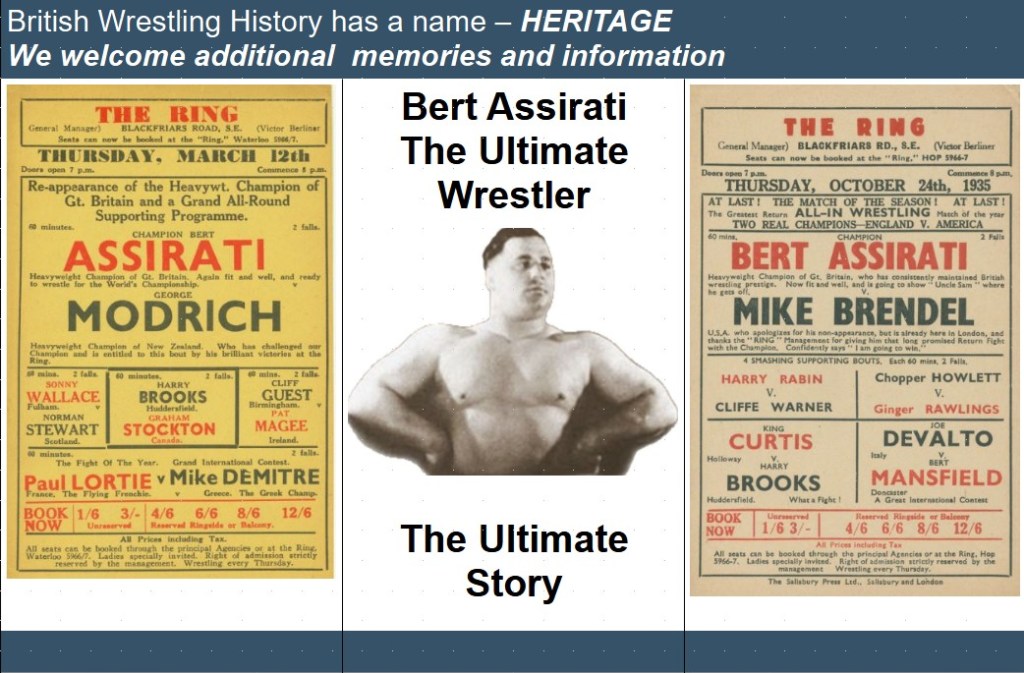

Assirati, The Ultimate Wrestler
From Singapore Bert travelled to India, where he continued to meet with overwhelming success. Wins over many of the local stars and overseas visitors including Australians Roy Herffernan and Bill Verna. Roy Heffernan was, in the opinion of John Shelvey, the best wrestler to come out of Australia. John told us, “Roy said of his meeting with Bert that he was really worried Bert would hurt him. However, Bert impressed by Roy’s obvious respect for the Englishman told him not to worry and that everything would be fine. Roy confirmed they had a good match and he came through it unscathed.”
Ron Historyo picks up Bert’s Travels in Madras Discoveries as he arrived in India at the end of November 1953. After a small print billing despite his picture Bert did not fight Bill Verna. Instead he beat George Constantine who he had travelled with from Karachi. Assirati gave a good account of himself winning 2-1
The many victories were offset by defeats against some of the country’s top men, including Dara Singh. It is reputed that in 1954 50,000 spectators saw Bert defeated by Tiger Joginder Singh in Bombay, and in February, 1955 40,000 witnessed a defeat by Aslam Pahelwan. The Civil and Military Gazette reported that Bert had the upper-hand in the first two rounds, but in the third Aslam charged Bert repeatedly and delivered a number of flying kicks before applying a ferocious armlock that ended the fight with a sprained elbow for Bert.
Ron Historyo again: “Well I was staggered to find a report of Bert Assirati, which I can only surmise to be completely going over in round one to a local hero and I can only assume being well paid for it.“
Mike Hallinan again, ” I interviewed Angelo Papini, Ernie Riley, Johnny Peters, Alf Cadman, and Ron Harrison, who all worked out in India with Assirati and they all said the same thing………..he beat up most of the Indian, and Pakistan wrestlers, and they didn`t want to work with him. He once sent Tiger Joginder Singh to hospital after he had given Big Bill Verna a bad going over. The only way to control Assirati was to pay him huge sums of money, which is what happened.“
Homewards from India Bert stopped off in South Africa, where he again defeated all comers with the only exception, to our knowledge, being a loss against the masked man Mr X, Willem Hall.
By the time Bert returned to Britain the wrestling landscape had changed beyond recognition. Joint Promotions and the Lord Mountevans rules were well on their way to becoming established as the main force in British wrestling.
The Mountevans champions were the nearest the country had come to recognising a nationally acknowledged champion, and on 19th October, 1955, the Royal Albert Hall and Dale Martin promotions hosted the big showdown between Assirati and Baldwin. Baldwin was billed as champion, and any grudge that Assirati held against the Yorkshireman was entirely justified. After all, Baldwin hadn’t even had the decency to wait for Bert to leave the country before jumping in his grave, so to speak.
Had anyone been in any doubt about the best heavyweight in the country before this match there was no doubt afterwards; as Assirati annihilated Baldwin. An odd situation then occurred where Dale Martin continued to employ Bert and advertise him as British heavyweight champion whilst Ernest Baldwin was advertised by the rest of the Joint Promotions group as Lord Mountevans British heavyweight champion. This peculiarity existed until mid 1956, when we find Bert working for Dale Martin for the last time in June. By the end of the year his appearances are outside Joint Promotions, working for the independent promoters.
We have no first hand knowledge of, and cannot comment upon, Bert’s relationship with Joint Promotions, but rumours of a less than harmonious relationship are common knowledge, and circumstantial evidence certainly supports this. Joint Promotions stated Assirati’s absence due to his tour of India as the cause of their action, but reality is that Bert and Joint Promotions had already gone their separate ways. It may well have been that his nature made him the nucleus for discontent, or that he simply refused to carry out the promoters’ instructions; we will never know.
During Bert’s absence both the promoters and wrestlers had learned that they could not just survive, but continue to grow, without the inconveniences, demands, and difficulties that came with Bert Assirati.
We do know, from a letter sent in 1995 to Allan Best by Bert’s wife, Marjorie, that the many rumours about Bert did upset her, but the picture was not as black and white as many portrayed.. Marjorie had just finished reading a book about wrestling and told Allan, “Although there were four pages dedicated to Bert as usual many of the ‘facts’ and dates were distorted and incorrect, but that is beside the point. These clever jerks get a kick out of writing about wrestling (most of them not knowing the difference between weightlifting and shoplifting) and definitely without a muscle in their own bodies. They should verify the facts before committing them to print. Actually Ernie Baldwin was a very nice fellow (he had taken over Bert’s British Championship crown) like most of Bert’s opponents and after all bouts, during the time I was promoting, there was seldom any gloating or sticking-out of chests or “I’m better than you” attitudes after the bouts,but after all ,what do these people know about the game. Nothing. They pick up rumours and tit-bits and get easy money for printing them.”
Wrestling historian Mike Hallinan, the foremost authority on Assirati, told Wrestling Heritage, “When Bert Assirati returned from his three year tour of the Far East, India, Pakistan, and South Africa he was faced with a huge tax bill, and with Joint Promotions not wishing to use him was forced to work for the independents. To supplement his income he decided to start his own promotions, and a chance meeting with Jack Taylor led to them forming ASTA Promotions. They put on shows the length and breadth of the country, using top quality wrestlers, with Assirati as top of the bill. The match that drew the largest crowds were the matches between Assirati and the Polish champion Eugene Stezycki, which always ended in a blood bath. Other great matches pitted Assirati against Bill Benny, Ed Bright, Alec Nuttall, Charlie Scott, Prince Kumali, Ernst Schmidt, Don Steadman, Johnny Peters.”
Naturally Bert continued to proclaim himself as British and European champion working for the independents. Fair enough, he had never lost these titles. Bert was just as ferocious with the opponents now being the likes of Strangler Bright, Eugene Stezycki, Kiwi Kingston, Alf Robinson, Charlie Green, Don Stedman, Prince Kumali and Frank Hurley. A new set of opponents maybe, but no soft touches there.
By the 1960s the world had changed, and wrestling had changed with the lighter weight wrestlers coming to the fore. Bert had been around for thirty years and and there was no place in the world of professional wrestling for the likes of Bert Assirati. It was December, 1960, and a match against Johnny Morgan at the Seymour Hall in London was the last time we saw Bert’s name on a poster.
Bert’s place in wrestling history is without contention. More contentious is exactly how he achieved his fearsome reputation, and the manner in which he conducted himself as a professional wrestler.
No one has ever questioned Bert Assirati’s skill, agility, strength or recognition as one of Britain’s greatest heavyweight.
Open to question has been exactly why Assirati was feared and avoided by many heavyweights of his day. Was it because of the qualities we list above, or was it because of a penchant for hurting opponents and inflicting unnecessary pain?
Ray Hulm was a big fan of Assirati, “Just the sheer presence of the man.” Ray trained with those who knew and worked with Bert and they told him of a man capable of inflicting pain at will. David Schmida told us that in Rene Lasartesse’s biography Assirati was described as really stiff and brutal; when his opponent didn’t hit him hard enough he would get angry and provoke him to not fall asleep and start fighting. If his opponents hesitated he would start punishing them.
It is this aspect of Assirati’s nature which made him such a contentious character. Nevertheless, every wrestler’s fear was counter-balanced with respect. Count Bartelli told Wrestling Heritage some forty years ago of his huge respect for the man. Eddie Rose agreed, “He was a great wrestler and most old timers agree with this, although there were other aspects to him. He was another old-timer with an aura of skill and toughness about him. Guys were not exactly queuing up to wrestle him. Perhaps not a great showman in the same sense as Pye, Pallo ,Cornelius, Marino or Veidor but a very solid, very strong and a rather ruthless wrestler. Bartelli once told me that he respected him and this was echoed by the likes of Jack Beaumont, Billy Robinson and Jack Atherton.”
Al Tarzo told us, “Out of the ring I was lucky to have had the pleasure of Bert and his wife Marjorie’s hospitality, in such that my first bout in Croydon I had an overnight stay at their home with them. I can only say that the man outside the ring was a different person and Marjorie was in charge, she was the business person.”
The passing of time makes it impossible for any of us to evaluate the greatness of Bert Assirati. Any assessments we make are based on the myths perpetuated by those of an earlier age. His strength, agility and skill are beyond question. Doubts begin to emerge around the word professional. Can superlatives be added to the word professional for a man who seemed so reluctant to lose in a sport where co-operation with an opponent was an important element of the spectacle?
Where would he fit into the hierarchy of Britain or the world’s greatest? The great Georges Hackenschmidt would not have stood a chance against Bert’s overwhelming strength and agility. Hack’s vanquisher Frank Gotch was a more vicious brute and would have been more likely to stand up to him. Kolo Kwariani so clever, but Bert had the power. George Gregory was a very clever Brit, but Bert bettered him. Ernest Baldwin, not in the same class. Lou Thesz? Lou and Bert said they wanted the match. The politics of wrestling meant it was impossible. What a match it would have been. Billy Joyce? No chance. He just didn’t have the size or the strength. Billy Robinson. Possibly. Our best bet. But who are we to say? We are mere enthusiasts, and we know our place. We also know Bert’s place.
We leave the final word to Wrestling Heritage member John Shelvey, “If he had worked with his fellow professionals, went along with the wishes of the promoters, conducted himself as a professional for the good of his profession, the good of the entertainment, his career would have probably been far more successful and we wouldn’t need to perpetuate myths.”
Bert Assirati died on August 31, 1990.
We thank all those who have contributed to this item, particularly Ron Historyo and Mike Hallinan for their painstaking research and Allan Best for many contributions of his wrestling memorabilia.

Reviewed 07/02/2022

