
Wrestling Heritage welcomes memories, further information and corrections.
Ring of Fire
There was no shortage of fiery action when Bill Howes was in the ring. He favoured punishing holds combined with flurries of action and an attitude to antagonise the crowds. When Bill Howes lost his temper you could see it in those wild eyes, with flying fists and feet that hurriedly confirmed the matter.
Fans would be convinced he really had lost control because all the signs were there of a man with a deranged mind. Lost control? Surely not, because the wrestling skill of Bill Howes established that here was a man with a disciplined mind. Yet it’s more than fifty years ago that Count Bartelli told us “Bill Howes was the most temperamental of the lot.” He was a wrestler that even the know-all dads seemed to like. In the same minute he could impress with his textbook ability and, seconds later, enrage those same fans with his total disregard for the rules.
It was the perfect temperament to make it all believable, which it may or may not have been, when he ripped off Kendo Nagasaki’s mask on Saturday afternoon tele. That was in the days when a Nagasaki without a mask was actually worth something. Dave Sutherland recalled, “Bill Howes, as uncompromising a hard man as you could find and one I never tired of watching, set out from the first bell on a mission of single minded determination to remove Kendo Nagasaki’s mask.” Memories of the event differ, not surprisingly as it was around sixty years ago, “He was doing a pretty good job of it too …. he had caused Nagasaki’s nose to bleed and pulling the mask up into that vicinity was causing him great discomfort. So much so that Nagasaki employed a rapid series of karate style blows to KO Howes after which he removed the mask himself, rushing into his corner to grab a towel to cover his face and bleeding nose.”
Another admirer was Heritage member Romeo, “Bill Howes was an asset to every promoters bill. If the show lacked action Bill soon made sure there was plenty of it when he entered the ring. Unorthodox and unpredictable. You never knew what he would do next. You couldn’t take your eyes off him. For me definitely one of the all time greats.”
Unpredictable was certainly the word. It wasn’t unknown by any means for the temper to be absent and Bill wrestle a clean, but always hard, match. Dave Sutherland again, “When I saw him on my first live experience of wrestling, topping the bill against Gwyn Davies, it was a sporting bout with both wrestlers relying on skill and fitness to provide us with an excellent fight that came to an unfortunate and untimely end as a no – contest.”
Wrestling colleague Paul Mitchell told us, “Bill Howes was a superb wrestler but an enigma in so many ways. Promoters even wondered which Bill would turn up.”
Claimed by fans of Bristol and Lancashire as one of their own, William George Howson was born on 26th August 1931 in Bristol. He was the son of George and Hilda Howson, George having moved from Birkenhead in 1927 when he married Bristolian Hilda.
Bill was certainly working professionally in 1949, though we have unverified records from a year earlier. We also believe the family had by then moved to Bolton and unconfirmed reports that Bill was a member of Bolton Harriers Amateur Wrestling Club. In those days Bill was certainly lighter than any of us remember him, and in 1951 he challenged Johnny Stead for the British lightweight title. By 1954 the range of opponents suggest that Bill had begun to fill out. The bright lights of London called in 1955 with a Royal Albert Hall appearance, and a loss, against Harry Fields. He returned later in the year to defeat Bert Royal. By 1956 championship opportunities came his way with a British light heavyweight title clash against Ernie Riley, which he lost.
Television exposure came in 1960, the first of around sixty televised contests against opponents that included Tibor Szakacs, Norman Walsh, Joe Cornelius and Bill Robinson.
On television in May 1962, prior to the F.A. Cup Final Bill defeated Jacques Lageat to take the European Mid Heavyweight Title. Although Howes was the more aggressive of the pair in the opening rounds it was Lageat that took the opening fall with a Reverse Double-leg Nelson in the fourth round. Howes equalised in the seventh round and took the deciding fall with a Body-slam and press in the ninth of a twelve round contest.
In May 1963 Bill was invited to the day that wrestling received Royal recognition. His Royal Highness, Prince Philip, accepted an invitation from Dale Martin Promotions to attend a Royal Albert Hall wrestling tournament. The proceeds from the event, reportedly around £10,000, were donated to one of His Royal Highness’s charitable causes, the Duke of Edinburgh Award Scheme.
In a star studded programme Howes put the European mid heavyweight title on the line against Poland’s Wernier Zarzecki. Scheduled over fifteen five minute rounds. The result was never in doubt and Howes needed only six of those rounds to take the contest, and keep the belt, by two straight falls.
In April 1966 Geoff Portz and Bill Howes met at the New St James Hall in Newcastle to contest the British Mid Heavyweight title vacated by Norman Walsh following a car crash injury. Portz knocked out Howes to win the title.
In January 1966 Dale Martin Promotions, who had until that time acknowledged Howes as European champion, began advertising Mike Marino as champion when he returned to their rings. This led to a peculiar position with two European champions in the Joint Promotions camp: Howes recognised in the north of England and Marino in the south.
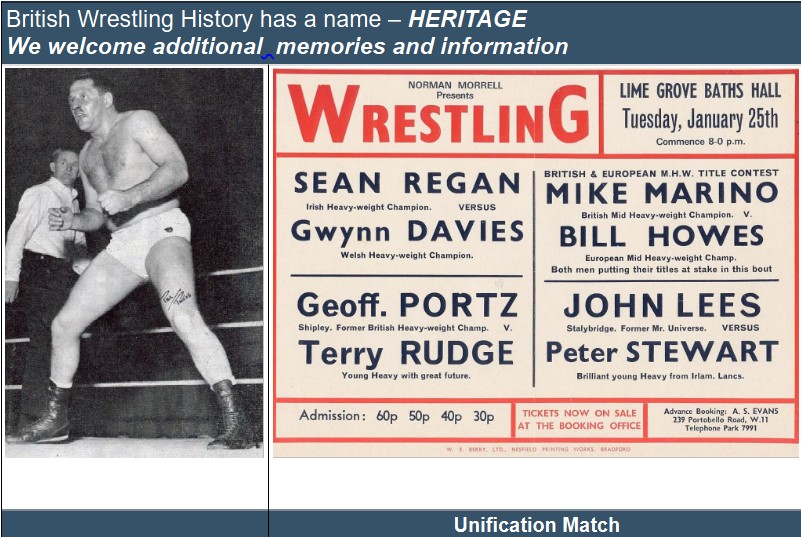
An attempt, or so us unsuspecting fans were told, to resolve the European Mid Heavyweight situation, was made in January, 1972. An eagerly anticipated unification contest was arranged to take place at the Lime Grove Baths. As this was a Norman Morrell promotion Marino was billed as British champion and Howes as European champion, with both titles at stake. As was only to be expected in wrestling the contest settled nothing with both men disqualified. That was the last we heard of any title unification.
Away from the ring Bill led a varied life. He owned a small supermarket in Little Lever, was a Special Constable for Bolton Constabulary and it was oft reported that he served in Korea during his National Service.
Bill continued wrestling until the mid 1970s, always at the top of his game. Following retirement he moved to the Isle of Man, bought an off-licence and very occasionally pulled on those boots for the Manx fans until last seen in 1982.
Bill Howes died in 2004.
Page added 13/04/2025
18519
 Wrestling Heritage