
Wrestling Heritage welcomes memories, further information and corrections.
Homecoming
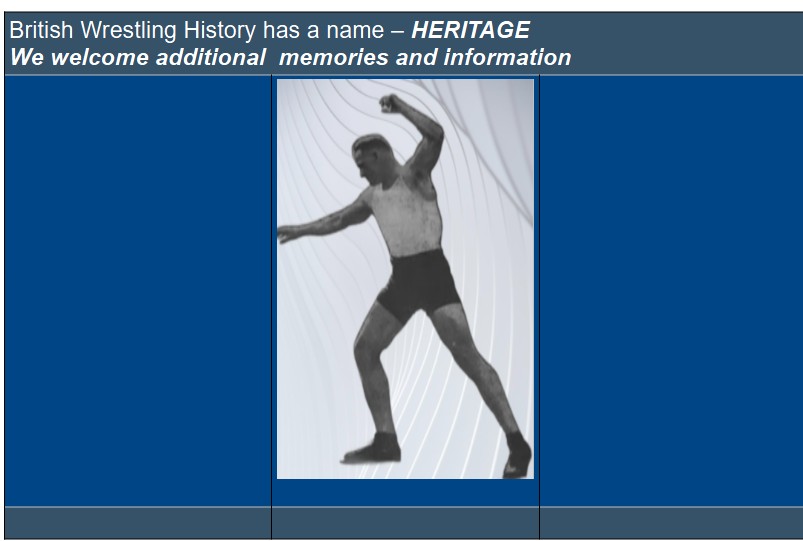
Billy Dutton from Hindley was one of Lancashire’s best catch wrestlers according to wrestler Joe Daley. Common with many Hindley lads Billy was destined for a life down the coal pit, where he worked for fifteen years. An unusual way out of pit life came in 1921 when he qualified as a masseur.
Billy’s horizons were far beyond the slag heaps of his home town. On 10th November, 1924 he disembarked the Ballarat in Melbourne, and it was in the land down under that he was to set up home. On his arrival in Australia he took a job as a miner whilst establishing himself as a wrestler. Billy qualifies for a place in our Wrestling Heritage due to his returning home and wrestling in Britain in 1934 (and South Africa on his return) arriving back in Melbourne on 26th March, 1935.
We turned to Heritage’s Graeme Cameron to take up his story.
When Billy Dutton arrived from Wigan in 1924, he already had an established reputation, not only as a wrestler but also as a writer and journalist. He was a member of a legendary Lancashire wrestling family, so many of whom were wrestlers that they had their own club, ‘The Dutton Club”, in which family members only competed against each other. As a writer and journalist, he had written a book, The Wrestler’s Dream and a series, The Mystery Lock for Health and Strength magazine in the UK prior to coming to Australia. He also had a diploma in Swedish Massage. He settled in the Illawarra region, adjacent to the southern border of Sydney, on a farm just outside the village of Woonona and worked in a coal mine in neighbouring Austinmer, both now suburbs of the city of Wollongong.
Dutton’s career was largely confined to the Illawarra region, but he did occasionally venture to other areas. The first match record is in March 1925 on home turf in Woonona, when he was unsuccessful in his challenge to Australian Heavyweight champion, Billy Meeske. The next record is in August 1927, when Dutton defeats New Zealand’s Theo Gudding on points at The Globe Theatre in Wollongong in a match billed as being for the New South Wales Cruiserweight title.
In July 1928, he defeated Western Australia’s Don McDonald, also at The Globe Theatre, then ventured west of Sydney to the town of Lithgow in July to defeat Greek Frank Katious at the Union Theatre after Katious was unable to continue. A month later Dutton drew 1-1 with George Boganski at the same venue. In November 1929, he seconded American former world champion John Pesek for his bout against Peter Limutkin at The Globe Theatre and a month later opposed American Alex Lundyn at Wollongong Stadium, the result of which is unknown. In 1931, he was one of a group of light heavyweights featured at Sydney Stadium, when finances didn’t allow management to import wrestlers. The only record for this period is match in May at Sydney Stadium, a 2-1 win over Joe Keatos.
In 1932, Dutton returned to the UK and remained for two years appearing across the UK and Europe. Only one match record survives. In December 1934, Dutton defeated “Young” Tom Rose at Blackfriars in bout billed as being for the British Cruiserweight title. Other opponents Dutton is known to have faced are Billy Riley and Joe Fletcher. In 1935, Dutton returned to Australia. In April, he lost to “Bad” Bill Bray 0-2 at Brisbane Stadium, suffering badly injured ribs in the match. There are no match records for Billy Dutton after this date.
Billy Dutton became something of a local celebrity in the Illawarra region. Apart from his wrestling career, he opened a gym in Woonona in partnership with another local man, often acted as a guest judge at local fairs, and worked as a journalist, reporting on wrestling and local events in the Illawarra region for The South Coast Times and Illawarra Argus.
16907
 Wrestling Heritage