
Wrestling Heritage welcomes memories, further information and corrections.
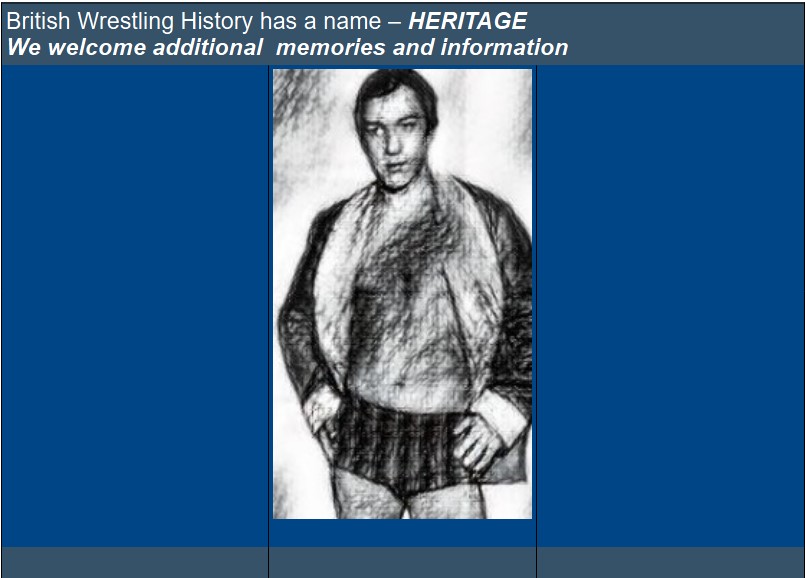
When wrestling fans of the 1970s gather together conversation invariably leads to the stars of the lightweight division: Johnny Saint, Jim Breaks, Zoltan Boscik, Bobby Ryan. This was the most exciting and competitive of weight divisions at the time as we could add to the list Jim McKenzie, Al Miquet, Bill Ross and the tail-end careers of George Kidd and Mel Riss.
As we talked to Bobby Ryan we were delighted to hear that he felt privileged to have shared rings with such illustrious company. Fifty years after the event Bobby maintains a great deal of respect for the wrestling business and those with whom he shared a dressing room.
Bobby’s stylistic manoeuvres, speed and agility made him a fans favourite. Wrestling enthusiast Skaro told us he considered Bobby “A wonderful wrestler… saw him in some brilliant matches with Jim Breaks, Mark Rocco and Marty Jones at the Victoria Hall, Hanley.”
SaxonWolf agreed, “A great wrestler, fitting perfectly into the ‘young, good looking lad’ role, that made him a perfect foil for Jim Breaks.”
Indeed Jim and Bobby brought the best out of each other, much to the delight of us fans. They had tremendous contests around the country, matching one another with speed and skill; delighting the fans when Bobby would outwit the Yorkshire man who would oblige with one of the tantrums that he made his own.
Little did we realise at the time just how fortunate we were to witness Bobby’s skill. Despite wrestling being in his blood, his father was Stan Rylands and his dad’s cousin was Jack Sambrooks (Jack Santos) Bobby had no inclination to become a professional wrestler. His favourite sport was speedway. Bobby was motorbike-mad and was determined that one day he would emulate those he watched on the speedway track. Speedway was hugely popular in Britain at the time, a 1960s revival following the introduction of the Provincial League in 1960, with most towns of any size having their own track and weekly meetings.
There was one barrier to Bobby’s dreams. His mother was firmly against him following his speedway dream. Parents came up with a plan. They suggested to Bobby that he go along to a local amateur wrestling club. He should give it a try, and then if he didn’t like his new hobby he could pursue his speedway interest.
Fortunately for wrestling fans Bobby loved it. He was back at the club, the next week, and the next and the…..
With encouragement from his dad Bobby took an interest in the professional style. Stan was a good teacher, “He was the best trainer I could ask for,” said Bobby, “but also my harshest critic.” Good though Stan was as a trainer and Bobby as a student it was inevitable that Bobby needed a breadth of mentors to fully prepare him for the professional ring. And so it was that he moved on to the next phase of his preparation, at Wryton Stadium. Under the stewardship of Jack Atherton, assisted by Bobo Matu and Ken Cadman Bobby developed the full range of skills necessary for his professional debut. In addition to the formal training Bobby worked out regularly with Mark Rocco and Marty Jones who were pursuing similar dreams.
Eventually the big day came. 7th January, 1969, a Jack Atherton promotion at Worcester. In the opposite corner Sid Cooper. Talk about being thrown in at the deep end. Well, unsurprisingly Bobby went down to the rumbustious Yorkshireman, but he gave a good enough account of himself to make sure the bookings came in.
He was on his way. Wrestling practically full time right from the start. On leaving school Bobby had enrolled as a student at Stoke Catering College. He hated it, and quickly decided that this was not a career he wished to pursue. Bobby went to work in his parent’s pub, so when the opportunity was able to devote himself fully to wrestling.
Just as dad had forecast being the new kid on the block a few of the more experienced professionals gave Bobby a hard time to start with. Who mentioned Boscik, Rees and Wood? It didn’t last long, though, once they’d been in the ring with him and proved he knew the business they treated him more professionally, with respect.
Almost a year to the day after making his debut Bobby appeared on television for the first time, opponent Bill Connors at the Solihull Civic Hall. This was the first of around forty televised matches stretching over the following ten years. Television exposure gave him national popularity though Bobby worked mainly in the midlands and north of England for Wryton Promotions.
One of those televised contests saw Bobby take the European lightweight championship from Jim Breaks. In the mid 1970s the British and European lightweight titles moved freely between Breaks and Ryan, with fans rarely being happier than the occasions they witnessed Bobby snatch one or the other of those titles from the Bradford man.
Conscious of the precariousness of the wrestling business Bobby decided to go part-time and took a job as a delivery man for a soft drinks company.
We are certain that Bobby Ryan could have remained one of the top men in the lightweight division until the sport went into near terminal decline at the end of the 1980s but Bobby chose premature retirement from the ring in 1982. His final bout was at Liverpool Stadium on 15th October, 1982.
Fans were shocked and saddened at his departure from the ring when he was at the top of his profession, but Bobby’s decision does mean that all our memories are golden ones.
With his inside knowledge of the soft drinks business Bobby started his own company, RSD Dispense, shortly after the turn of the century. The company, still a family business with Bobby at the helm, has now grown to become the leading supplier of soft drinks across Staffordshire, Cheshire, Shropshire, Derbyshire, and the West Midlands.
1900
 Wrestling Heritage