
Johnny Kincaid v .Peter Rann
Wrestling Heritage welcomes memories, further information and corrections.
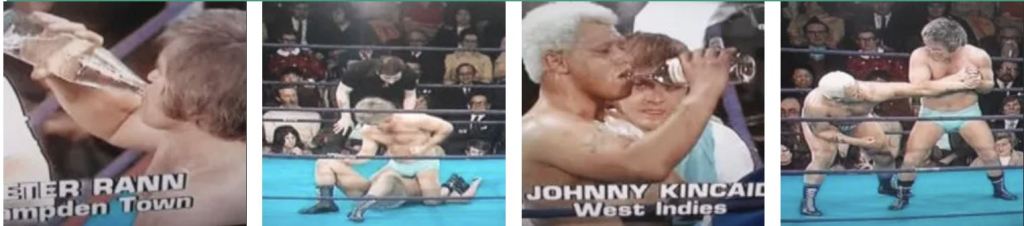
Watching this bout served in many ways to underscore comments made in our various sections. Peter Rann was an inaugural subject in Shining Stars and Johnny Kincaid featured in the first entry here in Armchair Corner under the title Beltless But Bouqueted.
So as we watched the pair in action we were able to wallow not only in the nostalgia of all those years gone by, but even in the fledgling history of this very site. Do pardon our self-indulgence, but the more we comment, the more we observe and the more we detect trends and develop theories – to be proved correct or to be shot down in flames.
This bout lasted just about 27 of it’s scheduled 30 minutes, possibly the longest ever 1-1 draw over six five minute rounds. The combatants were not rushed into scoring their falls after the first few seconds of the appointed rounds, as is the norm, but let things roll and were content to score after over three minutes each time. The uninitiated reading this will say “So what?”, but we fans who dissect every part we can see of this unfathomable mystery that is the spontaneous physical art between a pair of trusting co-workers, raise an eyebrow at the occurrence. Once perhaps their patience could have lasted to a fourth minute, itself very unusual.
The bout was scheduled for evening viewing. Could this confirm our thoughts that Rann was too unreliable for mainstream tea-time viewers? After all, his infamous feud with Kellett would spark off just four months later one mid-week August evening in the small hours, and even though a stalwart champion and journeyman pro, he seemed seldom to appear on Saturdays. So can such tenuous evidence dare to corroborate our impression of the hard villain as described in his biography here?
We were denied that real life colour of Peter Rann’s famously blue hair and his greying mop paled into insignificance alongside Kincaid’s golden locks, from the blond stage sandwiched between his lithe sixties debut and his full-blown heavyweight publican feted departure.
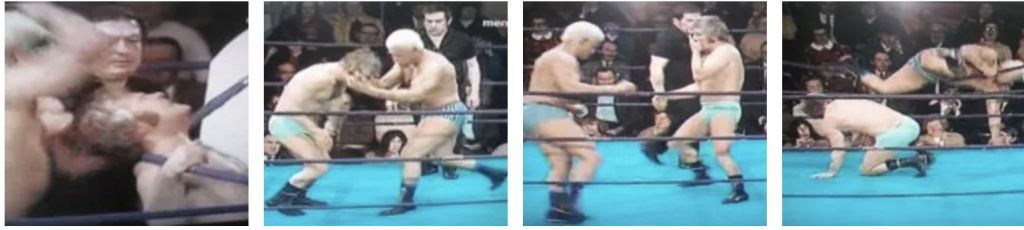
Down to brass tacks and we witnessed an unloving affair, with enough needle to arouse the audience. Kincaid favoured the headbutt, right, of his tag partner of the time, Rann’s drop-kicks connected, and the two scoring falls seemed genuinely inescapable.
The commentator denied us any of his customary hyperbole, suggesting perhaps that Rann the wrestler was somewhat more manageable than Rann the dressing room chatter.
A gift of an opportunity presented itself at the very end of Round Two. Kincaid missed a flying tackle and exited head-height over the top rope, conveniently where the camera would see it best. He became entangled in the ropes and then took a heavy landing. Before D’Orazio had had a chance to start the count the bell had rung to extinguish the round. Were this boxing, and wrestling at the time tried desperately to mirror its gloved cousins, the talk would have been of how Kincaid had been saved by the bell, with a dash of rhetoric about the rights and wrongs of a the count-out continuing after the end of a round, but Kent Walton was for once silent.
What would a televised bout be without conflict and confusion between captions and commentator? We traced Rann around the UK from Doncaster to Camden Town and ultimately Chiswick. But a rather precociously enlightened caption writer of the time decided to base the champ in “Campden Town” (sic.) Brixton’s Johnny Kincaid in fact came form Barbados according to Kent, but again we were in for a visual surprise as “West Indies” popped up mid-round. The discrepancies once again are trivial, but their regularity shows signs of a lack of communication between the promoters and the television producers.
This was a great sight, two seasoned pros going at it for the delight of neck-tied and cravatted seventies ringsiders who eagerly followed every step. Never boring, it was edge-of-the-seat stuff indeed. Crafted and honed through Rann’s over 20 years on the job, in this his final year of mainstream activity, and Kincaid’s intelligent awareness of audience expectation that made the various stages of his career so successful.
 Wrestling Heritage