
John Quinn v Barry Douglas
Wrestling Heritage welcomes memories, further information and corrections.
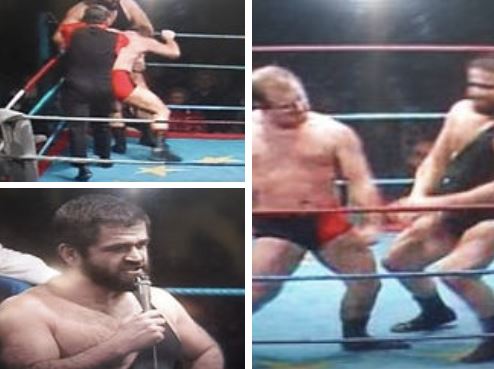
This was John Quinn’s second appearance on British television and, as such, this bout had plenty of theatrical moments before, during and after the contest, all successfully devised to catapult him to the position of Public Enemy Number One, and a well documented big payday television match further down the line. The main focus of our attention in this review, however, will be Quinn’s opponent, Leeds’s Barry Douglas. This is in line with the stated aims when we launched Wrestling Heritage, still easily viewable in our editorial, Sport or Spectacle?
In the long-term view of things, Barry Douglas’s role could easily be overlooked in this mighty progression of his far heavier opponent. In fact Barry Douglas’s role could easily be overlooked for the duration of his 20+year professional career, as could that of many others we celebrate here: Mick McMichael, Leon Fortuna, Bob Kirkwood, Tony Walsh. The list is endless. No titles, but a credible rival to the full spectrum of opponents, dutifully ensuring many major stars were able to shine brightly.
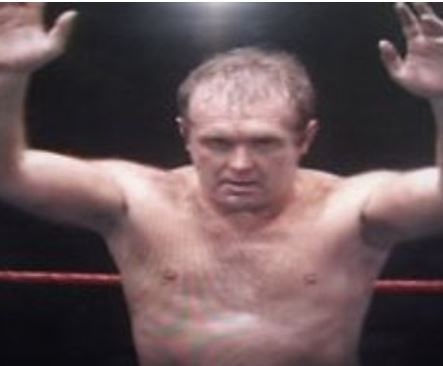
Barry Douglas’s case is slightly more surprising by virtue of being the son of Douglas de Relwyskow, and nephew of George, director of one of the main associates within the Joint Promotions group. We saw the silver spoon being licked clean by many others similarly born into the wrestling business with stardom and international travel and titles – even at world level – and at a young age. Dissecting Barry Douglas’s work to see what sweet tastes this spoon would serve up to him leads us along a contrastingly unique path.
A veteran by now of 18 years of television wrestling, we see Barry having success in the north, where he enjoyed televised victories over the redoubtable John Cox and Colin Joynson, and never succumbing to Albert Wall in their two televised stoushes. Darn sarf, he regularly featured on Dale Martin bills but invariably went down to one of the lower lights such as Johnny Czeslaw. This was a fate we have identified all too well only recently in respect of Nottingham’s Al Nicol, in another review in this Armchair Corner section, entitled Glass Ceilings & Hush Money.
What makes Barry Douglas’s television career stand out is the wealth of true international talent he faced, right from Tosh Togo in the early sixties, through Olympian and Heritage favourite Bert Mychel, mixing it in tag with Whipper Watson Jr and Red Pollard, and, possibly the supreme accolade: being chosen the wrestler to showcase L‘Ange Blanc on the great Continental’s sole televised appearance in the UK that exciting Thursday lunchtime in 1974. A few years after “today’s” bout he would once again fill the self-same role: the second victim of a visiting heavyweight destined to get his come-uppance in the end at the hands of Big Daddy Crabtree.
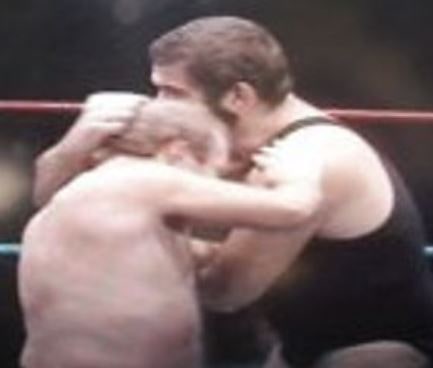
Peculiar match-making was flaunted before us as we saw Pat Roach, similarly sized to Quinn, billed in the next match, against Judo Pete Roberts, similarly weighted to Barry Douglas. We were required to turn a blind eye to the obvious conclusion that the foursome could, indeed should, have been matched more equally.
Second only to having masked men who refused to talk to him in the dressing room was Kent Walton’s affirmation at the mere sniff of an international star that “He’s not used to these rules, he doesn’t seem to understand.” Quinn had it laid on in spades.
In truth, of all the visiting North Americans we mention, perhaps Quinn fitted in most perfectly with the British psyche and fans were ready to roar abuse at his exaggerated insults. What helped Quinn enormously was that as a Canadian he was willing and able to ham up everything that might have seemed obnoxious about US wrestlers, without having the faintest feeling of treason. Notice the careful way he was always billed as being from North America, when real US citizens always had their home town mentioned, such as the Chicago Express.
His microphone work was entertaining and very unusual at the time, and we were soon treated to some of those high stomps we had come to know him for when he had first come to our attention through the The Wrestler magazine ten years earlier against another Heritage Favourite, Earl Black.
This was no squash match as Douglas gave as good as he took, ramming Quinn in the corner, slingshooting him to a couple of ring-shifting postings, and delivering forearms reminiscent of Mick McManus. The two pros worked in generous unison, Douglas getting trapped in the ropes to receive this time lower stomps, and Quinn equally obligingly getting himself trapped atop the ropes in the corner. Douglas trustingly lay prone as the big man delivered a fearsome elbow drop, above right.
The ending was a mess. In under two minutes of the third round the referee counted off what seemed to be a clear fall to Quinn and the emcee climbed into the ring to announce it. Probably tipped off by the tv producer that Quinn’s legs were protruding clearly through the ropes, the announcer declared the fall was disallowed.
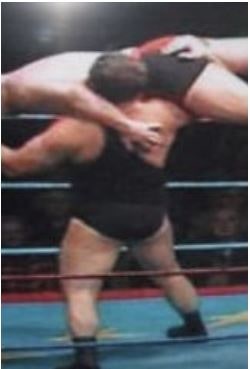
Poor Round Three was curtailed and the sure signs of rejigging were evident just a minute later as Quinn delivered the elbow, left, prior to hoisting Douglas for this Mighty slam from which he did not beat the count.
Job done.
Pat Roach now came to the ring to do some aggressive finger-wagging, à la Prince Kumali, and really rather manic threatening, thus generating heat for their matches around the country. This sat rather uneasily with the vanquished opponent still being in the ring, albeit rather groggy.
But Barry Douglas showed no signs of being snubbed and displayed a great team spirit, playing his part to the full, and ultimately claiming the plaudits he richly deserved. Barry Douglas carved himself an unusual niche in the wrestling world which he seemed to relish. He was happy to be upstaged much of the time by more glamorous opponents, or even ring invaders like Pat Roach here. But his hard-hitting approach and clever professional wrestling mind ensured that important bouts and visitors were in safe hands when Burly Barry was involved.
 Wrestling Heritage