
Wrestling Heritage welcomes memories, further information and corrections.
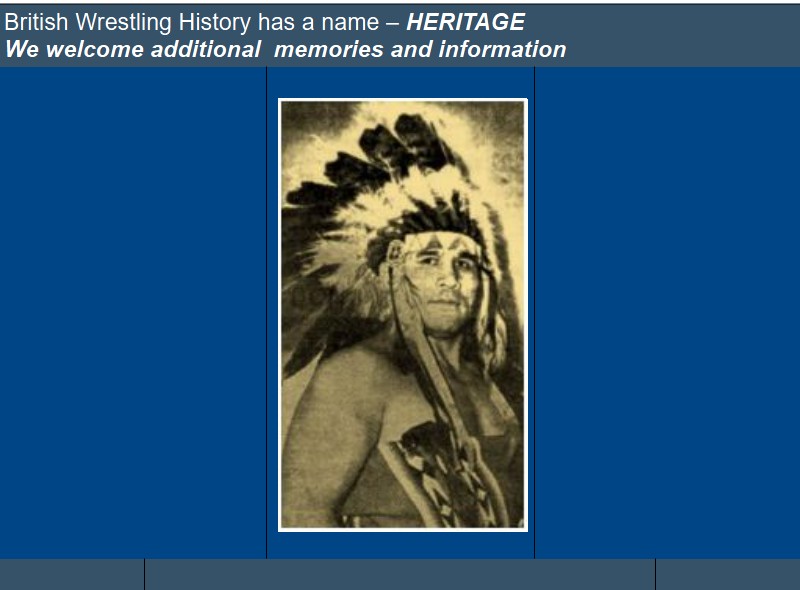
Chief Thunderbird met all the stereotypical criteria of those we referred to as Red Indians in those days. The regalia of an “Indian Chief,” entrance to the sound of pounding drums, greeting of his opponent and referee with a “How” and raised palm, and the obligatory war dance were all present; this was years before the arrival of Billy Two Rivers.
Jean Baptiste Paul was a genuine native American, from the Tsartlip First Nation on Vancouver Island, born in 1896.
He turned to professional life late in life. Using the name Chief Thunderbird he made his professional debut in 1933. His career, which spanned a quarter of a century, saw him wrestle throughout Canada, the USA, Australia and New Zealand.
Wrestling Heritage member Gareth Clayton wrote: “I lived on the west coast of Canada for three years a little while ago. I was studying out there and worked with some people from the local First Nations reserve. It was the reserve where Chief Thunderbird, otherwise known as Jean Baptiste Paul was from. I did some research into canoe racing and he was part of a very successful team. His family still live on the reserve now and at one point he had a totem pole erected in his honour after his death. I think it was removed due to age.”
Chief Thunderbird arrived in Britain in 1950, a veteran of seventeen years. Publicity for his visit was huge, by pro wrestling standards, with regional and national press reporting of his exploits and an interview on the Saturday night BBC radio programme “In Town Tonight.” Thunderbird sent a message to his people on the BBC Overseas.
Our earliest documented report, from Eastbourne on 10th November, reports a 16 stone, six feet two heavy who outclassed his opponent, Vic Hessle. Thunderbird won when Hessle retired in the third round following the application of his speciality move, the “Saanich Snap,” which bore similarity to what we usually call the “Indian Deathlock“.
Amongst other British wrestlers who succumbed to Thunderbird’s speciality during his April tour were Dave Armstrong, Giant Anaconda, Pat O’Reilly and Ernest Baldwin.
Thunderbird returned for a second visit, arriving in Liverpool on the Cunard Saxonia on 16th November, 1954. The second visit followed a similar pattern to the first, though he did travel more extensively, including a trip to Northern Ireland. Opponents included Dennis Mitchell,, Ray Apollon, Charlie Green and Dai Sullivan, who administered a rare knock-out defeat. Both visits included talks to children in schools and hospitals.
We are privileged to have a wrestling enthusiast who saw Thunderbird wrestle. Bernard Hughes told us of a match between Thunderbird and Alf Rawlings: “Thunderbird entered the ring with full ceremonial headdress and I think I remember an embroidered sleeveless kaftan type of top that slipped over the head. Memories are fading now, but I think that Rawlings got a submission fall. Chief Thunderbird tried retaliating with what we called an Indian Death Lock and Rawlings foiled it a few times by holding onto the ropes. Eventually Chief Thunderbird started using his Chop and giving what we presumed was a War Dance. (I was only fifteen). Anyway after going down a few times from the chops and watching the dance, Rawlings got up and proceeded to give his version of a dance. He then started punching and got warned by the referee. He threw Thunderbird to the ropes and on the way back punched him behind the ear. Thunderbird went through the ropes and way back onto the stairs to the dressing rooms. Les Kellett the referee disqualified Rawlings.”
Leaving British shores in the spring of 1954 Thunderbird retired a few months later following a ring injury of a broken leg.
Jean Baptiste Paul died on 23rd November, 1966,the totem pole commissioned in his honour bore the inscription “Friends and neighbors raised this Totem to honor a great Chief of the Tsartlip Band, Jean Baptiste Paul, 1896-1966. All the world knew him as Chief Thunderbird, greatly skilled in athletic games and world champion wrestler.”
20787
 Wrestling Heritage