
By Ruslan Pashayev

Clog Fighting Tales
Part 1: Dancing In The Lancashire Style
Special thanks to Hack of Wrestling Heritage UK, Lewis Hoyle of Rishton Library (Rishton, Lancs), and The Lancashire Record Office, (Lancashire Archives), Preston, Lancs.
When I was still researching my favourite subject, that of the Lancashire style of wrestling, which is also known as catch-as-catch-can, I accidentally found this very interesting historical reference.
“The following explains itself:
POLICE GAZETTE OFFICE, NEW YORK, April 21, 1884
Articles of Agreement, entered into this 24th day of April, 1884, between Robert Winstanley and an Un-known, who hereby agree to dance, Lancashire style, to a finish, for the sum of $250 aside. The man showing best style, time, execution and endurance to be de-clared the winner. The men to toss for choice as to who shall dance first; Harry Kernell to be referee; the judges to be selected on the occasion of the match; the match to be danced at Dan Kelly’s Front Street theatre, Baltimore, Md, Wednesday afternoon, May 7, 1884. In pursuance of this agreement the sum of one hundred dollars ($100) aside is now deposited with Richard K. Fox, the temporary stakeholder. The final deposit of $150 a side to be deposited with Lawrence Marmine, the final stakeholder, on Monday, May 5, between 1 and 2 P. M., at the POLICE GAZETTE office. The man absent shall forfeit the money down.
WILLIAM MURPHY, For UNKNOWN,
ROBERT WINSTANLEY.
Witness: ED. HANLEY.”
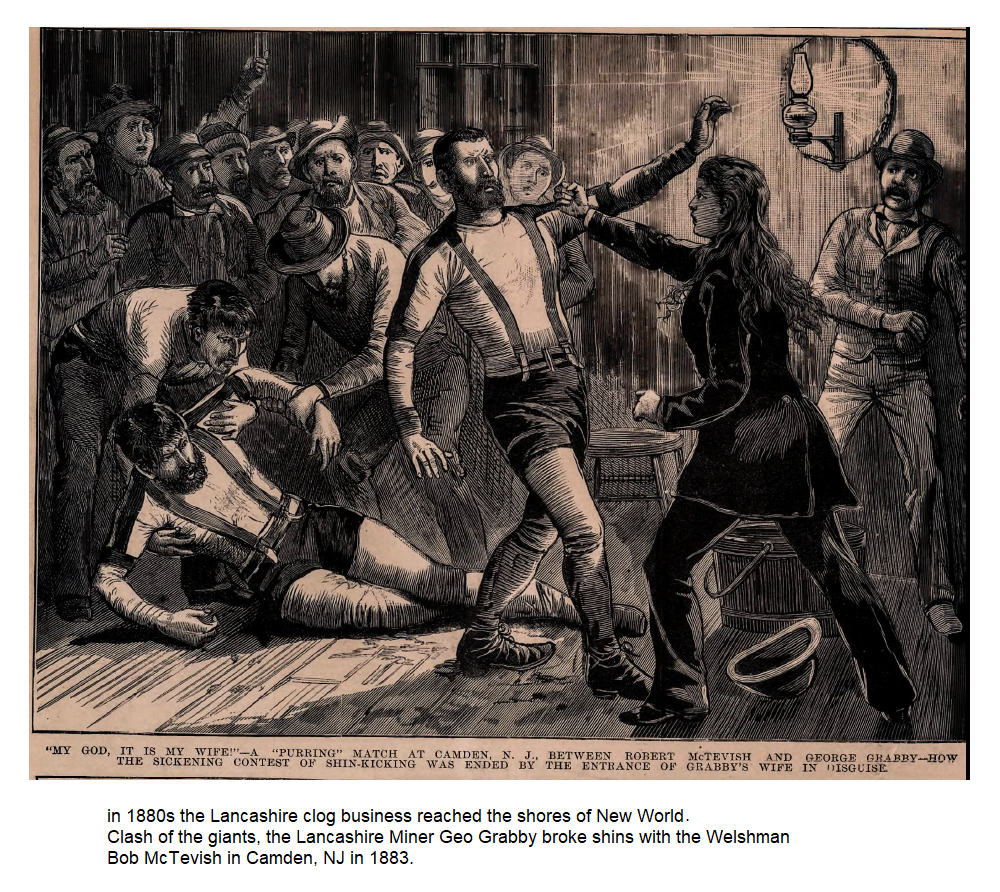
One man challenges the other to “dance in Lancashire style to a finish”, what a typical nineteenth century pro wrestling challenge terminology this is. Quite amusing, isn’t it? Whoever wrote this definitely has a fantastic sense of humour and sure was a wrestling fan (or a wrestler himself, the name of Winstanley is a very Lancashire wrestler’s name by the way). No doubt about that, since you cannot love pro wrestling and take it too seriously. If you really love and understand the pro wrestling game you have to take it lightly and remember that it is an entertainment, it is supposed to be fun to watch, just like the dancing.
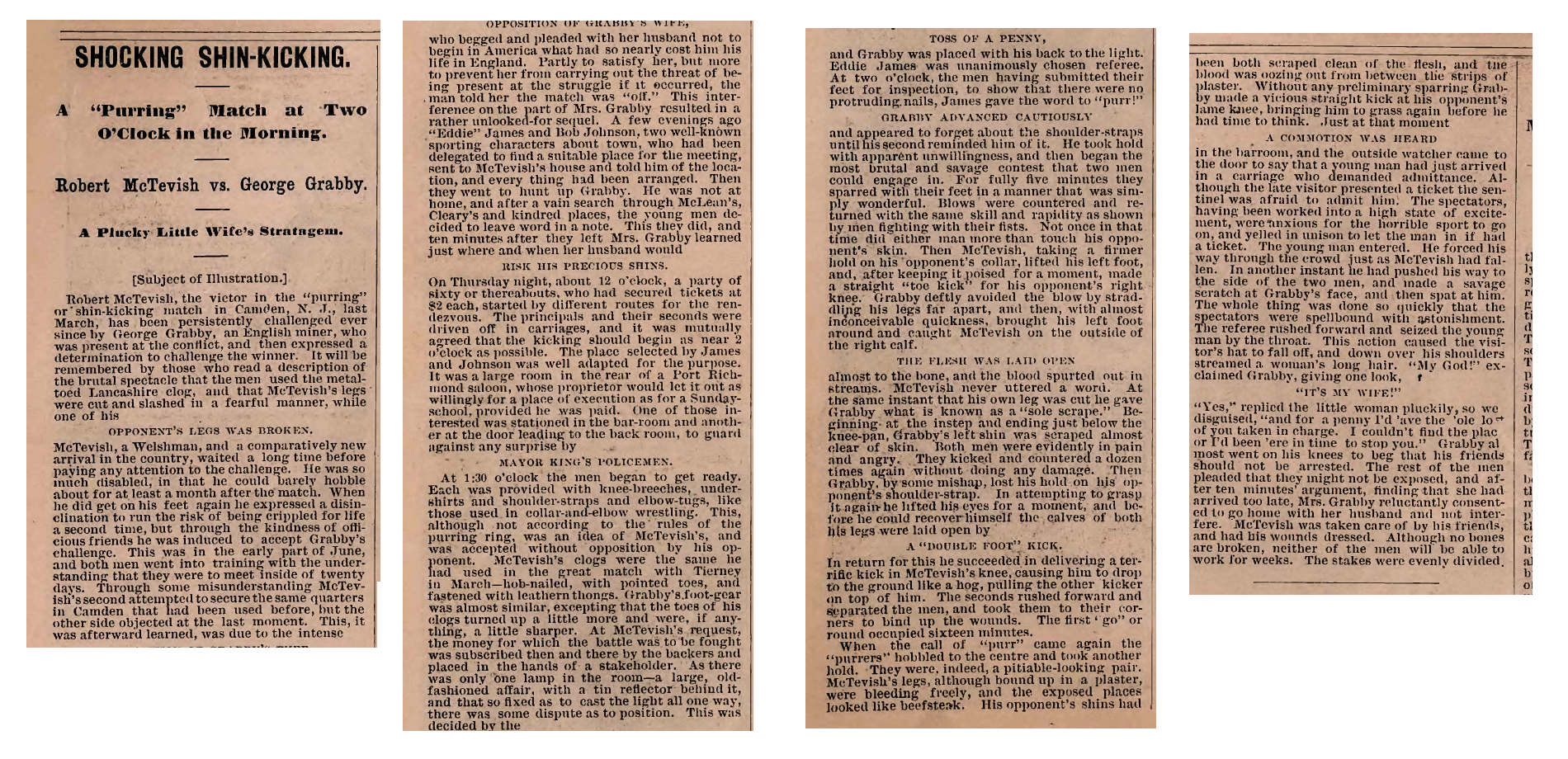
But what was that Lancashire style they are talking about in this historical document? Let’s clarify this first. They sure speak about the Lancashire clog dancing. The Lancashire clogs are among the most recognizable article that comes out of the glorious Land of Red Rose. And at some point in history they weren’t just used for dancing but also they were fairly considered the dangerous weapon used by Lancashire purrers in their deadliest and vicious clog fighting contests. Interestingly, the Mancunian morris dancers still have a dance called the Delph dance (named after the town of Delph in the Saddleworth areas) which imitates the clog fighting match.
There has been a great deal of discussion and disagreement on what the Lancashire’s own sport of Clog Fighting, or purring, actually was, and as a matter of fact many confusing and contradictory accounts on puncing matches, or the “kicking game”, have been around forever to only prove that a serious study of this subject has never taken place.
In those countless references, the purring, kicking, or better say shin-kicking contests were often confused with another Lancashire “manly” pastime, that of up and down fighting. It is fair to say that both those miners’-and-weavers’ games were of brutal and somewhat medieval nature and featured ferocious kicking of the opponent. But that was the only thing they had in common.
The up and down fighting was nothing but an unregulated prize-fighting, a no holds barred, free for all fight for money, an atrocious exhibition of all the bestial that is still there, deep in human nature, under the very thin superficial layer of civilization. That so-called sport besides purring (kicking) which was allowed to be applied at any part of opponent’s body from head to toe, and at any time, whether standing or when one of the two or both were on the ground, also incorporated fist-fighting (regular punching, boxing), wrestling (throwing, giving falls), head-butting as well as such brutalities of uncivilised, barbarian societies as deliberate hurting of opponent by choking him, breaking his limbs, biting and gouging him and etc.
Many of such fights were decided in the desperate animalistic struggle on the ground. And as an outcome of those contests many of the participants either lost their lives or were maimed for life. This disgusting sport was a huge turn off in Victorian England, it became illegal and its promoters and participants were prosecuted by the State. Interestingly, what was inappropriate and against the law back then nowadays is considered a norm and a legit sport and it has its own culture, the army of faithful fans and advocates of it.
Very opposite to all of that were the puncing matches or an actual purring, the clog fighting as it was known in eastern parts of Lancashire (in Salford and Blackburn Hundreds), it clearly was a “fair” or an upright struggle, and for the most part of it was nothing but a “fair shin-kicking contest”. Notably, similar shin-kicking matches were held in different localities all around the country.
The reason why the writers were so confused about it was in that most of them never actually witnessed either of those combative pastimes, to realise that they are very different and have nothing in common, nor they really tried to understand the true nature, the origins of those old fighting games.
20152
 Wrestling Heritage