
By Ruslan Pashayev

Clog Fighting Tales
Part 3: Norfolk and Tearing of Clothes
Interestingly, all of the above could also be fairly said about the famous Norfolk’s traditional style of English wrestling which was also known as the Out-Play or the noble art of “tearing of clothes” in which the wrestlers laid Hold and never quitted till they brought down their Adversary.
In his famous book called The inn-Play or Cornish Hugg Wrestler, the famous wrestling baronet of Bunny Park Sir Thomas Parkyns (1664-1741) compared the Norfolk Out-Play practitioner to a French fencer and some other contemporary eighteenth century sources referred to Norfolk wrestling as prancing around the ring, others spoke of it as of shuffling and dancing about and I will try to explain why.
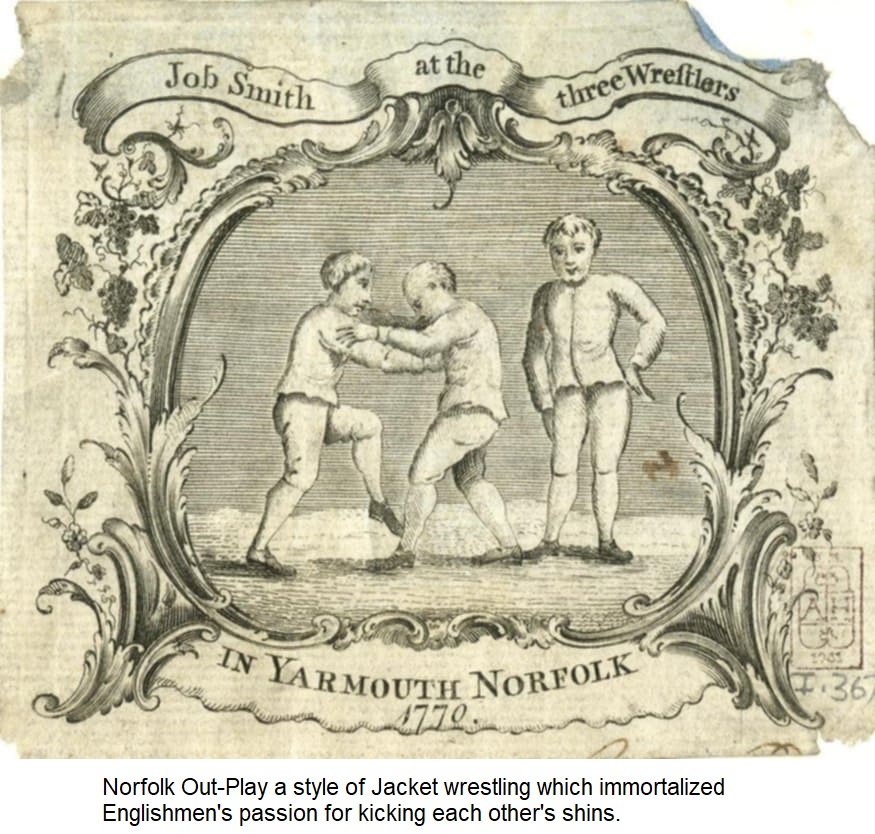
To visualize the original Norfolk collar wrestling we’ll probably have to have a closer look at the Glima wrestling bouts in which two men who are in fixed holds of each other try to trip each other’s feet or to hook (grapevine) the legs of one another, are evading from such attempts in a jumpy manner and kind of rotating, turning around with a certain speed as if they are two ballroomers dancing their waltz (right or left turns in particular). To the best of my understanding, this exactly the same waltzing around was happening during the typical Norfolk style wrestling contests. The only major difference, of course, was the kind of the fixed holds the competitor were in. In Norfolk style we have to deal with the holds of the collars of the fustian tight perfectly fit jackets, and in Glima it’s the holds of the glima-belts of a unique design.
Based on these evidences it would be fair to summarize the above. The Lancashire Clog Fighting was a local Lancashire variation of traditional English rural form of wrestling “at arms’ length” which since the times immemorial included shin-kicking as one of the major but fair to say un-scientific takedown techniques, and which over the time degenerated into a completely new sport, that of shin kicking. The participants weren’t willing to learn actual wrestling techniques and preferred to resort to kicking shins and that was all they did for the most part, but they still called their sport “wruslin”.
It would be fair to say that wrestling at arms’ length wasn’t the only wrestling fashion commonly practiced all around England. Another famous such style was known simply as Hug wrestling. This wrestling style or maybe it is better to call it a trial of strength of Norse origins was known under different names around the country among others such as the “Cornish Hug” (in the West Country) and the “Yorkshire Hug” (in the Dukedom of White Rose).
Probably the best description of the original Hugg Wrastelynge which at some point found its home on English soil was written in 1827 by a wrestling sport advocate and practitioner who wrote under the assumed name of “Sam Sam’s Son”:
Traditional English Hug Wrestling.
“Both grasp alike, and not much science is required. It only takes place where each conceives himself to be the stronger of the two. It is either right or left. If right, each man has his right hand on the other’s loins on the left side, and his left hand on the right shoulder; they stand face to face, and each strives to draw his adversary towards him, and grasp him round the waist, till the hug becomes close, and the weakest man is forced backward – the other falling heavily upon him. This is a very sure and hard fall”.
20160
 Wrestling Heritage