
By Ruslan Pashayev

Clog Fighting Tales
Part 4: Shin Kicking Games
Since the second half of 19c such shin-kicking games were known as being practiced in many places, in different regions of the country. This fact tells me that similar processes of transfiguration of old, pre-industrial times wrestling into something else were happening not just in the eastern parts of Lancashire but elsewhere in England, and here below I am giving info on some regional variations of that the same old English wrestling game.

Origins of the Shin Kicking Game.
From A New Book of Sports (1885).
—For about two hundred and fifty years ago, the West-country wrestlers, then accounted undeniably the best in England, entered the ring in their doublets and hose, and clearly wore no boots or shoes. The practice of kicking appears to have grown up gradually after this time, in Devonshire, out of the perfectly lawful habit of “striking” with the leg at the leg. Boys and men in Devonshire often settled a private quarrel by a bout at wrestling, and the impromptu umpires who supervised such contests would not be able to distinguish between a fair “strike” and a veritable kick. The spectators often rather liked the innovation, which made the struggle more sensational, and thus the use of the shoe had come to be recognized to some extent before the middle of the last century-as we know from a book, which recommends that kicks should be met by standing low and parrying or stop- ping with the knee.—
Old Devon.
From Remarks on Irritative Fever (1825). By J. Butter.
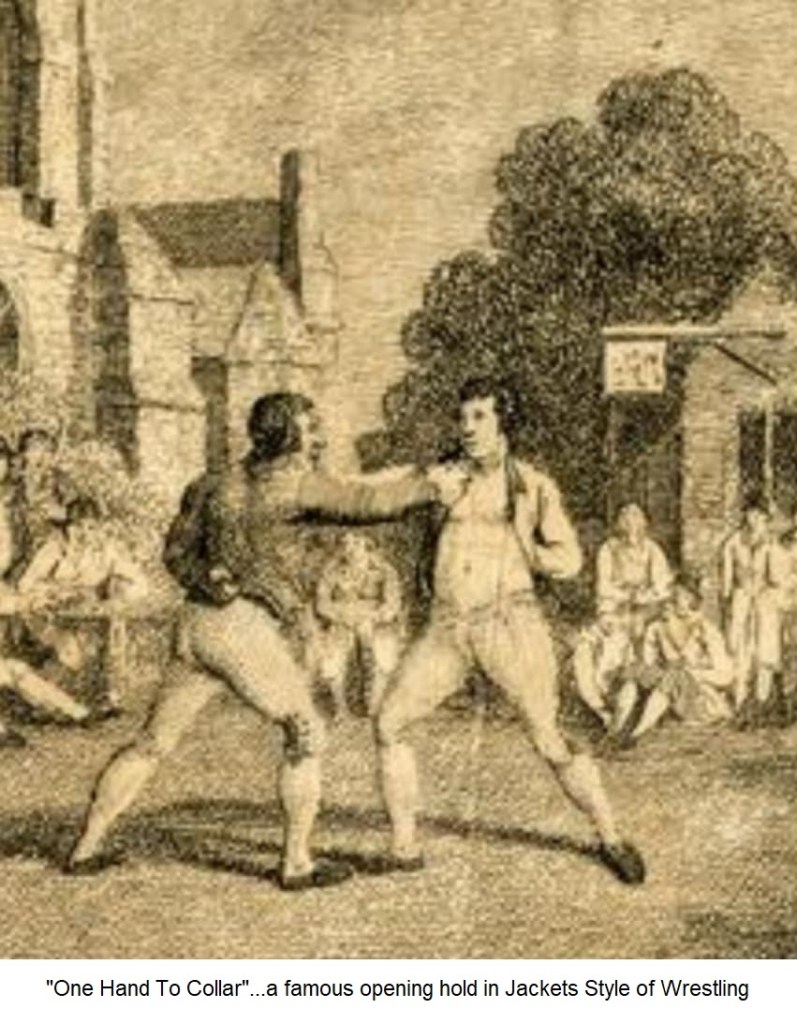
—Now in Devonshire especially, a habit prevails of kicking shins in wrestling. In this gymnastic exercise, two men collar each other, and kick each other’s legs; whosoever throws his opponent first on his back, gains the trial of strength. Now sometimes a man’s shins may be kicked all over, and yet no bad consequences, so far as I am informed, have ever ensued from this sport.—
Old Somerset. Hard Shin-kicking at Taunton.
From Recollections of Taunton by an old Tauntonian (1883) E.F. Goldsworthy.
—Wrestling was another amusement. The Devonshire wrestlers frequently came to Taunton to contend with men of the town and neighbourhood. Rab Channing and Tom Gainer were our local champions. Wrestling is a very healthy and useful exercise, but when the contest is carried on by kicking shins with hob-nailed and toe-tipt boots it becomes a very painful and dangerous amusement. I have seen men kicking away at each other’s shins until they were scarcely able to stand from pain and loss of blood; when they could not get at each other’s shins, each would try to lift his opponent bodily off his legs and dash him with great force to the ground.—
—Boys of course imitated the men. The first thing a boy would do when he met another was to lay hold of him by the collar with both hands, and the other boy would do the same. “Will you try a fall?” says one.”Yes,” says the other. They then would try to throw each other, and in making the attempt very often rolled together into the gutter. At this period you would see more boys with bleeding noses in one week than you would see now in a year. If mothers of the present day were to see their boys at such rough games they would squall their heads off their shoulders.—
Old Norfolk.
From Songs, Stories, and Sayings of Norfolk (1897) by W. Rye.
— A peculiarly brutal of what Arderon calls wrestling but which seems much more like the “puncing” of Midlands is thus told by him in his MS collectrions in the British museum: “Their manner of wrestling is one of the foolish diversions that is in custom, which is this. At the Assizes, Easter, Whitsuntide, &c., a great number of boys and men gets together upon the Castle Hill, Chapel Field, and other publick places, where they form themselves into rings as they call it, when one of the boldest walks into it, challenging to wrestle with any one present. Immediately one or other accepts the challenge, which is no sooner done then they snatch hold of each other with their utmost strength, and then they begin to kick each other’s legs with all the force and violence they are able, with shoes prepared and sharpened against the day, so that they cut even through their stockings every stroke they make, and very often before they part their some of them as long as they live. When the weakest is kicked as long as he can stand no longer, then a fresh man takes the conqueror, and for five or six hours together.”—
Old Lincolnshire. August Kick-boxing at Stixwould and Benington.
From A Lincolnshire Calendar (1997) by M. Sutton.
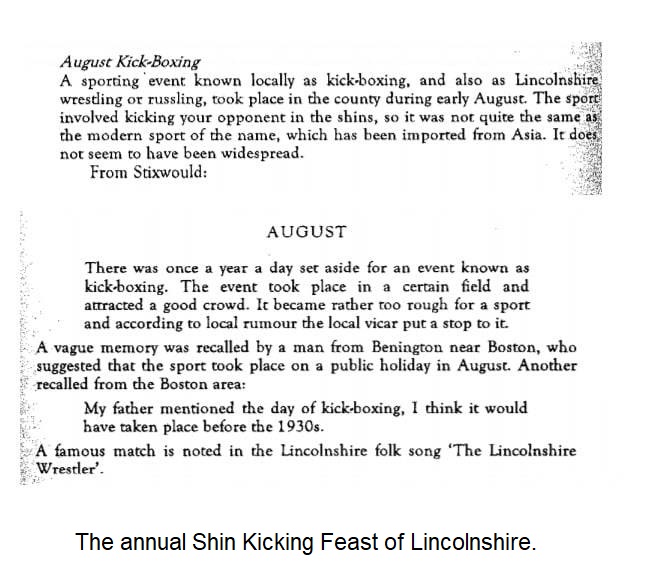
—“A sport event known locally as kick-boxing, and also as Lincolnshire wrestling “russling” took place in the country during early August. The sport involved kicking your opponent in the shins.”—
—“There was once a year set aside a day for an event known as kick-boxing. The event took place in a certain field and attracted a good crowd.”—
Old Derby, Hard Shin-Kicking at Alfreton.
From a Newspaper, Derby Mercury, Nov 24th, 1875 Page 4.
—“We are informed, that the second annual Statute Fair at Alfreton, in this County, on the 22d Instant (being Old Martinmas Day) commenced with great splendour;…At Noon a wrestling commenced, and Shins were broken in without Mercy, upon a Stage erected for that Purpose. This athletick Exercise drew a vast Concourse of People together, whose Patience begun to be exhausted, so many Heros appeared to claim bright Honour at this Sport, that it was near Night before it was over.”—
Foreign sources (Dutch, 18c).
From Hedendaagsche Historie of tegenwoordige staat van Groot Brittannie (1754).
— “The game of wrestling is also practiced among them (English), and some shorter man knows how to put a much taller and stronger man than him on the ground, by kicking his legs.”—
Interestingly, a similar wrestling “at arms length” game was very popular in Colonial America where it was known under different names, such as square-hold or box-wrestling and etc. In America this traditional manly pastime was preserved in its original wrestling match format, and never deteriorated into a pure shin-kicking fight.
Square-Hold American Fashion in Kennebunk, York County, Maine.
From Patriotism at Home, Or, The Young Invincibles (1866) by I.H. Andersen.
—“THE WRESTLING MATCH. The manner of wrestling on the present occasion was to be that variously styled “square- hold,” “arms’-length,” “toe-to-toe,” &c.; that is, the two wrestlers stand face to face, each with his right hand hold of his opponent’s left shoulder, and his left hand grasping tightly the right elbow. Thus firmly grappled, each endeavors to throw the other upon his back by dexterously tripping at his antagonist’s feet, and at the same moment suddenly exerting the strength of his hands and arms in the opposite direction. The rules of the contest prohibit the use of the arms without the accompanying “trip,” because such a course would invariably give the stronger party the advantage. There is a good deal of skill to be displayed in this mode of wrestling, and it is not always the stronger one of the two that comes off as conqueror.”—

20163
 Wrestling Heritage