

By Ruslan C. Pashayev
“As when the gallant youth which liue vpon
The western downes of louely Albion;
Meeting, some festiuall to solemnize,
Choose out two, skil’d in wrastling exercise,
Who strongly, at the wrist or COLLER cling.
Whilst arme in arme the people make a ring.”“Britannia’s Pastorals,” 5th song, by William Browne (1614).
When it comes to the game of wrestling England was always famous for its wide spectrum of wrestling styles that since the times immemorial were present in different regions all around the country and better than anything else exhibited the English manliness according to their own culturally unique traditions.
From the following passage of Paul Hentzner’s Travels In England (Circa 1598) we learn that traditional wrestling contests in the form of annual tourneys were very common among Englishmen from the very days of old and were held on the St Bartholomew’s Day (August 24th) before the magistrates of the cities.
“It is worthy of observation, that every year upon St. Bartholomew’s day, when the fair is held, it is usual for the mayor, attended by the twelve principal aldermen, to walk in a neighbouring field, dressed in his scarlet gown, and about his neck a golden chain, to which is hung a golden fleece, and besides, that particular ornament which distinguishes the most noble order of the garter. During the year of his magistracy, he is obliged to live so magnificently, that foreigner or native, without any expense, is free, if he can find a chair empty, to dine at his table, were there is always the greatest plenty.
When the mayor goes out of the precincts of the city, a scepter, a sword, and a cap, are borne before him, and he is followed by the principal aldermen in scarlet gowns, with gold chains; himself and they on horseback: upon their arrival at a place appointed for that purpose, where a tent is pitched, the mob begin to wrestle before them, two at a time; the conquerors receive rewards from the magistrates. After this is over, a parcel of live rabbits are tuned loose among the crown, which are pursued by a number of boys, who endeavor to catch them, with all the noise they can make while we were at this show, one of our company, Tobias Salander, doctor of physic, had his pocket picked of his purse, with nine crowns du soleil which without doubt was so cleverly taken from him, by an Englishman, who always kept very close to him, that the doctor did not in the least perceive it.”
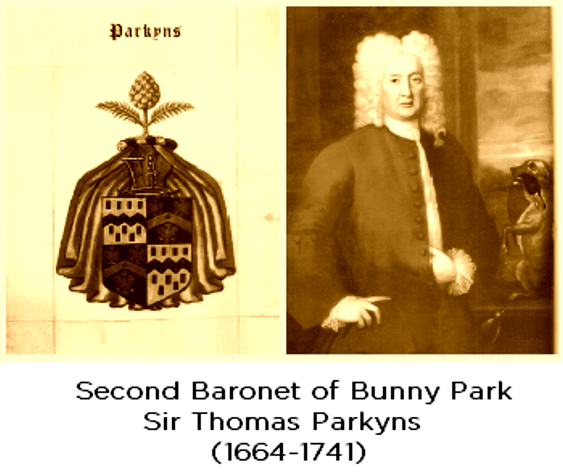
According to the Nottinghamshire’s second baronet of Bunny Park, Sir Thomas Parkyns (1664-1741), the author of “Inn Play or Cornish Hugg Wrestler” and of the “General Rules of English Wrestling,” (1727), the two most popular styles of wrestling in England were Norfolk’s “Out-Play” and Bedfordshire’s “Inn-Play” of which the Cornishmen were the best exponents. The core skill of traditional English wrestling styles was in using the legs and feet for throwing opponents to the ground; these wrestling techniques were known as “hooking” and “tripping” respectively. Hence, likely the names of these two folk styles were also based on that particular wrestling strategy, namely:
- The Norfolk “Out-Play”, or wrestling at Arms Length, in which attacks on the legs/feet of opponent come mostly from the “outside” of the natural fork of human body;
- The Bedfordshire “Inn-Play”, or Close Struggle, in which attacks on the opponent’s legs/feet mostly come from the “inside”, by placing legs/feet in between the legs/feet of the adversary.
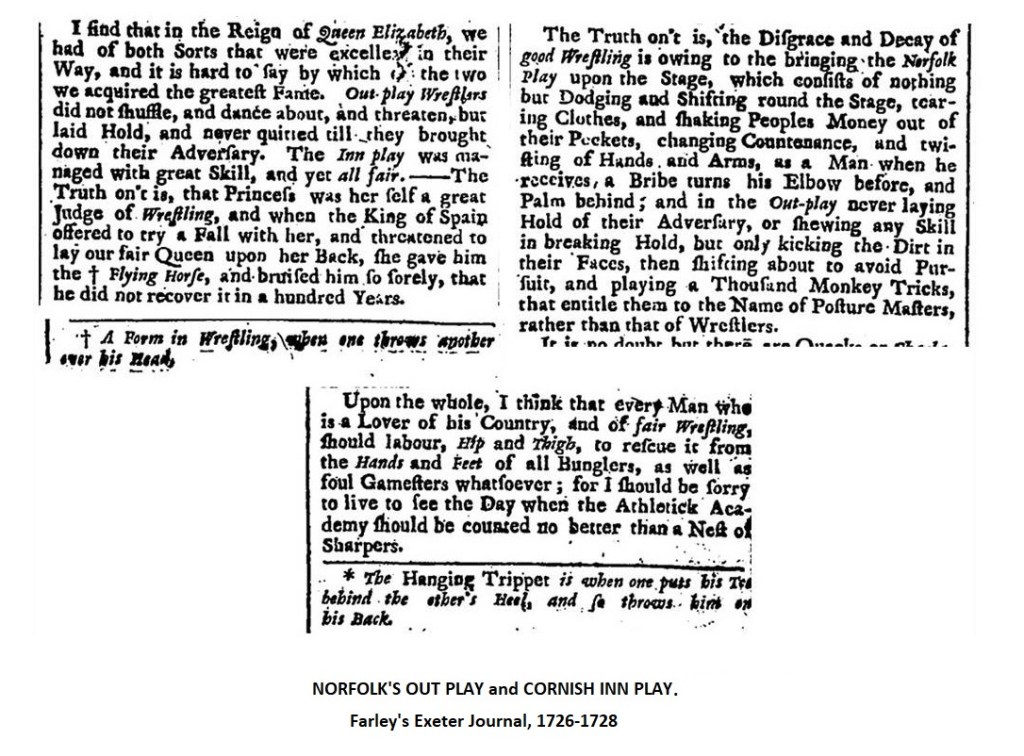
One of such historical English wrestling styles was – The English Collar-Belt Wrestling. And I am not talking about the infamous dog collar wrestling matches that we, the pro wrestling fans, love so much to watch.

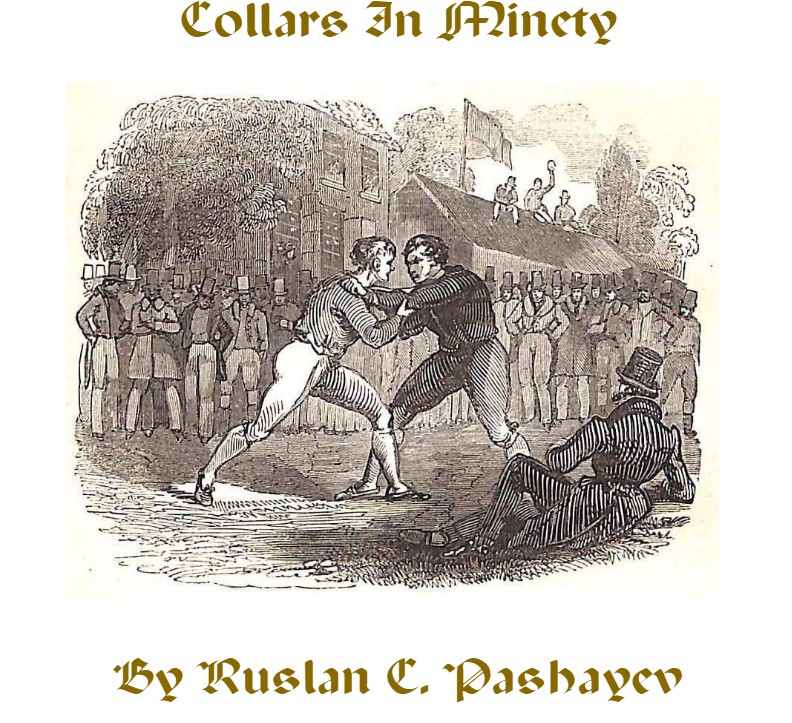
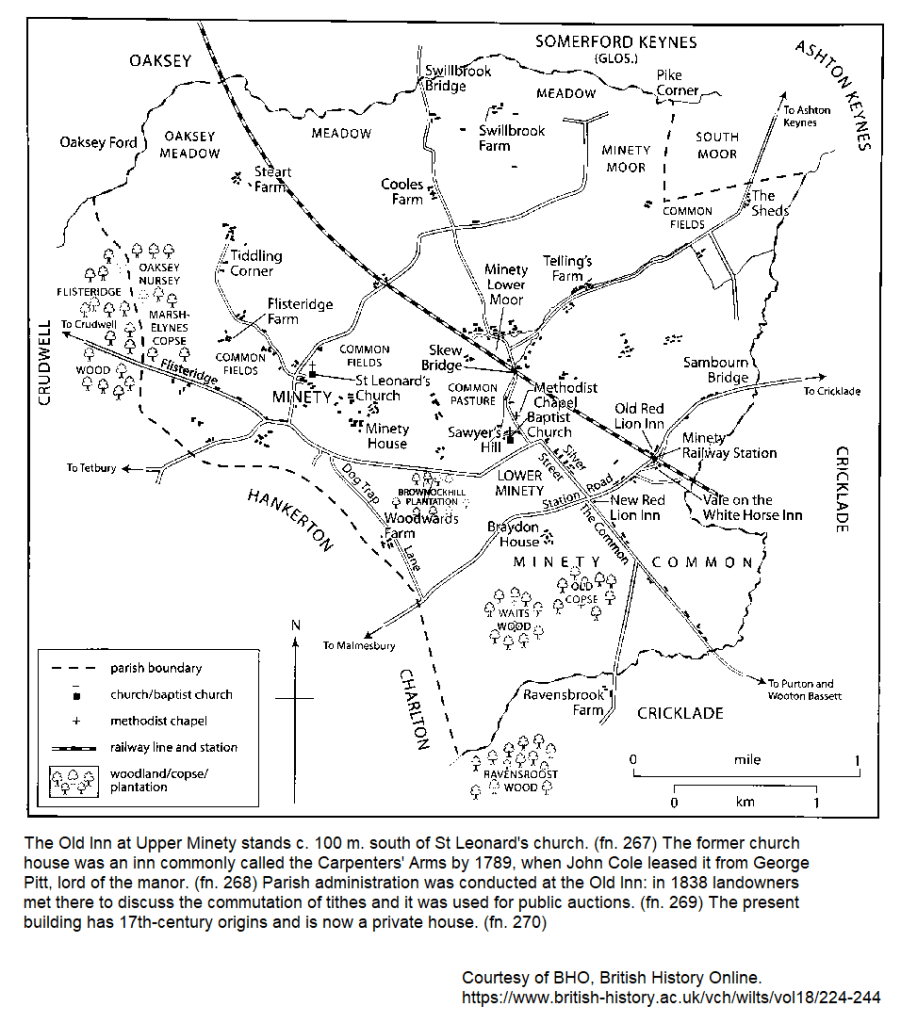
The September 27th 1762 issue of Gloucester Journal features an interesting article which reports about the sports being held at the Carpenter’s Arms in Minety, Wilhire, near Cirencester, Gloucestershire. Among the featured sports were a backsword competition for a hat of half-guinea value and a wrestling match for silver cup of two guineas value. The matches were to be held on a wooden stage specifically erected for this occasion. The wrestlers according to the conditions of the match were to “wrestle in belts” and had to try “nine turns” with each other to achieve a fall. The term of “turn” stands for an attempt to fell your opponent and give him a clean back fall. This is the only newspaper report that speaks of belt wrestling in England which I was lucky to locate in British newspapers archives online so far. Let’s have a closer look at this precious piece of English wrestling history.
Percy Longhurst the lifelong honorary chairman of British Wrestling in his article called “The Wrestling Furore” thus spoke of English “belt-wrestling”:
“The jacket is said to be the modern equivalent of the broad belt, passing over one shoulder and under the other, worn by old time champions; but when the jacket came into use is not very clear. I have in my possession an old print dating from the early part of the eighteenth century in which the contestants in a wrestling match are depicted stripped to the waist and wearing this belt. On the other hand Sir Thomas Parkyns makes no reference to whatever use of a belt and describes jacket-holds.”
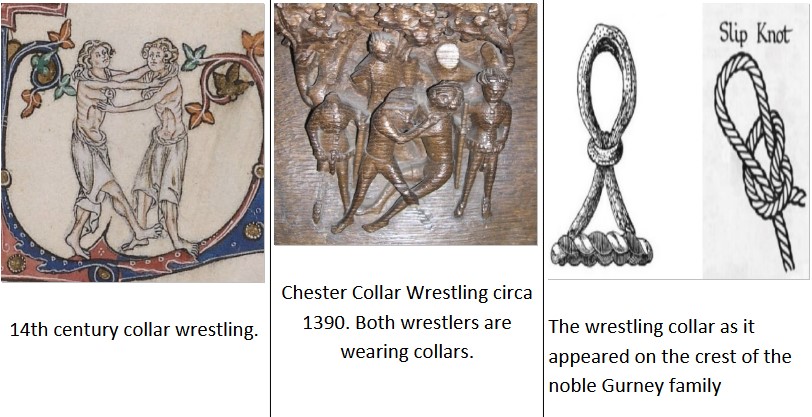
Considering the above said it is obvious that the eighteenth century English belt-wrestling wasn’t a typical type belt wrestling in which the belts are worn around the waists of competitors, but rather served wrestlers as an imitation of a “collar” to take holds by. Hence further in the text I will refer to this style of wrestling as a collar-belt wrestling. So to say the traditional English belt-wrestling was essentially a collar wrestling style. It is also fair to notice that the Parkyns most famous treatise on wrestling wasn’t really about the olde English pastime, the traditional “game of wrestling,” but it rather was a self-defence manual which explained certain wrestling holds and throws.

Probably the best reference to the collar-belt form of English wrestling comes from the 1740 poem by Wm Somervile (1675-1742) called “Hobbinol or the Rural Games”.
“High in the midst the brawny wrestler stands, A stately towering object, the tough belt measures his ample breast, and shades around his shoulders broad.”
Here is my short summary of what this poem speaks about the wrestling contest. The Games which included wrestling were held in the Vale of Evesham in Worcestershire.
1. The Wrestling is sure a “Collar” Style. The “Collar” is represented by a stout leather belt which is worn over the shoulder and across the chest;
2. The Wrestlers competed barechest;
3. The Holds are taken by the “collar”, and by any part of the body above the waist. Use of legs and feet for throwing (aka tripping) is allowed.
4. The Fall is defined as a “fair back”, a throw which sends a defensive wrestler flat horizontal onto his back before any other part of his body touches the ground; No foils counted. Foils was a term for any other kind of fall but back fall and usually three foils were equal to one fair back.
5. The Prize was a pair of gloves, embroidered, seamed with silk and fringed with gold.

Collar wrestling style was the most popular style of traditional English wrestling, being widely practiced all over the country especially being popular in such counties as Norfolk, Lincolnshire, Berkshire, Wiltshire, Oxfordshire, Gloucestershire. Despite having a certain wrestling vocabulary peculiar to collar wrestling styles (which is given by Norfolk’s “Celebrated Game Chicken” Charles Layton in his famous book), it is a fact that the main feature of that style was kicking your opponent’s shins and thus causing his falling. It looks like majority of gamesters didn’t bother to learn any those very few throwing techniques and at some point this noble sport degenerated into shin kicking and as such was revived in modern times. The sport of “shin-kicking” is still present among the folk games at the Dover’s Olimpicks in Cotswold, Gloucestershire.
“In a ring not far off the wrestlers are trying conclusions before a big crowd, for the favourite old West-country sport is in the heyday of its popularity, and almost every village can boast its champion. Collar and elbow or collar and hip are the only holds allowed, and a man is down if he be thrown off his feet. There is none of the wearisome work which accompanies the Cornwall and Devon style, when a man must be thrown flat on his back -a clean fall-before he is ‘felled.’ Here, if a knee touch, it is a fall; and there is much scientific play with the feet. Kicking is not generally recognised, although it takes place sometimes by mutual agreement; but the men are not allowed to wear their ordinary boots with iron tips and plates and the soles covered with big hobnails.Some of the wrestlers are good enough to hold their own anywhere, and here in the crowd one may see Ted Booker, of Denchworth, who, twenty years or more ago, was one of the best men in Berkshire.
Ted was only a little man, but his heart was big and his science was great, and he never feared to meet any man big or little. Many are the tales told of him. Once he threw his hat into the ring as a direct challenge to a certain stalwart keeper who had been talking very openly of what he would do to Booker cum nex’ feaaste.’ Booker had been his successful rival in the affections of a pretty servant up at the Hall, hence the bad feeling of velveteens.’ But the keeper was late, and another powerful young fellow had pitched his hat into the ring and was preparing to meet Ted.
Now, my buoy,’ said Booker, if tha’ bee’st goin’ t’ kick, thee saay so, for a’ can kick too; but if tha’ll not kick, nayther will I.’
So they agreed to play without kicking; but after a few minutes a favourable opportunity arose and the young man landed a kick on the shin which nearly brought Booker to his knees.
‘A’ can kick too, as a’ tell ‘ee,’ said Booker, and a minute or two afterwards the young man was lying flat on his back, During the bout the keeper had come up, but when he saw how the man to whom he had promised a hiding had disposed of his opponent, he thought better of the matter, and the long-promised struggle never came off.” (Berkshire Feaaste Forty-Five Years Ago, by P. Longhurst)
Although no kicking was produced during the wrestling match in Hobbinol, and it was a magnificent Flying Mare (shoulder-throw) that finished it.
“He grasped the wrist of his insulting foe, then with quick wheel oblique his shoulder point, beneath his breast he fixed, and whirled aloft, high o’er his head the sprawling youth he flung”
This extract from John Lane’s 1621 Pastoral Poem, “Tritons Trumpet” talks about wrestling tools called collers which were worn by contestants and by which the wrestlers took holds.
“This English Burrel hight, a Cornish man, To the late Henry th’eight a gardian, Beinge in daringe yoath esteem’d so stronge As that great Kinge, to trie his force did longe. Whome Burrel spar’d because hee was the Kinge, Ne (wrestlinge with him) woold not cast, or wringe; Which caus’d the Kinge thus saie , Burrel, I heard That thow the strongest weart of all my gard; I doe not find yt so ; whereat some said, Hee knowes it is the Kinge with whome hee plaid : Ells mote yoe quicklie feele him verefie , That this is Cornish Burrel certainlie . So, at the next concert Kinge Henry feeles , Burrel had strength, but not so many weeles. Long after this, ( Kinge Henry dead and gone) And his brown daughter Marie in his throne, And Burrel strooken old, yet of her gard , And Philip weddinge her, becom her ward, Hither hee brought a Frenchman, goodlie, younge, Whoe in the feates of wrastlinge, prov’d so stronge As foil’d, or cast downe all, or most her gard, And no man fownd (as yet) coold him discard. In so much that King Philip joid as much, As Marie at her gards reproch did grutch. Which urg’d old Burrel make a suite to her, That he mote trie Kinge Philipes wrasteler. Ha, quod the Queene, thine age hath thee dispoild, Ells I presume hee shoold not scape unfoild. But when before the princes in they came, In manner naked (as in thold embleame) With baggs calld collers on theire showlders plact, And to the concert either graplinge fast, Old Burrel aged neere three score yeeres and tenn, Rowzd his stiff jointes, and Cornish stratagem: Wheare thus befell, that Burrel at the last, Tore out the Frenches showlder blead, and cast, So as the man was carried from the place, Quite vanquish’d, whereof died in litle space. Lo! heere theire embleam in this monument, The rest depends on future contingent.”
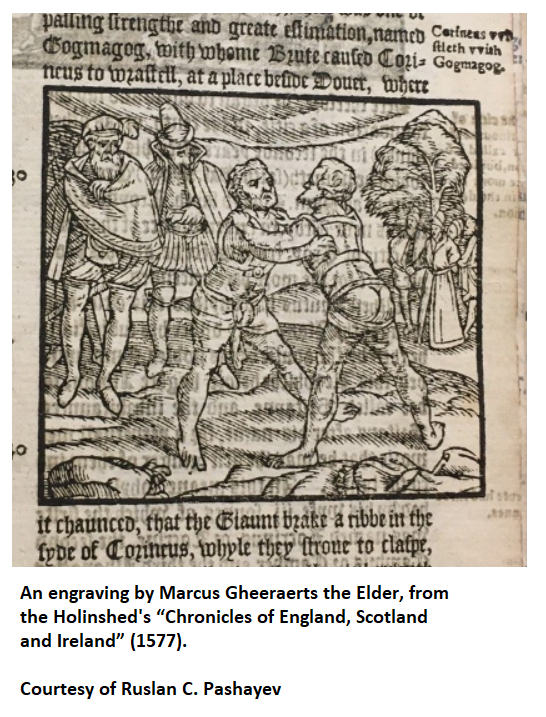
The 1577 book by Raphael Holinshed (c. 1525 – before 1582) called “Chronicles of England, Scotland and Ireland” on Page 15 of Vol.1, Part 1 features an engraving by the famous Flemish artist Marcus Gheeraerts the Elder (c. 1520- c. 1590) which depicts a wrestling match between Corineus and Gogmagog. The antagonists are shown wearing an elaborate harness around their shoulders and the upper torso. It is very possible that this is exactly how the 16 c traditional English wrestling collers looked like. On that woodcut the wrestlers are shown leaning towards each other, thus I assume protecting their legs from the reach of the vicious kicks of their opponent, their feet are wide apart and knees are slightly bent which suggests the push, pull, sway and lift being among the most common applied techniques.
The wrestling collar-belts apparently were made of oiled leather and got mentioned in an interesting document which contained information from what we understand was an official programme of the shows and sports which were performed at the Amphitheatre of King James The First. That unique document is preserved in the Bodleian Library.
“Curious prospectives, in this kingdome unnusuall, of singuler raritie and high invention, all possible exercises of the Olympiades, as wrestling in oyled skynnes for gold and silver collars, with other inferiour prizes, wrestling two or three against one, running, jumping, vaulteing, tumbling, daunceing on the ropes, gladiators in equall and unequall combate, two or three against one, to approve the singularitie of weapons with the true and rightfull use of them.
I was lucky to find a short reference from another document around the same time where different kinds of fabriques were mentioned and the oyled skynnes were among them to fully understand what the old wrestling programme was actually talking about:
“A. D. 1628. lynnen cloth. woollen cloth. pewter botles of pyntes & qrts. brass ladells & spoones. Coppr kettells, of y f[ren]ch making, wthout barrs of Iron about them. Oyled Skynnes of lether Madder seede”
© 2024 Ruslan C Pashayev All Rights Reserved.
11981
 Wrestling Heritage