
Wrestling Heritage welcomes memories, further information and corrections.
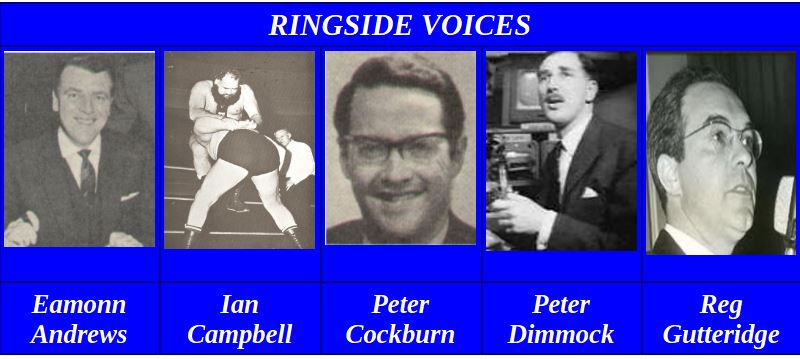
Eamonn Andrews C.B.E.
Dublin-born Eamonn Andrews was a lightning-fast radio boxing commentator through the fifties whose articulate delivery brought him to prominence on fifties television as the genial host of What’s My Line? He was further rewarded by having his own tv programme, a live a late-night chat show called The Eamonn Andrews Show. Unlike other chat shows nowadays that are all canned or rushed, ITV scheduled the show delightfully as the last programme before closedown but without an end time, allowing Eamonn and friends to discuss whatever they had to, live, and exhaustively.
After several years hosting the main sixties tv chat show, 45-year old Eamonn scored with one of his most sensational transmissions. Mick McManus was the scheduled interviewee in February 1967. However, arch rival Jackie Mr TV Pallo also turned up, and one hell of a cafuffle followed, resulting in microphones being angrily removed and McManus storming off, refusing to share the set with Pallo.
Great hype for wrestling, wholly endorsed by the authoritative Eamonn Andrews. Where else could we feature him on this site?
Wild Ian Campbell
The Monarch of the Mat clarified his Highland brogue for general consumption and provided useful mid-round analysis alongside Kent Walton in the early sixties.
Of the three analysts, Campbell comes out best.
In the 1962 needle match between Jackie Pallo and Mick McManus it was Ian Campbell who rhetorically and memorably asked “Which end of the needle is sharp?”
His general enthusiam for wrestling was infectious as he made excited comments that fans could relate to. Other analysts wanted to come across as omniscient.
Ian Campbell’s reward was to feature as the central character in a 1964 eopisode of Coronation Street.
Peter Cockburn
Peter Cockburn was an ITV announcer through the late fifties, and appeared on shows teaching maths for schools, and the ATV News. He was the ITV version of the dinner-jacketed BBC announcers that were the norm until the late sixties. In 1961 he got his call up to commentate on professional wrestling and did the honours on a number of presentations, principally the mid-week shows. By 1962 he was virtually alternating the important Saturday tea-time commentating with Kent Walton, commentating on all four bouts. We can still enjoy his cut-glass tones on the much shown bout from Belle Vue, Manchester, in 1964 between Ricki Starr and Pietro Cappello. The TV Times article, right, is from 1964. His wrestling commentaries largely petered out in the middle of the sixties, but he popped up again on a 1969 Saturday presentation. Our last record of him commentating was 1970. Peter Cockburn’s career contined as a voiceover man, and he can be heard in Carry On Camping.
Throughout the sixties Wimbledon tennis was shown on ITV, which often meant wrestling was dropped from its Saturday tea-time slot. One of the reasons for this was that principal commentator Kent Walton commentated on the tennis, too, no doubt spicing tennis parlance up with “humdingers”, loolas” and “I don’t know what Billie Jean is beefing about.” With Kent demoted to tennis, Peter Cockburn stepped up.
Peter Dimmock C.B.E.
Peter Dimmock was the mastermind behind the golden years of BBC televsion’s sports coverage and presided over the first ever coverage of Royal Ascot, the introduction of Grandstand, and the BBC Sports Personality of the Year amongst many other events. In 1972 the most popular BBC televsion programme by far was The Generation Game. Wrestling was featured in the semi-final highlight in one episode. Robby Baron and Mick McManus wrestled on some mats, Frankie Blake did the announcing, and Peter Dimmock was the commentator. The contestants then, in turn, had to fill the MC and commentator roles. Whilst the contributions of Peter Dimmock to BBC sport at large are undeniable, his lack of experience resulted in a very dry and unexciting wrestling commentary. The contestants had nothing to beat! However, wrestling can take the compliment that the by now senior BBC executive wanted this plum glamour role for himself ahead of David Coleman, Frank Bough or Harry Carpenter.
Reg Gutteridge O.B.E.
Wrestling’s Night of Nights took place at the Royal Albert Hall in 1966. By the modern miracle of closed circuit television, the event was broadcast live in cinemas around the country. The night’s presentation included the Royal Albert Hall debut of Doctor Death, the famous tag bout featuring the evil Japanese twosome often mentioned on this site, the sensational Starr-McManus match-up, and the last refereeing appearance of Lou Marco. In the chair to commentate on proceedings was Jackie Pallo’s Islington-born first cousin, Reg Gutteridge. Reg did a great job for boxing, becoming ITV’s authoritative voice behind the mike, in parallel with the BBC’s Harry Carpenter. Reg Gutteridge earned an O.B.E for services to boxing in 1995, and passed away in 2009. Undeniably a gifted commentatator, he only scrapes into our chosen context. We can only wonder why boxing has been rewarded with so many National Honours when wrestling and wrestlers have remained frozen out.
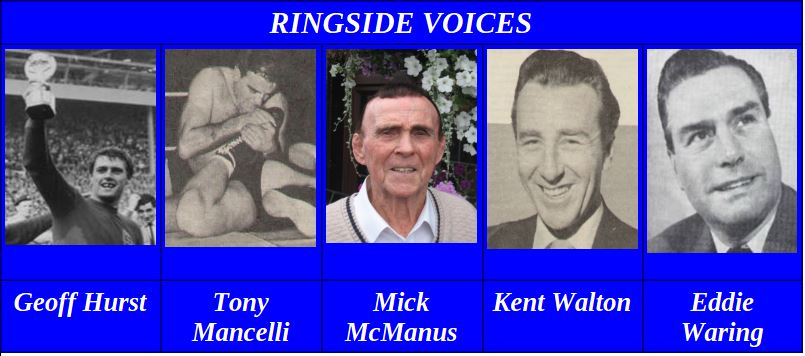
Sir Geoff Hurst?
Another wrestling mystery.
This is wrestling and this is historical research, so inevitably mysteries crop up and this is one of them.
World Cup winning hat-trick hero Geoff Hurst was billed as being at ringside for the 1969 FA Cup Day televised spectacular featuring Kellett, Kidd, Logan and McManus. Wrestling Heritage leaves no stone unturned in its archaeology and contacted Sir Geoff’s management team in 2012, only to receive a reply that he did not attend.
There’s no smoke without fire and our investigation is ongoing into just what Geoff Hurst’s interest, relationship and 1969 wrestling role were.
Tony Mancelli
Just for a short period between retiring from ring action and taking up duties as a referee, the former Southern Area Heavyweight Champion provided sage analysis alongside Kent Walton in the mid-sixties.
Mick McManus
By the mid-seventies, Mick McManus had his finger in every pie going. ot content with his weekly wrestling column in The Sun newspaper, promoter Mick gave himself the plum job as mid-round analyst alongside Kent Walton. It was a role that sat very uneasily with wrestling fans. On the one hand, the rule-bender-in-chief was heard commenting with a straight bat and criticising fellow villains. On the other, we heard him making complimentary noises about many a foe we had seen him embroiled with in out of control skirmishes only weeks and months before. Heritage Member David Franklin pointed out the sweetness of McManus commenting on Tony St Clair: “Drew with me on tv a year ago, and now he’s British heavyweight champion.”
Kent Walton
Quite simply the single most synonymous name associated with televised wrestling from its inception in 1955 through to Wrestling’s Final Bell in 1988. Cairo-born Kenneth Walton Beckett began his career as an actor in films and plays. Our earliest sighting is in the 1937 film “The Arsenal Stadium Mystery”. He served in the R.A.F., later taking up radio and tv work. It was in the R.A.F. that he developed his mid-Atlantic accent, from mixing with Canadian airmen. He compered the ITV pop show Cool For Cats for 4½ years, and was a judge on the popular Thank Your Lucky Stars. In 1955 he was hurriedly trained for his role as a wrestling commentator with great help initially from rule-bender Mick McManus, a fact Walton later downplayed. He always named his mentors as having been Jackie Pallo and Mike Marino.
In the early sixties he still commentated on soccer and Wimbledon tennis, resulting in Peter Cockburn (q.v.) being drafted in as a fellow wrestling commentator.
There are too many aspects to Walton’s wrestling work to cram into this potted biography. He always defended the authenticity of wrestling, even coming up with some of his own creations as the names of wrestling holds. He favoured the clean wrestlers and waxed lyrical about the “good-looking boys” Steve Viedor, Wayne Bridges and Jon Cortez. He also had ongoing feuds with principally three rule benders in Jim Breaks, Abe Ginsberg and Goldbelt Maxine, invariably concluding that he didn’t know “what they are beefing about.” And most of all for Wrestling Heritage fans, he developed a vocabularly and phraseology all his own and which we have called Waltonisms. You can read a list of Waltonisms as pooled together in the Talk Wrestling forum by clicking here. There are some real humdingers!
Unbeknowns to most wrestling fans, chain-smoking Kent carried on both as a Radio Luxemburg DJ and as a producer of low budget seventies films during the height of his wrestling fame.
Kent Walton died in 2003 aged 86 and is remembered with widespread affection by almost all Grapple Gazers. You can see from the 1962 TV Times cutting on the right that there are always dissenters!
Fact-packed biographies compacted together by wizards of the google abound on the internet, possibly in the style we have adopted so far, but they do absolutely nothing to convey just what made Kent Walton the ideal wrestling commentator. He spoke with beguiling authority and the full gammut of emotions from admiration to horror, from admonition back to wonder. He mesmerised a willing audience with his terminology and mellifluous tones, peppering his commentary with just enough criticism for us to believe he was one of us. Most of all, he straddled that uncomfortable fence to constitute a defining omniscient oracle, on whose every word we hung, and reacted.
Kent Walton took to his grave the mystery of precisely how involved he was in the inside goings on of professional wrestling, and all those masked men who wouldn’t talk to him in the dressing rooms. But one revelation we can make in this tribute 9 years after his death is the ongoing professional intimacy he shared with Mick McManus from 1955 to the end of ITV’s televised wrestling. Between them, the pair carved out editorially the path to be taken and the views and verdicts small-screen fans would be exposed to.
Eddie Waring
Ambitious Eddie Waring was Mr Rugby League in the late fifties and early sixties, and would go on to achieve more widespread fame as presenter of the iconic It’s a Knockout in its late sixties and early seventies heyday. He remained the BBC’s main rugby league commentator throughout.In 1965, however, as you can read in our feature articles in the Media section, The Other Side, the BBC also presented some professional wrestling and Eddie Waring stepped up as the commentator.
 Wrestling Heritage